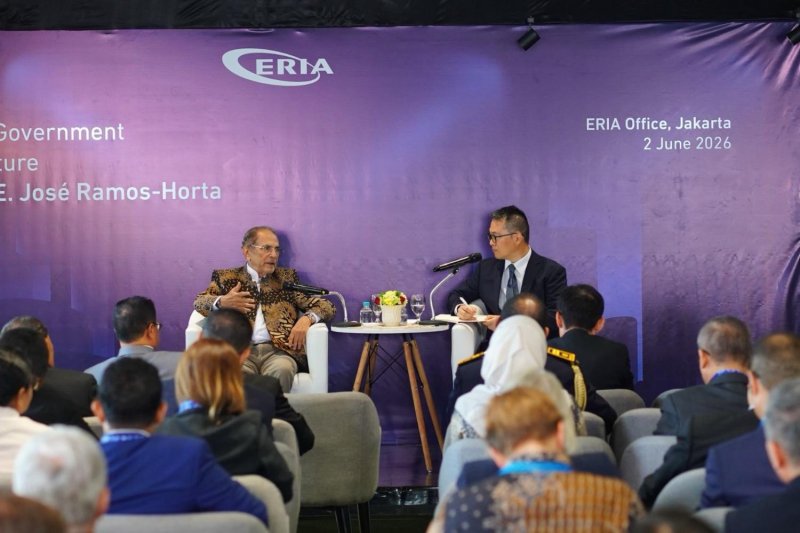
President Jose Ramos-Horta of Timor-Leste had a myriad of views to express -- at times with light humour and sometimes dark satire -- over his 25 years of struggle for freedom and independence.
During a public fireside chat in Jakarta on June 2 at the School of Government of the Economic Research Institute for Asean and East Asia (Eria), he spoke for nearly 190 minutes, including a question-and-answer session, about his experiences as a diplomat and freedom fighter. Among the audience were senior Indonesian diplomats, including former foreign ministers Hassan Wirajuda and Marty Natalegawa, and former vice foreign minister Dino Patti Djalal.
Here are eight takeaways from the 1996 Nobel Peace Prize laureate that could be considered humble advice to his colleagues in the Association of Southeast Asian Nations (Asean). His words of wisdom are relevant and useful in understanding ongoing conflicts within Southeast Asia. I have taken the liberty of providing additional context for the situations in Myanmar and the Thai-Cambodian border dispute. Lest we forget, Timor-Leste became the 11th member of the Asean family last October.
1. Engage your adversary as a future partner, not a permanent enemy
Mr Ramos-Horta spent two decades confronting Indonesian diplomats at every United Nations forum, whether in New York or Geneva. Yet, he said, "Never once did an Indonesian diplomat disrespect me. Some even invited me for lunch." He accepted those invitations because he understood that today's opponent is tomorrow's partner.
For Asean, this is a foundational principle. During the 1960s, Southeast Asian countries faced insurgencies and deep ideological divisions. Even so, they built a framework for coexistence by choosing not to treat one another as permanent enemies. During his talk, Mr Ramos-Horta referred to Thailand and Cambodia, noting that the military officers and diplomats managing the current border dispute are the same people who will manage the post-settlement relationship. How they conduct themselves now will shape what becomes possible later.
2. Never miss a window of opportunity, even if the terms are imperfect
The 1999 East Timorese independence referendum, Mr Ramos-Horta pointed out, "had many flaws." Security was left in the hands of the Indonesian military. The cantonment of Indonesian troops was never agreed upon. The entire process, according to Mr Ramos-Horta, should have taken 12 years of phased negotiation. Instead, it happened in less than 12 months. Although the conditions were far from ideal, he seized the opportunity rather than waiting for perfection.
"We never missed an opportunity," he told a young Palestinian student who asked how a country as small as Timor-Leste had succeeded where Palestine had not. "Even if that opportunity might look ridiculous, you don't miss it."
The current Thai-Cambodian diplomatic opening contains the ingredients of exactly this kind of moment. His message is that parties that wait for ideal conditions often look back and realise they failed to seize the opportunity.
3. In victory, be magnanimous
Here is his full quotation on the principle: "In victory, be magnanimous. Never seek to humiliate your adversary. If he is on his knees, hold his hands and plead with him to rise. Walk halfway to meet the vanquished. Embrace them and invite them into a new enterprise of peace."
He is clear that magnanimity is a choice, not a sentiment. When Indonesian generals departed Dili Port, Mr Ramos-Horta recalled that José "Xanana" Gusmão personally went to shake their hands and smile. Not a single Timorese who had served in Indonesian institutions was fired or told to leave.
In the Thai-Cambodian context, the party holding the current military advantage carries the greater responsibility for making the first structural move. A settlement that leaves an adversary politically humiliated at home will not endure, regardless of what the maps say.
4. Order your own fighters to stand down first
Mr Ramos-Horta said that then-prime minister Gusmão's decision to order Falintil (the Armed Forces for the National Liberation of East Timor) to stop engaging was "very frustrating" for the fighters. They felt they were being asked to surrender.
Mr Gusmão understood that if Falintil remained active, pro-Indonesian militias would have a pretext to continue fighting, the Indonesian military would have a reason to re-engage, and the referendum window would close. By restraining his own side, he kept the political space open.
In Myanmar, this principle lies at the heart of any settlement: can an agreement create conditions that encourage armed resistance groups to de-escalate because it serves their interests, rather than forcing them to surrender? The same principle applies to the Thai-Cambodian situation.
5. Choose bilateral truth over international tribunals when the relationship matters more than the verdict
Mr Ramos-Horta recalled challenging former UN secretary-general Kofi Annan's famous mantra: "No justice, no peace, no democracy."
His response, delivered directly to Mr Annan, was: "Are you saying Portugal is not a democracy? There were 50 years of dictatorship. A coup happened; they overthrew it. They didn't create any special national tribunal or international tribunal. And are we saying Portugal is not a democracy? It's quite a lively democracy."
He cited Portugal after dictatorship, Spain after Franco and South Africa under Nelson Mandela. In each case, the central question was the same: What outcome best serves the people who suffered?
For Thailand and Cambodia, historical grievances are unlikely to be resolved by relitigating them. A bilateral process focused on acknowledgement and forward-looking cooperation is structurally more likely to endure than one built on mutual blame.
6. Send the right person to the right level and keep them there
On Myanmar, Mr Ramos-Horta was blunt: "Don't send a junior diplomat. My apologies to the junior diplomat."
The Myanmar military, he emphasised, was "totally irreverent toward the Security Council". They paid attention to figures who had commanded armies, led governments and carried the weight of a serious state behind them. He even suggested former Indonesian president Susilo Bambang Yudhoyono, a four-star general, as someone capable of engaging Myanmar's generals.
Continuity, he argued, is equally important.
"You change every six, every 12 months -- well, it's not even 12 months, because by the time he or she takes office and starts, one year is gone."
An envoy needs at least two to three years and the operational freedom to build relationships rather than merely service a mandate. At the upcoming Asean foreign ministers' meeting in July, the terms of reference for a permanent special envoy on Myanmar will be discussed.
7. Work outside the box when the box does not fit reality
In Guinea-Bissau, Mr Ramos-Horta bought tractors for generals transitioning into civilian farming. He sourced military uniforms through Morocco when the UN had no budget line for them. He released solar panels sitting idle in a UN warehouse -- held back by sanctions logic -- and delivered them to provincial governors, who distributed them to communities that had never experienced electric light after sunset.
For Myanmar, this means Asean's envoy needs room to engage in the informal confidence-building measures that never appear in a Five-Point Consensus document. For Thailand and Cambodia, formal bilateral mechanisms must be reinforced by back-channel communications that raise the political cost of returning to conflict.
8. Distinguish between the absence of war and actual peace
Mr Ramos-Horta was candid in noting that while his country enjoys peace, with zero political violence, zero ethnic tension and zero religious conflict, there are still women at home who are victims of violence.
Applied to the Thai-Cambodian dispute, this distinction becomes particularly striking. It matters how Bangkok and Phnom Penh define peace. In both languages, they use virtually the same word: santiphab in Thai and santipheab in Khmer.
Real peace exists when communities on both sides of the border feel safe, when trade and movement resume, and when the political cost of escalation exceeds the cost of restraint. The institutional foundations for that peace must be built into any settlement framework from the beginning, not deferred until territorial questions are resolved.