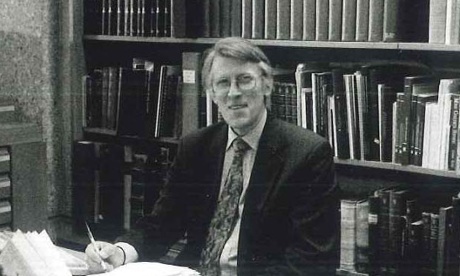
Ralph Hyde, who has died aged 76, was a specialist in London’s urban development, city views and maps, as well as an internationally recognised authority on the history of the panorama.
From 1975 until 1999 he was keeper of prints and maps at Guildhall Library, the eminent institution that specialises in the history of London. He lectured and wrote profusely on London images, early town plans and prospects, and published volumes including Printed Maps of Victorian London, 1851-1900 (1975), London As It Might Have Been (with Felix Barker, 1982) and Getting London in Perspective (1983).
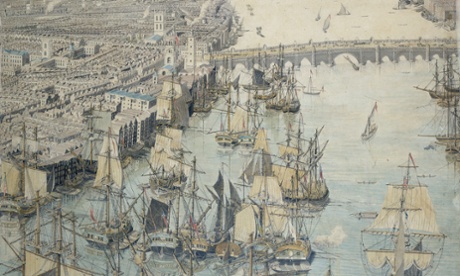
Hyde also prepared many publications for the London Topographical Society, including its all-time bestseller The Rhinebeck Panorama of London (1981), about the series of four watercolour panels that together give an image almost 9ft in length depicting an outstanding bird’s-eye view of London from the early 19th century. Hyde rediscovered and identified the panorama after it had lain hidden for many years in an attic in Rhinebeck, New York. It is now a treasured part of the collection at the Museum of London.
Son of Gladys (nee Jones) and Douglas, Hyde was born in Uxbridge, Middlesex, months before the outbreak of the second world war. When bombing of London began, Gladys, Ralph, and his elder brother, Jeffrey, went to stay with Douglas’s parents in Wrington, Somerset. During the war Douglas, who became a well-known journalist and political campaigner, left Gladys for another woman. But Gladys and her sons continued to live with Douglas’s parents. It was rough to be a single mother in those days, so Gladys let people presume that her husband had been lost in the war.
When Jeffrey moved to Bristol to study medicine, Ralph followed. He did his military service in the RAF in Kidbrooke, south-east London, after which he stayed in the capital to study librarianship. He got a position at Marylebone Library, where he met his future wife, Ruth Bollington (they married in 1964), then joined Guildhall Library in 1965 as assistant librarian.
In 1971 his thesis, Printed Maps of London: 1851-1900, was approved for the fellowship of the Library Association with a mark of distinction and a few years later it was published as Printed Maps of Victorian London, 1851-1900. Later books included The A to Z of Victorian London (1987), Ward Maps of the City of London (1999) and The A to Z of Charles II’s London 1682 (with Peter Barber, 2013).
Hyde acted as an adviser and consultant to the Motco Image Database, supplying commentaries for historical London maps and panoramic views, such as Richard Horwood’s map of London 1799 (2006), Christopher and John Greenwood’s map of London c1830 (2005) and Grand Panorama of London from the Thames 1845 and 1849 (2000).
His interest in panoramas was a natural outgrowth of his work with maps and prospects. In 1982 he published a work on the Regent’s Park Colosseum, the huge panorama rotunda – a kind of virtual reality of the time – that entertained Londoners for decades from the late 1820s onward. He then curated two exhibitions on panorama-related subjects: Gilded Scenes and Shining Prospects, at the Yale Center for British Art, in New Haven, Connecticut, in 1985; and the seminal Panoramania!, at the Barbican Art Gallery, 1988-1989, a big event that helped to raise international interest in this “mass medium” of the 19th century.
Hyde prepared substantial publications for both events, and Panoramania! The Art and Entertainment of the “All-Embracing” View (1988) is one of the most authoritative books on the topic. His other publications on panoramas included London from the Roof of the Albion Mills: A Facsimile of Robert and Henry Aston Barker’s Panorama of 1792-3 (1988) and A Prospect of Britain: The Town Panoramas of Samuel and Nathaniel Buck (1994).
When Hyde retired from Guildhall Library, he himself spoke about a semi-retirement. He began working with Jacqueline and Jonathan Gestetner, cataloguing their renowned collection of panoramas and optical toys. This treasure trove provided Hyde with many exciting scholarly challenges. One of the results was the article Myrioramas, Endless Landscapes: The Story of a Craze, published in Print Quarterly in 2004. Myrioramas, another 19th-century passion, were sets of cards showing pieces of landscapes, which could be arranged in any order, producing an almost endless variety of different panoramic views.
When Gestetner suggested to Hyde the idea of producing a book about their huge collection of folding paper peepshows, he soon became passionately interested. The handsome volume Paper Peepshows: The Jacqueline and Jonathan Gestetner Collection was finally published early this year. The part of the Gestetner collection the book discusses is now at the Victoria and Albert Museum.
Hyde had a wonderful sense of humour and an almost boyish enthusiasm for his work. During the years I spent writing my own book on panoramas, he helped me in countless ways, broadening my perspectives and helping me to avoid embarrassing mistakes.
Ruth predeceased him. He is survived by their three children, Jeannette, Nicholas and Alice, and seven grandchildren.
• Ralph Hyde, historian of maps, prints and panoramas, born 25 March 1939; died 5 June 2015