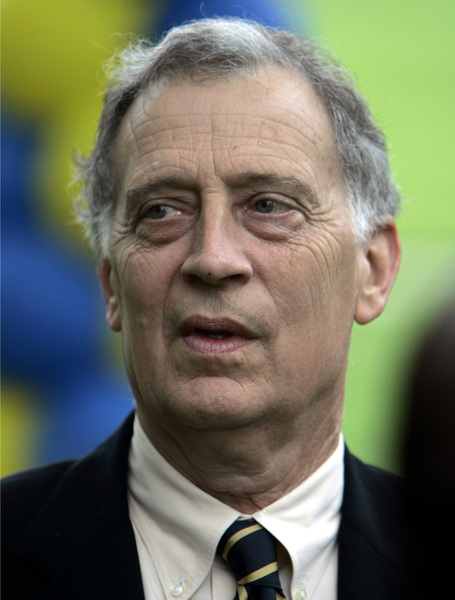
Ralph Cicerone, a distinguished University of California, Irvine scientist who conducted pioneering research into global warming and the depletion of Earth's ozone layer before taking the helm as the university's fourth chancellor, died Saturday. He was 73.
His family did not release a cause of death, UC Irvine spokeswoman Cathy Lawhon said. William Kearney, director of media relations for the National Academies of Sciences, Engineering, and Medicine in Washington, said Cicerone died unexpectedly at his home in Short Hills, N.J.
Cicerone was an internationally renowned researcher heralded for work that revealed that organic compounds called chlorofluorocarbons, methane and other trace gases were on track to surpass carbon dioxide as the main greenhouse gases driving global warming.
His research proved influential in developing environmental policies worldwide.
"For his powerful and profound work as a chemist and Earth system scientist, and for his recognized stature in his discipline, we in academia salute Ralph Cicerone," UC Irvine's current chancellor, Howard Gillman, said in a statement. "For his courageous work uncovering the causes and effects of climate change, the world owes him a debt of gratitude."
Cicerone was recruited in 1989 to launch the university's Department of Earth System Science, a first-of-its-kind interdisciplinary center to study the dynamics of air, land and sea.
Five years later, he was named dean of the School of Physical Sciences, where he worked with colleague F. Sherwood "Sherry" Rowland conducting cutting-edge research.
"His design for the Earth System Science Department was unique and well ahead of its time, bringing together top scientists from engineering, physics and chemistry to study a problem of crucial importance to humanity: climate change," Kenneth C. Janda, current physical sciences dean, said in a statement.
Cicerone's work laid the foundation for Rowland and MIT's Mario Molina to discover that CFCs used in refrigerants and spray cans were eating a hole in the protective ozone layer. That discovery won Rowland, Molina and Paul Crutzen of the Max Planck Institute for Chemistry in Mainz, Germany, the Nobel Prize in chemistry in 1995.
Two years later, Cicerone was one of only six U.S. scientists to receive a prestigious United Nations award for research that sought to protect Earth's ozone layer.
As chancellor of the Irvine campus from 1998 to 2005, Cicerone oversaw the construction of major research facilities and the $375 million teaching hospital at UC Irvine Medical Center. Under his leadership, UC Irvine's enrollment grew more than 25 percent to 24,000 students.
Cicerone left UC Irvine after being elected president of the National Academy of Sciences, where he continued to shape environmental policy until his retirement in June. He was often called to speak about climate change policy before congressional committees, a university statement said.
"I'm worried about the polarization in some sciences, and I want to work on communicating the value of science," he told the Los Angeles Times in 2004 after announcing his resignation as chancellor. "Our country has to have a reasoned basis for some of the decisions we are making" in fields such as the environment, medicine, census-taking and space exploration.
Cicerone was born in New Castle, Pa., and earned his undergraduate degree at MIT before obtaining a doctorate in electrical engineering and physics at the University of Illinois at Urbana-Champaign.
He is survived by his wife, Carol, a UC Irvine professor emerita of cognitive sciences; daughter Sara Cicerone; and his two grandchildren.