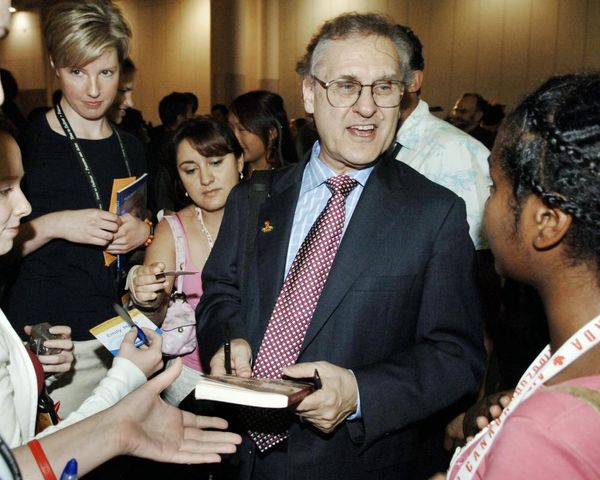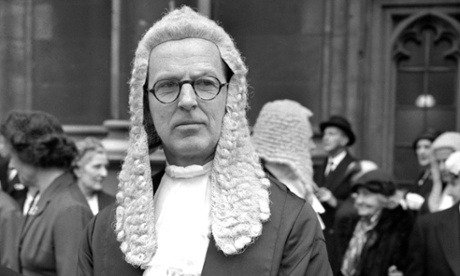
Jeremy Hutchinson is the stuff of legends. Arguably the greatest criminal barrister of the 60s, 70s and 80s in Britain, his work changed the country forever, helping to create a freer, less secretive society, and challenging the latent strands of puritanism in its moral sensibility.
In his own words, he “had the luck to live in those 30 years ... when this edifice of secrecy, censorship, them and us, was gradually and largely demolished”.
At a Guardian Live event hosted by former Guardian editor-in-chief Alan Rusbridger, Hutchinson, now 100, was as mesmeric, charming and committed to the values of a free, open society as ever, and delighted his audience with insights and anecdotes about his most prominent trials.
The Profumo affair
As Rusbridger pointed out, in 1963 Christine Keeler was, after the Queen, the most famous woman in Britain. Through her simultaneous affairs with then minister for war, John Profumo, and Soviet spy Yevgeny Ivanov, she found herself at the centre of a political scandal that proved to be decisive in the eventual downfall of Harold McMillan’s Conservative government, with Hutchinson called upon to defend her when she was tried for perjury in the wake of the affair.
Hutchinson said the press painted Keeler as a wicked, terrible woman who would ruin lives, but that in truth “she was a very pathetic figure.” Noting her troubled upbringing, he described how she eventually travelled to London, where she would be taken up by Stephen Ward, a socialite and an “extraordinary character” who was “fascinated by what was going on in the sex world”.
After joking that all of his colleagues “were looking through the keyholes” when Keeler first appeared in his chambers, he went on to recall that as soon as she spoke, her voice made her attraction suddenly disappear. “She had the voice of someone who was tired of life.”
“The press made a huge story about the Russian and the minister of war sharing a prostitute,” he said, going on to dismiss their claims that Keeler may have been passing secrets to the Soviets through pillow talk as “complete rubbish.”
“I don’t think she really knew what was going on – as opposed to her friend, Mandy Rice-Davies, who knew exactly,” he said.

Rusbridger commented on the very fevered atmosphere of that summer, and the general impression that everyone was having affairs all over the place. “The press built it up,” said Hutchinson.
He also assured the audience that Ward’s subsequent pursuit on vice charges relating to the scandal was a “miscarriage of justice”, adding that he would have liked to defend him at trial. “He needed someone who would stand up and fight the evidence against him,” he said.
The double agent George Blake
A British spy turned double agent for the Soviet Union, George Blake had a “delightful personality” and was a “very interesting person to deal with”, according to Hutchinson, who pleaded on Blake’s behalf for leniency after he was tried and convicted for espionage.
Hutchinson recalled how the secrecy of Blake’s trial affected his attempts to mitigate his sentence: “I was completely unable to do any serious mitigation for him, I was never able to know the essence of the case.”
Blake was eventually sentenced to a record 42 years, a penalty described by Hutchinson as “totally political”. While he was dismayed by the proceedings of the trial and its eventual outcome, he confessed that he was delighted to hear about Blake’s escape from prison – clarifying for the audience that this was an exception –only five years later, adding that he got “extra joy” from the fact that it turned out to be a completely amateur effort with a rope ladder thrust over the wall from outside at an agreed time.
The defence of Lady Chatterley’s Lover
“R v Penguin Books Ltd” was the obscenity trial against Penguin for publishing DH Lawrence’s novel in unbowdlerised form in 1960, in which Hutchinson acted as junior counsel for the defence. He had to prove that, even if the work was obscene, it had such literary merit that it was in the public interest for it to be published. He explained that it was a delightfully different experience: “Instead of defending some alleged rapist or murderer, one was suddenly representing [de facto] DH Lawrence, and the case was not of fact but of opinion.” Hutchinson recalled how he “saw DH Lawrence sitting in the dock with his bright eyes, where all these appalling people had sat.”
According to Hutchinson, the defence had the “absolute ideal witness” in sociologist and cultural theorist Richard Hoggart, who was credited by host Rusbridger with describing “DH Lawrence in a way that was unchallengeable.” Hutchinson said taking Hoggart through his evidence was one of the most enjoyable moments of his career.
“I was determined that we should get Lawrence read in front of the jury,” said Hutchinson, adding that in obscenity cases his policy was not to hide from the potentially obscene passages, but to demonstrate their literary merit in context
– for instance, a passage was read in the trial that expresses reverence to a man’s testicles. “It was extraordinarily moving to hear these beautiful passages read out in court and then turn to Hoggart and ask: ‘what did you think about that?’”
After 90 minutes, Hutchinson showed no signs of flagging and the event finished with a standing ovation for one of the greatest criminal barristers of our time.
To order Jeremy Hutchinson’s Case Histories for £20 go to bookshop.theguardian.com or call 0330 333 6846.