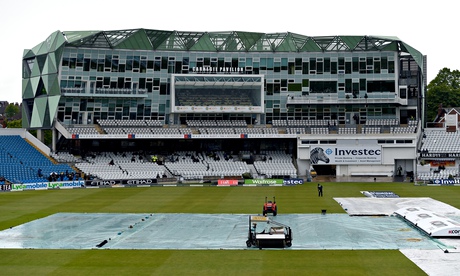
A good game has been spoiled. The rain that washed in from over the Pennines shortly after lunch precluded any further play on the fourth day of another scintillating Test, depriving New Zealand of an opportunity to make inroads into the England second innings (although the game is still there to be won by them on the final day) but almost certainly derailing any real prospect England may have had of a record score to win a Test. Now there is probably only one potential winner.
The cricket that did take place in the morning was as exhilarating as any that had preceded it in this most entertaining of series, with New Zealand’s lower-order batsmen making merry against England bowlers who broke ranks and lost discipline under a fierce assault.
Resuming on 338 for six, a strong position but by no means secure, New Zealand scored a further 116 runs in 16 overs before Brendon McCullum called them in immediately after Stuart Broad had conceded 19 runs from an over. BJ Watling, an overnight centurion, went on to make 120 before falling to the second new ball, but Mark Craig hit a merry unbeaten 58 and Tim Southee a clobbering 40 from 24 balls before Matt Henry cracked a couple of sixes to finish things off, the eighth player in the innings to clear the boundary.
The declaration at 454 for eight, made from only 91 overs, meant that England, dead level on first innings, would – of course – require 455 to win, in 171 overs, which in terms of run rate, 2.66 per over, sounds within compass, particularly given that the pitch at the start of the innings was still barely into its fourth day of wear. Quick scoring rates give teams time but can dissipate some of the advantage that a fifth-day pitch can bring.
By the time the rain sent the players from the field, Alastair Cook and Adam Lyth had made a positive enough start, reaching 44 without loss, with Cook on 18 and Lyth 24.
England will now have a maximum of 98 overs to get the remaining 410 that they need which, even allowing for the ferocious pace at which New Zealand have scored in this match and throughout the series, is probably out of England’s reach, although there cannot be anyone who would begrudge New Zealand a drawn series, nor would castigate England still to give it their best shot even if they concede the match in so doing.
To place England’s initial task in perspective, though, it would require the second highest fourth-innings score ever made in a Test, with only the 654 for five, made in the famous timeless Test in Durban in 1939, exceeding their current target.
Curiously their opponents have a greater history than most of getting big fourth-innings scores, with three of the top six going to them: 451 against England in Christchurch in 2002 when Nathan Astle ran amok; 440 at Trent Bridge in 1973 when Bev Congdon and Vic Pollard gave them hope; and 431 in Napier in 2008. Each of these, however, was in a losing cause, as was India’s 445 against Australia in Adelaide in 1978. Only South Africa’s 450 for seven, against India at The Wanderers two years ago, resulted in a draw.
For much of this match England’s pace bowling has been poor. When they arrived at Headingley, they may have found pinned to the dressing-room wall a drawing of a set of stumps and there, at the top of the off stump, the image of a cricket ball. It is the simplest message that Jason Gillespie gives his Yorkshire seamers: there is really no substitute for trying to hit the top of off stump.
It is a fundamental bowling tenet that England bowling coaches, including David Saker and Ottis Gibson, have conveyed consistently and one to which the head coaches have also subscribed.
In its strategy this match has been no different. Imagine, then, a scenario where a team could face 61 overs of seam and, should they have a mind to do so, allow all but 17 of those 366 deliveries to pass harmlessly through to the keeper. That is the statistic that emerges from New Zealand’s first innings and there is little evidence to suggest the second was any different. Generally England bowled too wide and often too short.
There may be a seductive element in the presence of a well-populated slip cordon,and fields heavily loaded to the off-side. It is also not helpful when the slips and particularly the wicketkeeper tend to applaud and encourage a bowler who persistently pursues something outside the fabled “corridor of uncertainty” to one of absolute predictability: better they tell the bowler to smarten up.
It is possible to sympathise to some extent when batsmen, even those down the order, have the facility to swing through the line and hit length balls for six: England tanked the Kiwis around likewise at the end of their innings. The default response to this, though, particularly from Stuart Broad, is to drop short, which at the pace he is bowling is no less inviting. In this circumstance, just as “top-of-off” is the starting point, straight yorker ought to be the first port of call when the flog is on.
A question needs asking of Cook at this point for, if the two coaches do not agree with the tactics, either Cook does or he is not challenging Broad in particular. The captain sets the agenda, the bowlers say how they intend to go about it. And if the two do not agree, then the bowlers do not bowl. Simple.