With railway operators required to conduct railway inspections more frequently than for road infrastructure, artificial intelligence and drones are being actively introduced to inspect areas such as bridges and tunnels. A survey showed more than 6,000 railway facilities have seen over 120 years since their construction, and the new technology is expected to help maintain them.
-- Tunnel doctor
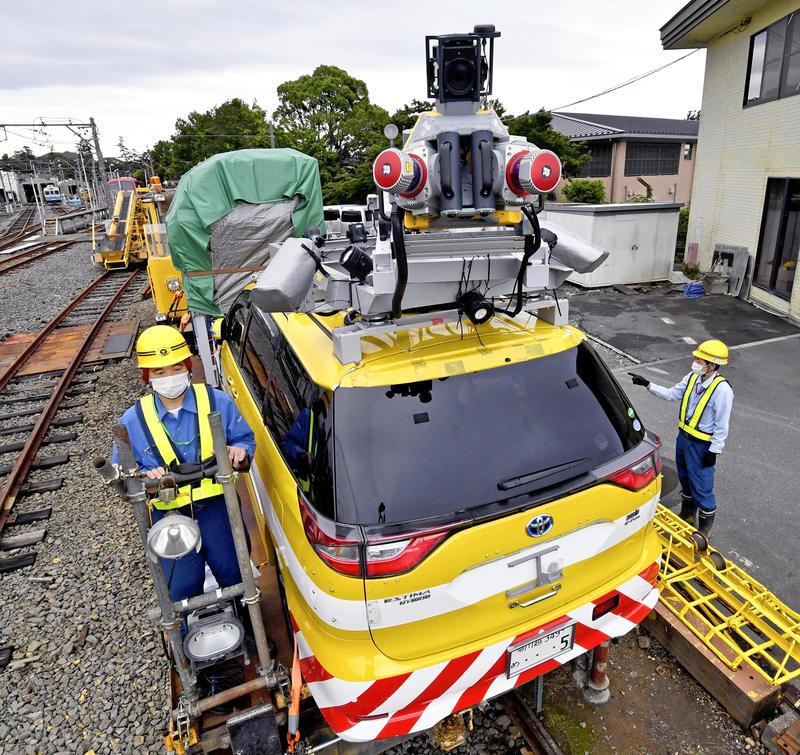
In late June, a yellow car traveled by trolley on the rail track of the Izu Kyuko Line, slowly passing through 31 tunnels on the 18-kilometer stretch along the coast of Shizuoka Prefecture.
The vehicle, called InfraDoctor, was developed to inspect the tunnels of metropolitan expressways. It emits infrared lasers from the roof to check for water leakages and dents based on how the laser reflects. In addition, the AI will analyze images taken by a highly sensitive camera and automatically detect small cracks.
Izu Kyuko was the first railway company to introduce this system and conducted inspections in June. Visual inspection alone could check only an about 1-kilometer stretch per day, meaning it needed 15 days to complete the inspection. With this machine, though, it took only three days and also could reduce costs by about 40%.
"We can reduce the burden on inspectors, and it works exceptionally well," an employee in charge said.
Tokyo Metro Co. introduced drones in February to inspect tunnels on the Hanzomon Line. The machines can help workers closely inspect parts that are often hard to visually check, such as vents. The system is expected to be expanded to all routes in the future.
Osaka Metro Co. began using drones to inspect the ceilings of stations in February, while Hokkaido Railway Co. plans to introduce drones, on a trial basis, for some inspections this fiscal year.
-- Aging facilities
A labor shortage and a lack of government support for the inspections prompted the introduction of this latest technology.
Since 2014, the Road Law and other related rules require roads, bridges and tunnels to be inspected once every five years in the wake of the Sasago Tunnel ceiling collapse on the Chuo Expressway, according to the Land, Infrastructure, Transport and Tourism Ministry. From this fiscal year, the central government established a subsidy system to support local governments and other organizations that manage them.
Meanwhile, railway operators are required to conduct infrastructure inspections under the Railway Operation Law, and railways have conducted inspections every two years in the wake of accidents. In 2001, the ministry set standards for conducting regular inspections by visual observation and hammering tests once every two years and detailed special inspections once every 20 years, except Shinkansen bullet train lines.
Although the central government provides support for the repair of local railway infrastructure, railways are not allocated a generous system like roads because they are often operated by private companies.
East Japan Railway Co. has a civil engineering center in each of its branches to perform maintenance work. Many other JR and private railway companies have set up special departments as well to cope with their aging railway facilities.
The Japan Society of Civil Engineers conducted a survey in October last year on 169 railway companies and found about 6,000 railway bridges and 100 tunnels were built when more railways were made over 120 years ago.
However, there have been fewer inspectors due to the massive retirement of skilled baby boomers, especially in JR.
"With the aging of facilities, more places need to be inspected," a railway official said. "However, since inspections are mainly conducted at night, many people are reluctant to become inspectors. We will continue to rely on the latest technology."
Nihon University Prof. Hitoshi Tsunashima, who specializes in railway technology, said: "It is unquestionable that management of railway operations will become difficult in the future due to the fallen population, and government support is needed to maintain a safe railway network. I hope the entire industry will promote technology and human resources."
Read more from The Japan News at https://japannews.yomiuri.co.jp/