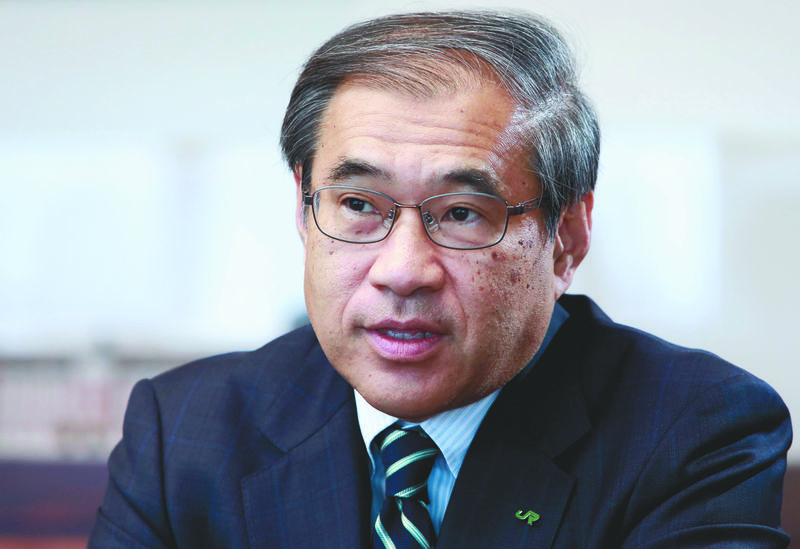
Yomiuri: Reconstruction from the Great East Japan Earthquake in 2011 is providing an opportunity to reconsider the ideal state of regional railways. The Yomiuri Shimbun asked East Japan Railway Co. President Yuji Fukasawa, 65, about his ideas.
Fukasawa: In the wake of the Great East Japan Earthquake, about 400 kilometers of our company's rail lines were impassable in the Tohoku region. I was an executive director at that time and responsible for the reconstruction. I remember how depressed I felt when I actually saw the disaster-hit areas.
Three rail lines suffered particularly serious damage: a 55-kilometer section between Miyako Station and Kamaishi Station on the Yamada Line in Iwate Prefecture; a 44-kilometer section between Sakari Station and Kesennuma Station on the Ofunato Line in Iwate and Miyagi prefectures; and a 55-kilometer section between Kesennuma Station and Yanaizu Station on the Kesennuma Line in Miyagi Prefecture.
For the three affected railway lines, I proposed that relevant municipalities introduce the bus rapid transit (BRT) system as a temporary measure during reconstruction until the railways were restored.
The BRT system runs on streets that are built on top of tracks and are only used for buses, which serve as a substitute for trains. In areas without dedicated bus lanes, buses bypass ordinary roads. Under the BRT system, buses are less likely to be stuck in traffic, so it's easy to keep them running on time. Introducing the BRT system was also faster and cheaper, in terms of construction and management costs, than rebuilding the railway tracks.
Yomiuri: Municipalities that are home to the three lines objected to the introduction of the BRT system and asked for reconstruction of the railway lines. However, negotiations deadlocked over the sharing of the huge reconstruction costs.
Fukasawa: Ultimately, we got a decision regarding the Yamada Line from the mayors of relevant municipalities and other parties. We repaired railway tracks, bridges and other facilities and then transferred the line to the third-sector company Sanriku Railway Co.
With regard to the Ofunato and Kesennuma lines, we reached an agreement to fully restore them using the BRT system, and the system is already operational. This is the first time that our company has had an operational BRT system.
We set up more stops for the BRT system than the number of original railway stations. We created stops at locations that have a lot of traffic, such as hospitals and high schools, and the buses will make stops on ordinary roads as well. Another advantage of the BRT system is that it's possible to increase or decrease the number of stops as well as the number of buses in operation in accordance with the number of users.
Through the negotiations, I realized anew that many people had strong feelings about trains. We will make sure to improve the quality of our services after shifting to the BRT system.
Yomiuri: On the JR Joban Line that connects Miyagi Prefecture and Tokyo, many sections were impassable due to the tsunami that followed the earthquake and the effects of the accident at Tokyo Electric Power Company Holdings, Inc.'s Fukushima No.1 nuclear power plant. After the government evacuation instructions were lifted, JR East resumed operations in a phased manner.
Fukasawa: On March 14, trains began running again on the section between Namie Station and Tomioka Station in Fukushima Prefecture on the JR Joban Line. This means that all railway sections damaged by the earthquake were operational through the use of both railways and the BRT system.
Before the disaster, the Super Hitachi limited express train on the Joban Line provided 3-1/2 round trip services from Sendai Station to Ueno Station in Tokyo per day.
Now, the Hitachi limited express offers three round trip services from Sendai Station to Ueno Station or Shinagawa Station in Tokyo per day. Only some of limited express trains stopped at Ono and Futaba stations in Fukushima Prefecture before the earthquake, but now all the limited express trains do. Green cars (first-class cars) were only used during the busy season before the earthquake, but are now in service year-round.
Yomiuri: Operating concurrently with the Joban Line, Tohoku Shinkansen bullet trains run on the section between Sendai and Tokyo stations. The Hitachi limited express is a 10-car train and has the capacity to carry 600 passengers. The train is unlikely to be fully occupied, and some say it has an excessive transport capacity considering the balance between revenue and expenditure.
Fukasawa: I believe that the Hitachi limited express is a sign of hope for the future of the Tohoku region. I hope our company will help revitalize the region after the disaster.
After the earthquake, we have been operating the Tohoku Emotion train with only dining cars on the Hachinohe Line's section between Hachinohe Station in Aomori Prefecture and Kuji Station in Iwate Prefecture. The train is popular among passengers who live farther away, such as the Tokyo metropolitan area.
When the train enters Hirono, Iwate Prefecture, local residents welcome passengers by waving Tairyo-bata fishing boat flags along the railway tracks every day without fail, even on rainy and windy days. Passengers are quite impressed by the passion of the people in Hirono. [The people of Hirono] are wonderful and I really appreciate them.
I want to work really hard to contribute to the development of the Tohoku region through railways, various services and tourism. We plan to transport marine products by train from the ports in the Tohoku region in the morning to Tokyo and sell them at Tokyo Station and other places on the same day. We plan to hold a tourism campaign to promote the six prefectures in the Tohoku region from April through September of next year.
Yomiuri: Against the backdrop of a declining population, many local regular railway lines are in the red. However, many people in areas along such lines hope to retain railway services. As a private company in charge of operating public transportation services, how will JR East deal with the situation?
Fukasawa: We have to keep the company operating seamlessly into the future. Someday, we may have to make the tough decision to close some of the rail lines because they would be too difficult to maintain as they are now. If that were to happen, we may propose introducing the BRT system and other means.
What is important here is that our company needs the trust of the people. If we lose their trust, our management will be fundamentally undermined. We have to firmly keep that principle.
It has been 33 years since the privatization of Japanese National Railways (JNR) in 1987. Just after it was privatized, 90% of the company's sales came from the transportation business such as railway services. Subsequently, we expanded our business to include station buildings, hotels, real estate and other areas. Now, 70% of our sales come from the transportation business and the remaining 30% from other operations.
How about the next 30 years? Japan's population is declining and people's lifestyles are changing. I think it will be difficult for our company to survive with the current business structure. In the future, we will further expand the scope of our business to achieve the ratio of transportation to non-transportation business sales to 6:4 by 2027.
One of our measures for the future is the Takanawa Gateway Station in Minato Ward, Tokyo, on the Yamanote Line that opened on March 14. I hope to make the station a place where people can feel the future. Within the station building, there are security guard robots, cleaning robots and an artificial intelligence digital display that provides information such as destinations. The station also has an unmanned convenience store where there are no cashiers or other personnel.
We are also promoting a large-scale development project around the Takanawa Gateway Station. We are building a town with residences and cultural facilities, as well as offices, commercial facilities and hotels. It is the first large-scale town development project for our company.
Traditionally, we have focused on "stations" as a starting point when considering our next business venture, but from now on, we will enhance services for each individual customer through the use of Suica transportation IC cards and other tools from a people-centered perspective.
When I was young, I was in charge of managing surplus JNR personnel. I bowed to officials of various companies to ask them to hire these employees, and because of that, I have seen many people struggle with unfamiliar jobs after leaving a railway-related job. Since then, I have thought those kinds of situations should never happen again. I will manage the company with an eye on long-term goals for the future.
---- Fukasawa was born in 1954 in Hakodate, Hokkaido. His father was an engineer for the now-defunct Seikan Renrakusen ferry connecting Aomori City, Aomori Prefecture, and Hakodate. He graduated from the University of Tokyo Faculty of Law in 1978 and joined JNR. After JR East was launched in 1987, Fukasawa took up such posts as executive director for personnel affairs. He has been in his current job since April 2018.
Read more from The Japan News at https://japannews.yomiuri.co.jp/
.jpg?w=600)