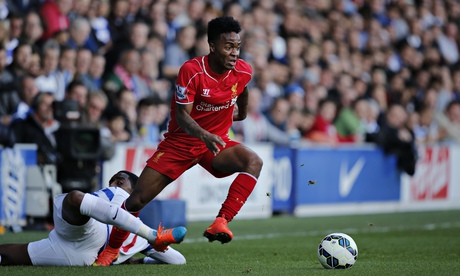
When Raheem Sterling’s powerful little legs finally stopped whirring in the 95th minute and he trotted off the pitch having brought a desperately unlucky Queens Park Rangers to their knees, there could be no doubt that Liverpool’s flying winger had both earned his rest and brought an emphatic end to last week’s ludicrous debate about whether society is ready to embrace footballers who admit to being a bit tired.
While the fuss made over Sterling having enough self-awareness to tell Roy Hodgson that he was feeling fatigued before England’s match against Estonia last Sunday was amusing to watch from a distance, there were some people who harboured genuine grievances about this most uncontroversial of controversies. How dare Sterling? they chuntered. How dare he be tired? At the humble age of 19? When he earns how much money? What about the working man?
The criticism of Sterling was laughable nonsense – yes, teenagers do get tired, just like everyone else; no, Sterling cannot wrap himself in his pay cheque to guard against fatigue; and no, the travails of us normal folk who have to live in the real world are not comparable to those of a professional athlete seeking to protect his body for the sake of his career. Short-term benefits are no substitute for long-term rewards. And anyway, it was Sterling who came off the bench in Tallinn to win the free-kick that led to Wayne Rooney’s winner for England.
Perhaps that is the problem. Sterling has become such an important player for club and country in the past year that he will have to become accustomed to his every sneeze being analysed for some deeper meaning, and inevitably all eyes were on him at Loftus Road, including Hodgson’s.
The England manager sat in the directors box and, trust his luck, contrived to miss the crazy finale that saw Liverpool twice threaten to throw victory away before they snatched the points when Sterling, who was at the heart of all of their best moves, raced on to a wonderful pass from Philippe Coutinho in stoppage time to force Steven Caulker to turn the ball into his own net.
The awkward truth for Liverpool, however, is that at times their performance harked back to the bad old days when Hodgson was their manager, which is not ideal given that Real Madrid visit Anfield on Wednesday.
Other than Sterling, Real’s scouts would not have seen much to scare them. Life after Luis Suárez is proving difficult for Liverpool and Sterling’s excellence should not distract Brendan Rodgers from the multitude of flaws that were evident in every area of the pitch, especially when QPR threatened to run riot in the first half. With better finishing Harry Redknapp’s side would have led 3-0 at the break and Rodgers would have been facing more awkward questions about the way that Liverpool spent the Suárez money.
Liverpool were grateful that Leroy Fer and Charlie Austin were unable to convert glaring opportunities, but their defence continues to create the impression that disaster is always lurking nearby, with Eduardo Vargas twice taking advantage of their susceptibility to crosses, while the decision to play Steven Gerrard further forward in the first half did not work and Adam Lallana offered little before being replaced by Coutinho. Then there is Mario Balotelli, a riddle of a player who was disappointing yet again.
Balotelli is an easy target but, based on the evidence so far, he is not the answer. In time that can change – the return of Daniel Sturridge from injury will help the Italian – but it was revealing to hear Rodgers speaking afterwards about the way his team’s dynamic has changed. Last season, Liverpool destroyed opponents with the speed of their football; their ability to get behind defences in the blink of an eye. Now they play in front of teams. They are too ponderous. It is not that Balotelli is lazy or that he does not move, more that he is not on the same wavelength as his team-mates yet and the positions he is taking up are not creating enough space. Nor did it help that he fluffed his lines when the game was goalless, blazing over an open goal after Alex McCarthy had parried Lallana’s shot.
Liverpool were worryingly susceptible to QPR’s impressive energy in the first half and they looked like a team still in search of a new identity.
Yet they will be encouraged by their improvement in the second half. They were more dangerous after the introduction of Coutinho, who scored a fine goal, Gerrard began to dictate play in a deeper role, and Sterling was more pivotal.
Coutinho deserves praise for his contribution but this was Sterling’s day. It was his rapid thinking at a free-kick he had won that led to Richard Dunne’s own goal for Liverpool’s opener and his quick feet that resulted in their second and third.
QPR’s fans tried to rattle Sterling but he is a chest-out sort of player now and they tend to make the difference when the margins are tight. Like all good bed-time stories, this one had a happy ending.