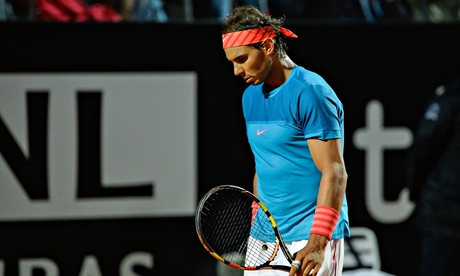
Only a fool would deny that Rafael Nadal is in crisis. For the fifth time this year, the greatest clay-courter of all time has lost on his favourite surface, in a tournament he has won eight times, a little over a week before an even bigger tournament he has won nine times.
For the second year in a row, Novak Djokovic will start favourite at the French Open, the tournament the Spaniard has owned for a decade. The bookmakers might be the natural enemy of sporting types everywhere, but they are not stupid.
This year Nadal will arrive in Paris ranked outside the top four for the first time since 2005. He has been in the top 10 since April of that year and, while it is unthinkable that he could tumble below that psychologically crucial cut-off point, he is under serious pressure in the lower reaches of the table. If his latest conqueror, Stan Wawrinka, were to win this title, for instance, he would be a mere hundred points behind Nadal.
The last time Wawrinka played Nadal on clay – two years ago in the quarter-finals of the French – the Spaniard wiped the dirt with him, 6-2, 6-3, 6-1.
When they met in the final of the Australian Open last year, Wawrinka had not beaten him in 12 attempts, and left Melbourne as champion. That is the measure of Nadal’s dilemma.
On Friday night, there were so many look-away moments in the second set of their quarter-final it was embarrassing – never more so than when the Swiss hit the most outrageous winner behind Nadal’s back into the ad corner, as the Spaniard was dashing in the opposite direction in anticipation of the more obvious reply across court. But so rampant was Wawrinka, he risked the difficult and spectacular shot. He knew it would hurt Nadal in more ways than just on the scoreboard.
It even brought a wry smile of resignation from Rafa – and that never happens.
Wawrinka is not one of the game’s solid performers. He has the weapons – his single-handed backhand is the most lethal in tennis, more so even than Roger Federer’s, because of his ability to hit it flat and hard down the line when in the mood – but he has to struggle against himself some times.
Not here.
Wawrinka had done well to get this far, putting aside recent complications in his personal life, and he was hitting the ball with increasing confidence as the match progressed. But not many observers expected him to beat Nadal. To come from 6-2 down in the first-set tie-break showed how much he wanted it – and, perhaps, how acutely he sensed vulnerability across the net.
As champions do, Nadal refused the invitation to panic. “I don’t know what’s going to happen [at the French Open],” he said later, “but I’m going to fight.”
Nadal has to stay positive; otherwise he is a walking target for anyone in the top 20, not just the very best in his sport. On clay this year, he has lost to Fabio Fognini (30 and 28) twice, in the semis in Rio and third round in Barcelona, the world No1, Djokovic (Monte Carlo semis) and No3, Andy Murray, last Sunday in straight sets in the Madrid final. His only tournament win on the dirt was in Buenos Aires, where he beat Juan Mónaco (60).
Without the comfort of a top-four ranking in Paris, however, Nadal will be exposed to the possibility of facing any of Murray, Djokovic or Roger Federeras soon as the quarter-finals. On current form, that would condemn him to an early exit – although it is likely it will also bring out the best in him. The second week could be one of the tournament’s most exciting in years.
Yet, as much as everyone admires Nadal’s fighting spirit and respects his extraordinary history on clay, he bears the haunted look of a worried man who must pretend otherwise.
Ghosts are emerging in stats and long-forgotten opponents. The Times this week tracked down the 33-year-old Scot Alan Mackin in Newfoundland, where he is coaching, to talk about the time he beat the 15-year-old Nadal on the clay of Terrassa, near Barcelona, before becoming a footnote in tennis history.
Everyone loses, but great players lose way less often than ordinary players – and rarely when playing on home turf – or, in this case, clay. Nadal has never taken winning for granted, because his uncle Toni has drilled into him the virtues of being humble, not so much as a life lesson but to best prepare him for the sort of crisis he is experiencing right now.
Physically, there would seem to be no problems. “I feel great. No, I’m not tired. I’m fine.”
Mentally, he professes to be just as fine. He says the sense of uncertainty that hit him in earlier losses this year has gone. “I feel well and I am confident that I am able to play without nerves.”
He put defeat down to playing at night, when the ball slows and gives opponents more time and leverage to handle his vicious top-spin, and the excellence of Wawrinka.
But the nerves will surely return. They must. They are the fuel to light his engine, as he has often reminded us before. It is difficult not to admire what at least sounds like sangfroid. “If I go to Roland Garros and I lose, I don’t play well … life continues. It’s not the end of the world.”
Of course it isn’t … except Rafa’s world is tennis, and it’s not looking too rosy right now.