Summary
- Harriet Harman, Labour’s acting leader, has rejected claims that Jeremy Corbyn supporters are being “purged” by the party as it vets those who have registered to vote in the leadership contest. Speaking after a meeting with the four leadership candidates, she said:
In undertaking these processes, we are completely impartial, the question is not which candidate you support, but do you support the aims and values of the Labour party. I want to absolutely assert, the party has been completely impartial as between the candidates but the party is not agnostic about the 2014 rules. The question is not which candidate you support. The question is do you support the aims and values of the Labour party.
- Labour has revealed that, following checks, the number of people eligible to vote in the Labour leadership contest is 57,000 fewer than originally thought. (See 2.35pm.) But there are still more than 500,000 people participating. This means the surge of people signing up to take part (many of whom are assumed to be Corbyn supporters) is not quite as large as people assumed - but still enormous by the standards of modern party elections.
- Harman has said she is confident there will not be any legal challenges to the result. She said:
I am confident that there won’t be questions over the integrity of the result and there aren’t any bases for legal challenges. We’ve had a useful discussion with the candidates – a routine discussion. We’ve had a number of discussions throughout this process.
- Harman has said the party may beef up the checks it is carrying out on people who signed up to vote in the contest. Andy Burnham, Yvette Cooper and Liz Kendall are all pushing for this.
- Harman has said that 3,000 people have already been prevented from voting in the leadership contest. The final number will be higher, she said.
- Burnham has warned Corbyn that, even if he becomes Labour, he won’t be able to change party policy on Nato easily or quickly. He said this at today’s Radio 5 Live hustings; a full summary is here, at 11.49am. If party policy did change, Burnham would not serve in Corbyn’s shadow cabinet, he said.
- Diana Johnson, a Labour MP supporting Cooper, has implicitly accused Burnham of sexism over an answer he gave at today’s hustings about Labour having a woman leader. She spoke out on Twitter.
What does Andy mean by saying he'd support a woman leader 'when time is right'?Why not in 2015?Is Labour not ready?! If not now, then when?
— Diana Johnson (@DianaJohnsonMP) August 25, 2015
Anyone saying time "is not right" for a woman Labour Leader should remember the brave women behind Labour's creation. pic.twitter.com/G5Y2WTb0XK
— Diana Johnson (@DianaJohnsonMP) August 25, 2015
To me it seemed clear the answer was a joke. See 1.23pm.
That’s all from me for today.
Thanks for the comments.
Updated
Labour party reveals details of who is voting in the leadership contest
The Labour party has issued a six page briefing note with details about how the leadership election is being conducted. Unusually for the Labour party, which isn’t always forthcoming about internal procedural matters, it is highly informative.
Here are the key points. I can’t find a copy on the web, but I will post the key excerpts here.
- Labour has announced that 553,954 people are eligible to vote in the contest. That’s around 57,000 fewer than when Labour released figures on the day of the deadline for signing up. The party explained the discrepancy in this way:
The headline figures are different now from those given recently mainly because:
· People not being on the electoral register. On average this was about 15% of applications.
· Duplication of Affiliate and Registered Supporters, or who were already members
· Members not being eligible because they are in arrears.
Given the evidence suggesting that new sign-ups are even more pro-Corbyn than ordinary members, the fact that the electorate is smaller than expected may be bad news for his camp. But, given that he has a clear lead amongs ordinary members too, it would probably be a mistake to read too much into this.
- Labour has confirmed that ordinary party members will have more than half the votes in the contest. Here are the figures.
· Total members of the Labour Party: 292,973
· Fully paid-up membership prior to General Election 2015: 187,000
· New members joined since General Election2015: 105,973
· Affiliated Supporters: 148,182
· Registered Supporters: 112,799
· TOTAL ELECTORATE: 553,954
- Labour has confirmed that 3,000 people who have applied to participate in the election have been banned because they do not share the party’s aims and values.
- More than 130 staff are working on checking applications. This is what the party says about the process.
Every Affiliated Supporter and Registered Supporter has to personally confirm that they share the aims and values of the Labour Party either in writing, by email or on a phone call.
Commensurate with our obligation to implement the 2014 rules rigorously and exercising due diligence, checks are undertaken at national, regional and local level. This work is being done by 70 staff operating on a 24/7 basis in Newcastle, more than 30 staff in London and more than 30 in the Nations and Regions. This includes the following checks:
· Candidates from other parties in recent national or local elections;
· People who nominated candidates in those elections;
· Known members of other parties, including lists obtained from published data – executive committees and similar;
· Known supporters of other parties, usually activists, identified by local Labour Parties or our elected representatives in those areas – local knowledge is key;
· Checking the reasons given by individuals when they apply to have a vote
· People in the public eye who have made clear that they do not share our aims and values;
· People who have made public statements, usually on social media, which make it clear they do not share our aims and values.
· MPs and CLPs have been sent the names of new participants and any information that they have responded with is acted upon.
The Newsnight blog also has a good account of how “cheats” are being caught.
- Two national executive committee panels are taking the decisions about whether to exclude people. The panels comprise: Jim Kennedy, Alice Perry, Ann Black, Paddy Lillis, Jo Baxter, Keith Birch (and Cath Speight – reserve). Party staff do not take these decisions. This is what the party says about the 3,502 cases that have been sent to the panels for a decision on whether individuals should be excluded.
Total ruled ineligible – 3,138 (of which RS [registered supporters] 1,972, AS [affiliated supporters] 748 and Members 418).
Those deemed eligible – 144 (some decisions still pending).
- More than half of those so far excluded are Green party members or supporters.
Approximately, of those found to be ineligible, 400 are members or supporters of the Conservatives and 1,900 members or supporters of the Green Party.
- Almost all ballots should have been received by the end of this week.
By Friday 28 August 99.9% of all participants will have received their ballots.
There are three major tranches of ballots being sent out.
· First batch of 340,000 on 14 August
· Second batch of 170,000 voters who should have received their electronic ballots between 21 and 24 August, while those with a postal ballot should receive them on 26 August
· The final batch should receive them by email on Friday 28 August.
- Labour has had legal advice defending the process.
The Labour Party has received legal advice from the Deputy Returning Officer and independent legal adviser, John Sharpe, that the due diligence and procedures taken to verify supporters and members are robust, that the processes are fair and being undertaken with due diligence and that the result will be compliant with the 2014 rules.
- Labour party members can vote if they are over 14 (the age when people can join), but registered supporters and affiliated supporters have to be over 18.
Updated
Here’s some Guardian audio of Jeremy Corbyn dismissing claims of Tory infiltration in the leadership contest during the hustings.
Labour leadership hustings - Verdict

Back to the Labour leadership hustings, and the key question: who won?
Do take a close look at the picture posted above. We probably don’t use pictures enough in political journalism, because sometimes they can be remarkably revealing. This one sums up the encounter rather well.
Andy Burnham? Doesn’t he look glum? Misery and disappointment in headphones. In fact, he didn’t really do badly at all, but his answer to the question about Nato and serving in a Corbyn shadow cabinet has probably exposed him to further charges of flip-flopping. Actually, he was making an astute point about how political parties determine policy, and how leaders cannot always get their own way. (Even Tony Blair, with a majority of 179 and sky-high ratings, was constrained over what he could get past his party, as he discovered over the euro and PR.) But nuance does not always make for effective communication, and Burnham is unlikely to get credit for reminding Jeremy Corbyn that he won’t be able to change Labour policy overnight. Burnham is also being criticised for what he said about Labour having a woman leader. (See 9.45am.) To me it seemed obvious that he was trying to respond to a tricky question with a joke, but the Sun (predictably) and the Staggers (less predictably) have had a go at him over it.
Liz Kendall? She just seems to exude studied indifference. She is set to come last, and now seems resigned to that. Her performance was fine, but she did sound like someone who is now starting to just go through the motions.
Yvette Cooper? In this picture she is engaged, and that was true of the whole 90-minute show. Unlike Burnham, she confronted Corbyn robustly (at least, quite robustly - not this robustly), criticising him strongly over his plans for “people’s QE” (quantitative easing) and his willingness to share platforms with extremists.
And Jeremy Corbyn? Have you ever seen as politician at a hustings looking so calm and laid-back? (Not just metaphorically laid-back, but literally laid-back too.) The criticism he faced did not seem to trouble him at all, and what was striking was just how determined he was not to deviate from the anti-austerity radicalism that has set him apart in this race. At times this sounded refreshing (on immigration, for example - see 11.49am.) At other times it sounded woefully naive (Corbyn seems to think, for example, that campaigning on poverty is the best way to win over Tory-leaning supporters in middle England - see 9.14am.) But this approach has worked very well for him so far, and so it’s not surprising that he’s sticking to the script. Study the picture again, and you’ll see a shallow, happy smile. It’s deserved.
Updated
Harman says Labour may beef up its checks on those voting in the leadership contest
Harman says she was not criticised at the meeting.
But at the meeting there was a “useful” discussion about what extra information could be considered to determine whether people are or are not supporters of Labour.
The rules will not change, she says.
But new evidence might be considered.
- Harman says Labour may beef up the checks it is carrying out to determine whether people voting in the contest are genuine Labour supporters.
Harman rejects claims that party is “purging” Corbyn supporters
Q: Isn’t this new system ridiculous?
No, says Harman. She says the new rules allow supporters to take part in the leadership contest, as well as trade union affiliates.
Q: Has there been a purge? It seems that Corbyn supporters have been disproportionately affected?
Harman says people have to support the aims and values of the Labour party to get a vote. The party has been impartial in this, she says. Supporters of Corbyn are not being singled out. The party is agnostic between the candidates. But it is not agnostic about non-Labour supporters taking part.
Q: How many people will be excluded?
Harman says fewer than 600,000 people will take part. But more than 500,000 people will vote.
Q: How many people have been barred?
Around 3,000 so far, says Harman.
It is not Labour staff taking this decision. The decisions about excluding people are taken by people on a national executive committee panel. They are elected to the NEC.
- Harman rejects claims that party is “purging” Corbyn supporters.
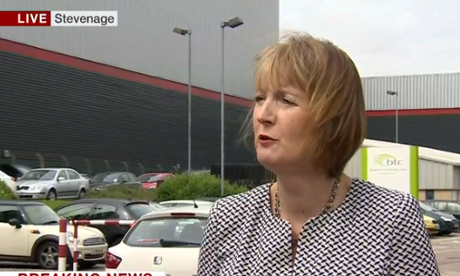
Harriet Harman's interview
Harriet Harman, the acting Labour leader, is speaking to BBC News now.
She says there will not be any legal challenges to the contest.
Her meeting with the candidates was routine, she says.
She says the election system being used is a new one.
The party is continuing the process of verifying voters, she says.
That process will carry on “right up until the last moment”.
Labour"s attempt to keep location of meeting with candidates a secret does not seem to have worked! pic.twitter.com/gpk8j1uoys
— Carole Walker (@carolewalkercw) August 25, 2015
According to ITV’s Libby Wiener, Labour has disallowed 3,000 votes in the Labour leadership contest.
3000 infiltrators discovered and barred from ballot, according to senior Labour source. 600,000 voting #itvnews
— Libby Wiener (@LibbyWienerITV) August 25, 2015
Radio 5 Labour leadership hustings - Summary
This is a beefed-up version of the summary I posted earlier, with the key quotes.
- Andy Burnham warned Jeremy Corbyn that he could find it hard changing Labour policy on Nato if he became leader. Burnham said that he could not serve in a Corbyn shadow cabinet if Labour opposed Trident, or came out in favour of leaving Trident. This seems to contradict assurances that he has previously given about being willing to serve under Corbyn. But, when challenged over whether he would have to resign immediately, Burnham insisted that it was not as simple as that, because the leader on his own does not control party policy. He implied that, even if he became leader, Corbyn on his own could not reverse Labour policy on Nato because others in the party would oppose him. Corbyn himself confirmed that his proposals were just proposals, and that he wanted party members, and the the conference, to have more say over policy. He said that he was personally opposed to the renewal of Trident, but he did not explicitly call for Nato withdrawal. Instead, he just said that he had many criticisms of it. Here is the key exchange. Burnham was asked if he would back a Corbyn-led Labour leaving Nato.
AB: I would not support a policy of leaving Nato. I think that would be highly irresponsible with the world as it is right now.
Q: So you would resign from the shadow cabinet?
AB: What a second. You are jumping several guns here. This debate would have to take place in the party ...
Q: Straight question. If you were in the shadow cabinet, and the policy of the shadow cabinet was with was with Jeremy Corbyn and his political colleagues, leaving Nato, would you resign?
AB: Yes, because I’m saying I could not support [that].
Q: So you couldn’t join a Jeremy Corbyn shadow cabinet?
AB: Well, with all respect to Jeremy, one person doesn’t just impose a policy across the entire party within week one. I’m saying that I could not support such a policy.
- Corbyn dismissed public concerns about immigration, saying that in some years more people emigrate than immigrate and that immigrants have contributed enormously to British life since the second world war. This is what he said when asked if the current level of immigration was sustainable.
There is net immigration at the moment. In some years there’s net migration outwards. There are very large numbers of British people who choose to live abroad. Two million British people live in other parts of Europe. I think the issue has to be making sure that our services are properly funded and properly provided for in all areas, and if there is a shortage of housing or shortage of school places, don’t blame those that have come to this country to work and to pay taxes and develop our economy. Instead, blame the government that is not investing in those services.
Corbyn is right about the figures; see 10.03am. Asked what he would say to people concerned about neighbourhoods changing, Corbyn replied:
Neighbourhoods change all the time. We are a society where people have come to. My constituency has people from probably 70 different countries living there, a very large number of languages. People understand the difference of cultures, and I think children growing up in a multicultural society have a very good understanding of the rest of the world.
Burnham said this was a “quite a London perspective” on the issue.
- Burnham called for councils to be given control over welfare spending.
- Corbyn dismissed concerns about “entryism” by Labour’s opponents during the election as nonsense. He said:
Are there any Tory infiltrators? I think there has been a lot of nonsense in the papers. 600,000 people have either joined the Labour Party or signed up as supporters, we should be pleased about that. There are a few Tory MPs I understand tried to register, got rejected. End of story.
- Burnham said he was ruling out a legal challenge to the election result “under all circumstances”.
- Yvette Cooper criticised Corbyn for sharing public platforms with extremists. She did not identify them, but there have been many articles criticising Corbyn for the people he has been willing to appear alongside, such as this one in the Telegraph and this one on Coffee House. In response, Corbyn said that even Tony Blair was talking to Hamas. He went on:
Listen, if you are going to bring about some real change, you’ve got to talk to people you don’t like, don’t agree with and don’t particularly want to be in power.
Cooper replied:
You do have to talk to people, you do have to have talks, and that is part of negotiations, that’s absolutely right. But I think there is a difference between doing that and between actually encouraging people to come to public meetings and speak to the public and appearing to endorse them, or describe them as friends, as you do so.
Corbyn said Cooper was taking the quote about “friends” out of context.
- Corbyn said that the personal attacks on him have been “pathetic”. He also said he did not want his supporters to launch personal attacks on his opponents.
- Cooper attacked Corbyn’s plans for “people’s QE (quantitative easing), saying they were not credible.
- Burnham and Cooper clashed over the extent to which it was right to defend Labour’s record. Burnham said that Labour should admit it spent too much just before the crash, but Cooper said over-spending did not cause the financial crisis.

Updated
The meeting with Harriet Harman about the leadership contest is taking place around now.
Labour have not managed to keep the venue secret.
Labour leadership race descends into farce as media pack arrive at 'secret' location for candidates meeting in Stevenage
— Libby Wiener (@LibbyWienerITV) August 25, 2015
The hustings has just finished. All four candidates gave final, 30-second summaries, the highlight of which was Burnham saying he was not a Westminster politician and that, if he were Labour leader, he would be out and about in the country, and “in more pubs than Nigel Farage”.
Adrian Chiles is now hosting a Radio 5 Live programme with listeners giving their reaction. He says he was struck by how friendly the four candidates were. After it was over, Corbyn and Cooper had a big hug, he says.
I’ll be posting a summary shortly, and then posting reaction and analysis.
Updated
Stephen Tall points out that Guardian figures show that Corbyn was right about net emigration (if you go back to the 1970s and 1980s) - see 9.51am.
@AndrewSparrow @bbc5live Gdn's data blog has migratn figs. Corbyn right, was net emigration for some of 70s and 80s: http://t.co/NksZu0ut2i
— Stephen Tall (@stephentall) August 25, 2015
Q: Would you apologise for Iraq?
Burnham says that would apply that the invasion was launched for the wrong motives.
He says he was deeply moved when Iraqis made the case for an invasion.
And, if Saddam Hussein did not have weapons of mass destruction, he certainly wanted people to believe that he did, he says.
Q: [To Cooper] Does Corbyn have a problem with some of the people he has shared a platform with?
Cooper says she disagrees with Corbyn on this. It is a question of judgment.
Q: [To Corbyn] Unite Against Fascism won’t share a platform with fascism. But you have?
Corbyn says he does not accept this.
He says he has shared platforms with people with whom he profoundly disagrees.
Even Tony Blair is talking with with Hamas, he says.
Cooper says you have to have talks. But there is a difference between doing that, and holding public meetings, encouraging people to come to meetings, and describing people as “friends”.
Corbyn says she is in danger of misquoting him.
Cooper says she does not question Corbyn’s values. But she is worried by the signals sent out by Corbyn sharing platforms with some of the people he has met.
UPDATE: Earlier I wrote that Corbyn said that even Tony Blair had shared platforms with Hamas. I’ve corrected that, because Corbyn actually said that even Blair had spoken to Hamas.
Updated
Kendall says decisions about public services are better if they are made by the people they affect. She wants to devolve power, not just to councils, but to local communities.
She wants to win power to give it away.
I’m going to have to check the quote later, but Corbyn did seem to say that some years there was actually net emigration, not not immigration. Sky’s Joey Jones says Corbyn seems to have got this wrong.
Think @Corbyn4Leader just said in some years there is net migration away from UK. Working back through ONS stats, haven't found one yet.
— Joey Jones (@joeyjonessky) August 25, 2015
I will post more on this in my summary.
UPDATE: Stephen Tall points out that Guardian figures show that Corbyn was right about net emigration (if you go back to the 1970s and 1980s).
@AndrewSparrow @bbc5live Gdn's data blog has migratn figs. Corbyn right, was net emigration for some of 70s and 80s: http://t.co/NksZu0ut2i
— Stephen Tall (@stephentall) August 25, 2015
Updated
Q: [To Corbyn] What do you say to Ukip supporters who think Labour was not tough enough on immigration?
Corbyn says he would say to them that they should look at the massive contribution immigrants have made to British life since the second world war.
Q: Is the current level of immigration sustainable?
Corbyn says the figures vary from year to year. If services cannot cope, people should blame the government.
Q: But what about people who are concerned that their neighbourhoods are changing?
Burnham says Corbyn’s view is London-centric. People are concerned about immigration, and they are not racist. Corbyn risks driving people back to Ukip.
Corbyn says Labour can win a lot of people back on this issue. He says, during the election, he spent time in constituencies like Thanet. He found that people were concerned about immigration, but that if you engaged with them, you could persuade them what the real problem was.
Andy Burnham accuses Jeremy Corbyn of 'denying' that migration is an issue. Corbyn says anti-immigrant rhetoric does not help
— Steven Swinford (@Steven_Swinford) August 25, 2015
Updated
Back in the hustings there is a question about women.
Q: [To Burnham] Wouldn’t it be great for Labour to have a woman leader?
When the time is right, Burnham jokes.
He says improving social care would be particularly helfpul to women.
And he says the DWP budget should be under local council control.
The Labour MP Jamie Reed is also tweeting (sarcastically) about entryism.
When the candidates meet with Harriet today, hope we weed out all those infiltrators who want Labour to win elections.
— Jamie Reed (@jreedmp) August 25, 2015
Corbyn says he has put out a large number of policy proposals. They are there for debate.
He has strong views on not renewing Trident, he says. And he has many criticisms of Nato. They are their for debate. He does not think Nato should demand defence spending at 2% of GDP.
He wants to change the way policy is made. It should not just be up to the leader and the shadow cabinet. Members should have a greater say, he says. The party conference should not just have a walk-on part.
Young people are totally political. But they are turned off by yah-boo politics. What is happening is very exciting.
And Labour is attracting people back to the party.
People are excited by the possibility of change. “Surely that’s a good thing.”
Kendall says she could not serve in a Corbyn shadow cabinet. She does not support his policies. And, if she did try to argue for them, people would not believe her.
Q: Would you accept collective responsiblity over leaving Nato or scrapping Trident?
Burnham says those are not policies that he could support.
But he says he has never broken a Labour whip.
He would not resign from the shadow cabinet over the welfare bill. If he had done that, that would have plunged the party into civil war.
Q: If you were in Corbyn’s shadow cabinet, and the party backed leaving Nato, would you resign?
Yes, says Burnham.
Q: So you could not serve in a Corbyn shadow cabinet?
Burnham says it is not just the leader who decides policy.
A member of the audience from Edinburgh says he would like to hear the candidates challenge the idea that the Scots are more leftwing than the English. Studies do not back this up. And the SNP’s manifesto was more fiscally conservative than Labour’s, he says.
Kendall says she agrees with this. The SNP is very pro-business. They are nationalist rather than socialist, she says.
Kendall: "If you look at powers they've got to raise taxes they haven’t used… I believe [@theSNP] are a nationalist not a socialist party."
— PoliticsHome (@politicshome) August 25, 2015
She says the earlier questioner was right to say people are fed up with politics.
Q: They are fed up with Blairism too.
Labour must apply its values to the future, she says.
Updated
Cooper says Corbyn is providing people with false hope, because he is promising things paid for by printing money.
Q: [To Burnham] You are a vintage Blairite. How will you win back Scotland?
Burnham says he has been loyal to all Labour leaders.
He agrees that George Osborne’s austerity plans are flawed.
Under him, tax would be fairer. He would have a land value tax. The mansion tax was a property tax, but it went about it the wrong way.
He says he believes in solidarity. How does nationalism help working people, he asks.
The questioner (who voted SNP) says people voted SNP because they wanted to try a different way of doing things.
Corbyn says people in Scotland want to challenge the political case for austerity.
He says you cannot cut your way to austerity; you have to grow your way to austerity.
At the hustings a member of the audience from Scotland says Corbyn is the candidate who would win back support in Scotland. She voted for the SNP, she says.
But, on Twitter, the Labour MP John Mann has just posted a tweet attacking Corbyn.
Jeremy Corbyn's printing money policy is fundamentally anti worker- as bad as that other off the balance sheet trick of PFI
— John Mann (@JohnMannMP) August 25, 2015
Liz Kendall repeats her point about Labour needing to be seen to be economically credible.
The Labour case for sound public finances: “It was Nye Bevan who said freedom is the by-product of an economic surplus” #Labourleadership
— Liz Kendall (@LizforLeader) August 25, 2015
Burnham is getting more stick on Twitter. This is from the New Statesman’s Stephen Bush.
Andy Burnham warns Yvette Cooper about "looking for applause" from party members. Gotta love that guy's chutzpah.
— Stephen Bush (@stephenkb) August 25, 2015
Burnham says the big mistake of the last parliament was that Labour let the Tories put the myth of over-spending around their neck. He will take that on.
But he disagrees with Cooper, who has refused to admit Labour did anything wrong. Labour did not regulate the banks properly. And it was spending too much before the crash. He knows, because he was chief secretary to the Treasury at the time, he says.
Q: [To Cooper] Your supporters say Burnham has flip-flopped.
Cooper says there is a difference between her and Burnham. Labour was running a defict when it should have been running a surplus. But it is a mistake to say that over-spending caused the financial crisis. It did not. The government was in a strong enough position to withstand the crisis.
Burnham says Cooper is falling into the trap of just talking to the party. Do people in the country think Labour got everything right? He doubts that. The Oxford Economics Foundation did an authoritative study of Labour’s record. It found that, overall, its record was good. But it said Labour did spend too much before the crash.
Q: [To Cooper] You have said the new leader must now swerve all over the place. Who is that aimed at?
Cooper sidesteps the question, and says it is important to stick with the facts. Labour left the economy in a strong enough position to withstand the crash.
Burnham tells Cooper she should stick to the facts.
Q: [From a Cooper supporter] What would you do to reassure middle England?
Corbyn says he would point out that the cuts will make Britain even more divided, point out the impact of social care cuts, point out that poverty will rise, and point out that everyone needs public services. He would also make the case for tougher environmental regulation, he says. The Tories would create a very nasty society. They are proposing a “political austerity” that would take us back to the 1930s, or even the 1830s.
Burnham also says the right answer is somewhere in the middle from what has been said. That is attracting some derision on Twitter.
Andy Burnham sums up his 'radical Labour vision': "I think the answer lies somewhere in the middle here." #labourleadership #5live
— Dylan Sharpe (@dylsharpe) August 25, 2015
Burnham says no party can win an election if it is not trusted on the economy.
Labour has to offer a radical vision. But it must be credible.
Burnham: we need a radical Labour vision, but one that shows how we going to pay for every penny we spend #LabourLeadership @bbc5live
— Tom Barton (@tombarton) August 25, 2015
Kendall says the party lost the election because it was not seen as credible on the economy. She says there are more people who are self-employed than are on the minimum wage.
Q: [To Cooper] Do you back Corbyn on more rail nationalisation?
Cooper says she supports the case for more public control of the railways.
She says the four candidates get on personally. But what matters are the policies.
She says she does not back Corbyn’s plan to print money to fund infrastructure.
Corbyn challenges that. But Cooper goes on. That is not credible.
Q: But 40 economists backed Corbyn.
Cooper says the letter from the economists did not back that bit of Corbyn’s plans.
Corbyn says Labour did not offer a credible alternative to austerity at the election.
Labour needs a plan to finance investment in infrastructure.
Cooper asks where the money is coming from.
Corbyn says they used quantitative easing to back the banks.
Q: [To Corbyn] Some of your supporters say they would rather have your policies, even if that led to Labour losing the election. What is your view of that?
Corbyn says all the proposals he has put out are proposals. They are there for people to comment on. He wants to open up the policy making process.
Of course there has be be “an inclusive, respectful debate” in the debate. He does not engage in abuse, and he does not expect his supports too either.
A member of the audience in Stevenage says he has been personally attacked by Corbyn supporters for backing another candidate. What does Corbyn say about this?
Corbyn says he condemns that sort of behaviour.
Corbyn on Corbynites attacking so-called 'red Tories': “If anybody is making personal attacks in my name then it’s wrong.” #labourleadership
— PoliticsHome (@politicshome) August 25, 2015
Updated
On Twitter the Labour MP Paul Flynn has just said this about the entryism issue.
Malign entryism is minute problem swamped by burgeoning increase in idealistic young people joining the Labour Party since General Election.
— Paul Flynn (@PaulFlynnMP) August 25, 2015
Burnham says there is a danger that, when former leaders intervene, it reinforces the impression that the party his hierarchical.
Cooper says it is good to have Gordon Brown’s support but that he only has one vote.
Q: [To Corbyn] What do you feel about the former party leaders attacking you, in subtle language.
Corbyn says he did not notice anything subtle about the language.
Q: Gordon Brown did not mention you.
Corbyn says people commenting should focus on policy, not on attacking people’s character. That is “pathetic”. He has focused on the issues.
Updated
Q: What do you think about the intervention by former leaders?
Kendall says she understands why former leaders wanted to make their views clear. But it is for this generation of politician to make their case. She will do that, although she understands that she is “quite a long way behind”.
Q: You are worried about Corbyn winning?
Kendall says she has concerns about his policies. But she has concerns about the other candidates too.
Q: Who’s your second preference?
Kendall says she won’t say.
Q: What are you going to ask at the meeting with Harriet Harman today?
Corbyn says he is going to ask how many people have been excluded, and what the process is. There are reports that as many as 25,000 people have been excluded. But the real figure could be much lower. He says, as a proportion of the 600,000 people voting, that is not high.
Burnham says he hopes they can deal with this today, and then focus on putting their case to the country.
Liz Kendall says they should focus on kicking the Tories out.
Yvette Cooper says that it is up to the party to check that people are eligible to vote, not the candidates. The candidates should not be debating the process.
We need to talk about the big ideas of this election, not get caught up in process. Yvette on http://t.co/61hAucNgep #labourleadership
— Yvette For Labour (@YvetteForLabour) August 25, 2015
Jeremy Corbyn says claims about entryism are “nonsense”. He says that if people are coming over to Labour from other parties, the party should be pleased about that.
Corbyn: I think there been a lot of nonsense. A lot of people have got involved in politics for first time. That 's good #LabourLeadership
— Tom Barton (@tombarton) August 25, 2015
Updated
Burnham rules out legal challenge to result “under all circumstances”
First question.
Q: Are you happy with the way the election is being conducted?
Andy Burnham says there is some evidence that Tories are voting. A Tory stood up at a meeting he was at and said so. He does not want Tories taking part.
Q: If it’s close, due you rule out a legal challenge?
Yes, says Burnham, “under all circumstances”.
- Burnham rules out legal challenge to result “under all circumstances”
Radio 5 Live Labour leadership hustings
The Radio 5 Live Labour leadership hustings is about to start.
Nicky Campbell is presenting.
All the candidates are here, except for Jeremy Corbyn, who is due shortly. The hustings is in Stevenage.
Updated

Andy Burnham held a rally in London yesterday. Here’s the write-up from the Daily Mirror (which is supporting Burnham.)

Updated
The audience is all ready to go for our #Labourleadership debate. Listen live: http://t.co/UQMSd5TKbb pic.twitter.com/irclaBsXsZ
— BBC Radio 5 live (@bbc5live) August 25, 2015
You can listen to the Radio 5 Live hustings here.
Good morning. It’s going to be a busy day in the Labour leadership contest. We’ve got a hustings on Radio 5 Live starting shortly, and I’ll be covering that in detail, as well as other developments in the contest.
Here are the key overnight stories.
-
Harriet Harman, the acting Labour leader, will hold a meeting with the four leadership candidates this morning to address concerns about the way the election is being conducted. The meeting was requested by Andy Burnham, who said he needed to be “more assured” about the way the contest is being run. He said:
I have confidence in it as long as we get clarification about how the very small number of applications that have been made on a fraudulent basis [are] being dealt with properly.
- Burnham has ruled out launching a legal challenge against the result.
- Charles Clarke, the former Labour home secretary, has described the election as “a disaster”. Speaking on Newsnight last night, he said:
I think it’s been a disaster actually, I’m very sad about it. We’ve got legal challenges, I think there may still be further legal challenges about the process, issues about who can vote who can’t vote, many party members who have been active for years distressed to see people who have been campaigning against the party with an equal vote to them in these circumstances, and I think we’ve made a series of mistakes.
Asked who was to blame, he replied:
I think the National Executive Committee, I don’t think Harriet’s done it very well, I think the changes Ed Miliband brought in were a mistake and many people argued that at the time, and there have been a series of mistakes of this kind.
Clarke also said he was voting for Liz Kendall as leader, with Cooper as his second preference, and Burnham his third preference.
- Cooper has set out plans for “a new politics in a modern age”. Her proposals include moving the House of Lords out of London, electronic voting in parliament and allowing MPs to clap in the Commons.
And here is the agenda for the day.
8.30am: Radio 5 Live hustings.
Morning: Harman holds a meeting about the conduct of the election with the candidates.
If you want to follow me on Twitter, I’m on @AndrewSparrow.
Updated