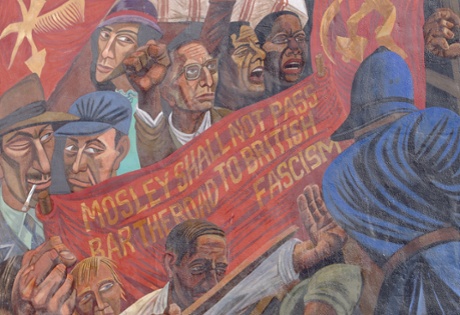
As the new leader of Her Majesty’s Opposition gears up for his first speech to the Labour Party conference in that role, here are some words he wrote to endorse a recently-published book called Rebel Footprints - A Guide to Uncovering London’s Radical History:
Anyone reading this will walk the streets of our city with a different view of the world, and what people can do when they act together.
The sentence captures the strand of the Labour Party to which Jeremy Corbyn, MP for Islington North, belongs: not so much the Labour Party as the wider Labour movement; not so much a parliamentary thing as a collective, grassroots thing with its own values, its own conventions and its own firm convictions about history.
David Rosenberg’s book is just as stoutly of that line. Reading it is, much like Corbyn’s astounding ascent, a rather nostalgic experience if, like me, you are old enough to remember when the word “Islington” was synonymous, not with Tony Blair and the self-satisfied “metropolitan elite” of Tory demonology, but with alternative theatre, musty left wing bookshops and, yes, bearded socialists.
Back then, some of the much older London stories Rosenberg tells - covering the 1830s to the end of the 1930s - were forever being told by lefties of that strain, usually in the upstairs rooms of pubs, with great reverence and a missionary desire to spread the word about great truths of the past that the Establishment preferred common folk not to know.
Here was the history they didn’t teach you in school with its deference to royalty and war. Here was the authentic, hidden history of ordinary peoples’ heroic dissent and their liberating discoveries of their own power in solidarity, even when its expression was harshly suppressed.
Rebel Footprints revisits such touchstone tales of the broad London Left’s enduring identity. It begins with Robert Peel’s newly-formed Metropolitan Police violently breaking up a workers’ rally against rising prices, unemployment and low pay held at Coldbath Fields where today stands Mount Pleasant Sorting Office (now the location for another kind of London power struggle).
A constable died, but an inquest jury defied the coroner’s direction to record a verdict of “willful murder”. The foreman, Rosenberg reports, described the behaviour of the police as “ferocious, brutal and unprovoked” and adds that “a cheering crowd carried the jurors through the local streets that night in a torch-lit procession.”
Ensuing pages escort us through the deep poverty of Bow, where thousands of East Londoners “slept rough or scrambled for places in shelters and lodging houses, mainly established by religious charities” but where landmark trade union battles were fought too, as well as closer to the City, in Spitalfields, with Jewish and Irish migrants to the fore.
Then we’re in Bloomsbury, coloured pink and red on Charles Booth’s 1889 map of poverty to denote “well-to-do-middle classes” where, to steal from Dorothy Parker, privileged radicals painted in circles, lived in squares and loved in triangles. Rosenberg, though, wants to reclaim Bloomsbury from its celebrated “Set”, documenting instead the endeavours of such as the Bloomsbury Socialist Society, whose members included Eleanor Marx, daughter of Karl. And, hey, did you know that Edith Nesbit, Fabian and author of The Railway Children, used to hang out there with her, and match girls’ strike leader Annie Besant and George Bernard Shaw?
Suffragette campaigns in Westminster get a chapter too, as do Bermondsey and Battersea, where Rosenberg takes me into historical territory I haven’t tramped through before, making introductions to, among others, local boy John Burns, the youngest of 16 children who went on to forge a Progressive Alliance of Labourites, Liberals and Radicals which conveyed him to parliament in 1892 and held local government power. Rosenberg describes Battersea at that time as “the beacon of municipal socialism in London.” Its Nine Elms neighbourhood was its poorest. Today, the same place name is synonymous with the pious satisfactions of being appalled by property porn.
Inevitably, Rebel Footprints draws to a close back in the East End, covering George Lansbury’s Poplar rates revolt and the 1936 Battle of Cable Street, perhaps the two events most frequently invoked for didactic and agitational effect among London’s present day protest milieu when they upbraid Labour boroughs - it’s always the poor, cash-strapped Labour ones they go for - for implementing government-imposed spending cuts or demolishing housing estates, or when demonstrating against the English Defence League.
Reaching these destinations in Rosenberg’s company stirs my heart’s old sympathies with the idealism of the radical Left but also my head’s familiar doubts about its grip on reality - the same mixture of feelings revived by Corbyn’s Labour leadership contest victory. Back in the days of “Islington Trendies” I moved among London’s Bennites, anarchists and Trots, but never join them. I liked their optimism, but was suspicious of some of their certainties. Could they ever hope to connect on any scale with an evolving working class whose interests they reckoned to represent, let alone anyone else?
These recollections might suggest a sniffy attitude to Rosenberg’s book. Not so. Like the late Bill Fishman, the distinguished historian of the East End whose memory Rebel Footprints is dedicated to, Rosenberg brings his London stories and their characters alive. He wants you to recognise their importance and to admire them. But he is wise to the dangers of sentimentalising them.
One of the many pleasures of his book is that its chapters are augmented with maps and walking routes, taking in streets and landmarks where events he describes occurred (he also leads such walks, which you can find out more about here). Rebel Footprints may stir an old ambivalence in me, but I still urge you to let Rosenberg take you on his London journey. His book is published by Pluto Press. You can buy it here.