They're only lines on a map, but they will profoundly shake up a state's politics.
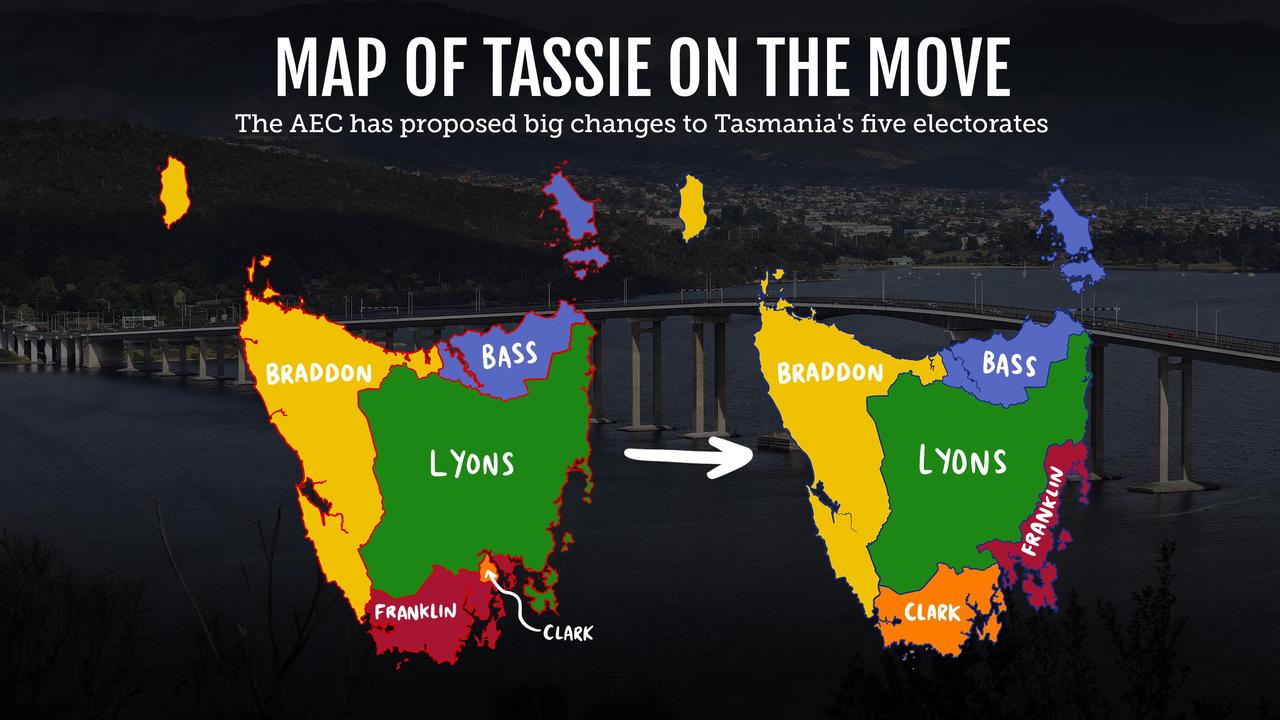
The Australian Electoral Commission is set to decide on new boundaries for Tasmania's five federal electorates, shifting more than a quarter of voters into a new political home.
The process is routine.
Redistributions, which allocate every part of Australia into an electorate, happen at least every seven years to ensure sizes don't get out of whack.
What makes a Tasmanian redistribution different is that the boundaries are also adopted at the state level.
And these are not small changes.
Political analyst Kevin Bonham has labelled the reforms the biggest in more than four decades.
Veteran campaigner Brad Stansfield says they are "radical in many respects".
"I don't think anyone was really expecting it," Mr Stansfield told AAP.
The major shift is around Hobart.
Under the proposal, the current inner-city seat of Clark would lose Hobart's working-class northern suburbs and expand south, becoming an urban-regional mix.
Franklin would represent Hobart's eastern shore and expand up the east coast, moving its border hundreds of kilometres north.
A third electorate, the sprawling and predominantly Lyons, is dragged into the mix, picking up Hobart's northern suburbs and making it another mix of bush and city.
The shake-up tilts the political calculus, making Clark less friendly to Labor, Lyons less supportive of Liberals, and crashing the Green vote in Franklin.
At the federal level, the changes are unlikely to tip out the three incumbents, given their healthy margins.
It gives Lyons MP Rebecca White - a rising star of the party - a headache as her home and political base is in Franklin, held by veteran Labor MP Julie Collins.
"There's a question about whether she might seek to relocate back to her home base and that could depend on what Julie does," Mr Stansfield said.

That dilemma is nothing compared to the pandemonium at the state level.
Tasmania's lower house elects seven members per electorate, meaning a few thousand votes often clustered around individual towns and suburbs can get an MP elected.
These changes tip several MPs into a different electorate from their key support bases, or their homes or offices.
Labor leader Josh Willie - a popular figure in Glenorchy, the northern suburbs of Hobart - has a tough call to make, having to choose whether he stays in Clark or branches out into Lyons.
Independent Clark MP Kristie Johnston, a former Glenorchy mayor, is another in a pickle.
Under the changes, her house and electorate office would be in Lyons, and her business - a Newtown pub that was smack-bang in the middle of Clark, would move its northern fringe.
"It's going to be interesting," Ms Johnston told AAP.
"I'll just continue to work for the people of Clark as it is, right up until it's not Clark any more."
Several MPs face the prospect of having to move seats, move house or move their offices to fit in with their new boundaries.
Like many, Ms Johnston hasn't decided where to run next, and in any case, the redistribution will not be final for a few months.
Given Labor and Liberal MPs run alongside and against each other in each electorate, there's the thorny issue of intra-party rivalries to consider too.
Several off-record conversations with party MPs, staff and supporters suggest the squeeze will be on in Clark.
Former Labor leader Dean Winter is set to shift from Franklin to Clark, as is Treasurer Eric Abetz and Greens leader Rosalie Woodruff.

Independent Peter George would also move, if not for a commitment to be a one-term MP.
"In the highly unlikely event I change my mind - and risk divorce - I'd stand in Clark," he told AAP.
That would mean at least nine sitting MPs competing for seven seats, along with a suite of fresh candidates, guaranteeing political carnage.
"It'll certainly shake things up," Mr Stansfield said.
"There is going to be a lot of seat-hopping going on ... some people might find themselves without a chair when the music stops."
Alternatively, there could be opportunity in Lyons.
Liberal Jane Howlett and Labor's Brian Mitchell are eyeing moves to Franklin, while Shooters, Fishers and Farmers MP Carlo Di Falco might follow.
Despite the tumult, the three main parties all support the redistribution, with the main opposition coming from a clutch of councils keen to redraw the lines.
The decision-makers are a panel that includes the Australian Electoral Commissioner, their Tasmanian equivalent and other officials.
On Thursday, the committee met in Hobart for a public hearing.
The lectern - open to anyone who wanted a word - was the fifth opportunity during the lengthy redistribution process giving the public a say.
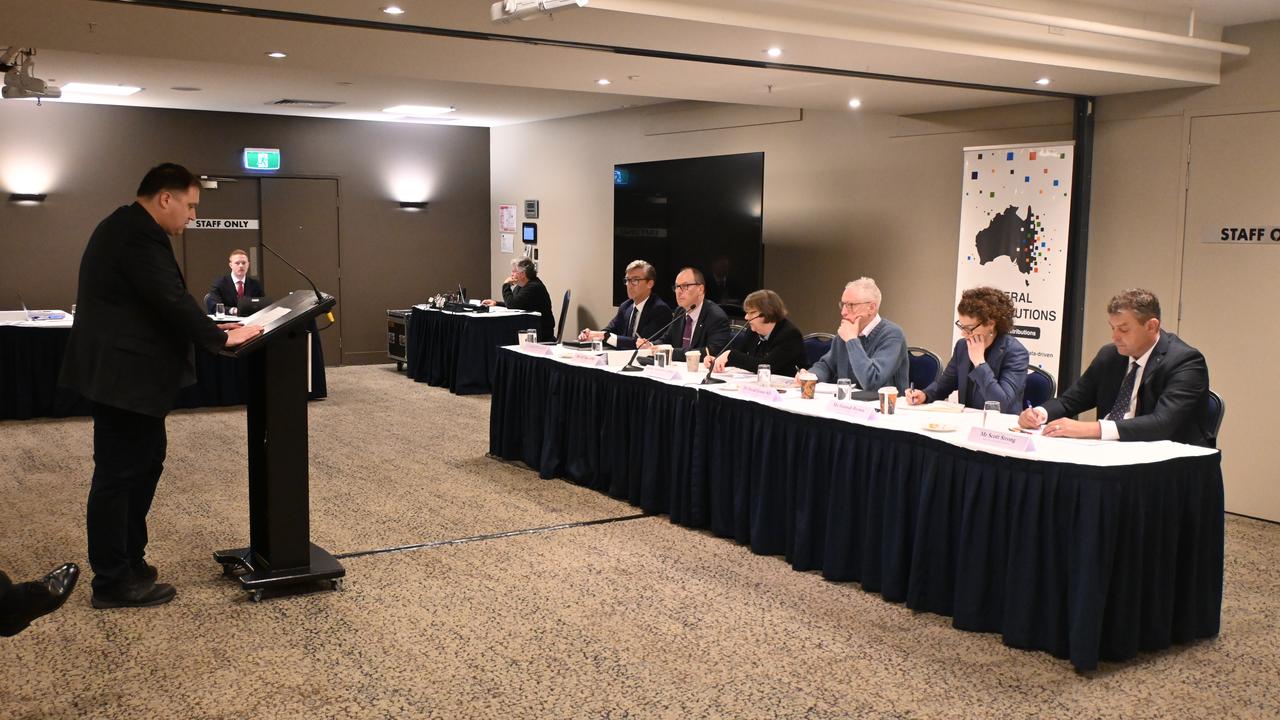
Each contribution was thoughtful, including a well-researched historian arguing to rename Franklin to Tongerlongeter, an Aboriginal warrior who led the resistance to British settlement in the early 19th century.
It was also profoundly unrepresentative, given every submitter was a man of a certain age and background.
The only women in the room appeared to be AEC employees, and an attempt to contact one by phone was abandoned after a few attempts, ending the hearing after eight short speeches.
"How often is a federal member actually going to make it to our neck of the woods?" said John Brown, the general manager of Break O'Day council, in the state's northeast.
Mr Brown and Break O'Day's mayor made the six-hour round trip to Hobart to make their point, arguing they should be part of Bass, the electorate based around their key regional centre of Launceston.
But even they conceded the redistribution was a zero-sum game.
"We know you've got a difficult task. We know you have to play the numbers," Mr Brown said.
"I don't envy you in your deliberations."