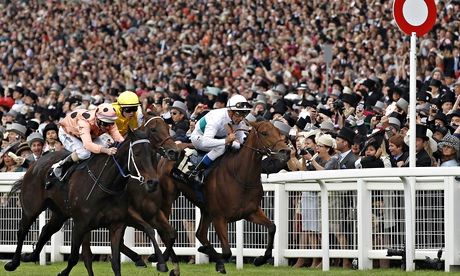
It attracted little attention inside the racing bubble, where there is a widespread belief that the sport is in a death spiral and we are all of us doomed, but when the Sports Business Group at Deloitte published a survey of 2014 attendance figures last week, it showed that racing is still, and by some way, second only to football in its popularity with British fans.
Rugby union, with 4.9m tickets sold, is making ground and will close the gap further next year thanks to the World Cup but cricket (2.2m), rugby league (2m) and motorsport (1.6m) can only dream about attracting the paying audience of nearly 6m people that will have been to the races in Britain this year. There is little that has not changed profoundly in the British way of life since organised horse racing started to emerge in the early 1700s but our love of a day at the track remains relatively intact.
Racing is also responsible for four of the year’s top 10 events in terms of attendance – Royal Ascot, Cheltenham, the Grand National Festival and the Derby meeting – and the Cheltenham Festival, which was in sixth place with 232,000 spectators over its four days, will hope to move up a rung or two from 2016 when its redevelopment is finished. At the top of the sport at least business is good and should, if the economy ever picks up, get better.
These four events and 14 days of racing alone, however, account for more than 800,000 spectators. Add in the Ebor meeting at York and Glorious Goodwood, which is nine more days, and the total is into seven figures.
Racing fans have always seen the sport as having two distinct codes, the Flat and National Hunt. The four entries in Deloitte’s top 10, though, are split between the two and, while the Flat has more big festivals, Cheltenham’s Open meeting is a rival for most of these. This year’s record attendance over the three days of the Open was 71,640, which is 11,000 more than the four-day St Leger meeting at Doncaster.
At the other end of the scale there are tracks staging race meetings which, for practical purposes, attract no one at all.
The lowest attendance of all in 2014, unless it gets collared at the post over the next fortnight, seems likely to be the 231 people who turned up at Wolverhampton on 1 February, all of whom should really receive a medal from the Racecourse Association to mark their devotion to racing in the raw. But there have been dozens more three-figure crowds over the year, at the all-weather tracks in particular. Lingfield, for instance, staged 24 midweek Flat meetings in the first three months of the year, with an average attendance – including complimentary tickets for owners – of 522.
The old division between Flat and jumps racing is now far less significant than the distinction between racing staged to attract a live, paying audience and racing staged to drive off-course betting. Some will prefer to see it as a contrast between “good” racing and “bookie fodder” but both serve important functions and both, in their own way, generate invaluable income for the sport. Betting turnover underpins the economy of every major racing industry in the world and the clue about one of its most important features is in the name. It needs to keep churning. It cannot be switched on and off.
Owners often ask, quite reasonably, where racing would be without them. Racecourses, meanwhile, point out how much of British racing’s enduring popularity is thanks to its famous venues and the efforts of tracks like Ascot and Cheltenham to grow their audiences.
But the whole billion-pound shebang would be nowhere at all without customers: the people who stump up for the six million tickets annually and those who never venture to the track but keep betting all year round. What they want to keep them happy – the most competitive racing possible, in essence, because it is more exciting to watch and more fun to bet on – should be the primary consideration in every major choice and decision.
Instead the sport’s main factions seem to focus only on what is good for them. If they could only learn to put the customers first, the bubble might be good for another 300 years.