As a child of the 80s who could never get past the bit in Threads where the petrified woman soils herself in Sheffield city centre, I’m not naturally drawn to the terror-inducing subject of nuclear war/energy/other. But BBC4 Goes Nuclear, a season marking the 70th anniversary of the Hiroshima bombing, promises a realistic discussion about atomic energy and I’m 40 now, so it’s probably time I got to grips with a subject that would usually send me running for the remote.
Part of that season, Race For The World’s First Atomic Bomb: A Thousand Days Of Fear (BBC4) tells the story of the scientists at the Los Alamos facility in New Mexico who secretly raced Hitler to produce the bomb that would end the second world war. Again and again, the narration reminds us that the horrific act of burning thousands of Japanese civilians “ended the war”. Precious little time is given over to the direct consequences of that action. All the talk here is of science, the personalities involved and the strangely mundane details of life at the secret research facility in the New Mexico desert.
The Manhattan Project was lead by General Leslie Groves and heading up the theoretical division was Robert Oppenheimer, the obvious Cumberbatch role when the inevitable biopic is made. This story of some 6,000 people brought together in a makeshift town, along with a clutch of Nobel prizewinners debating their research is so obviously cinematic; one of them even turned out to be a Soviet agent who passed vital information to the enemy.
While the bomb-makers worked, affairs were had, children were born and misinformation was spread among the locals of Santa Fe who grew curious about what was happening behind the barbed wire. If they had known the ridiculously dangerous conditions under which the scientists worked – the slip of a screwdriver precariously wedged between two hemispheres resulted in an instantly fatal dose of radiation for those nearby – they might have protested against the US government’s decision to bring such a threat to their doorstep.
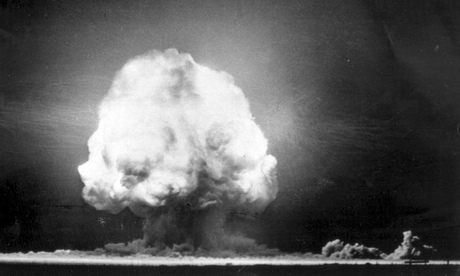
In 1945, on the date of the first bomb test in New Mexico, President Harry Truman met with Stalin and Churchill, while the US scientists huddled just 10 miles away from the test site, backs turned (as if that made any difference), waiting to see what would happen. Those present said the light of the blast competed with the sun itself.
Little is said in this documentary about the moral implications, but they do cut back twice to the famous footage of Oppenheimer quoting solemnly and, it seems, tearfully, from the Bhagavad Gita: “Now I am become death, the destroyer of worlds.” His lip quivers and his eyes are cast down like a man who has confronted his part in all of this. That moment aside, the tone of the narration and frequent references to the crucial mechanism as “the gadget” are unnerving in their understatement. “The bomb saved lives,” concludes the final speaker as the credits roll. Ultimately it has to be a numbers game, because the reality of those burning bodies is too horrific to countenance.
The most affecting thing I’ve seen on this subject is the Newsround special commemorating Hiroshima on CBBC. It features a five-minute animation reminiscent of Studio Ghibli’s finest, recalling the story of Hiroshima survivor Bun Hashizume, and conveys the other side of this story with intelligence and real feeling. It should be garlanded with every award going; the complete antidote to the coldly scientific nature of Monday’s offering.
Despite my almost pathological nuclear fear, I did once go on a tour of Sellafield, determined to confront the irrational dread left over from a childhood blighted with memories of Chernobyl and the aforementioned Threads. The visitors’ centre, with its jaunty cartoon atoms, cheerfully depicting fission, and the bus tour around the perimeter of the reactor, did little to convince me I wasn’t going to end up like Bob Peck in Edge of Darkness.
I wish I’d gone there with Jim Al-Khalili, whose Britain’s Nuclear Secrets: Inside Sellafield (BBC4), part of the same season, got the exclusive backstage tour that none of us are usually permitted. “It’s eerie being so close to something so deadly,” he grins, Geiger counter going quietly nuts in one hand as he gestures to the reactor wall with his other. Al-Khalili explains everything from the original principles of atomic power to its future applications with his usual clarity, never once patting the collective head or aiming clear over the top of it. In short he’s the kind of reassuring presence you would want around in the event of a nuclear disaster.