As the child of Asian immigrants my understanding of what constitutes an average Australian household was gleaned from 90s television shows such as Hey Dad..! and Round the Twist. Lives spent in pleasant, suburban neighbourhoods, with parents who regularly embraced their children and dinners of “meat and three veg” all felt foreign to me. The households of my white friends seemed relatively like those on TV, while mine was remarkably different. There were no pop culture references to understand it.
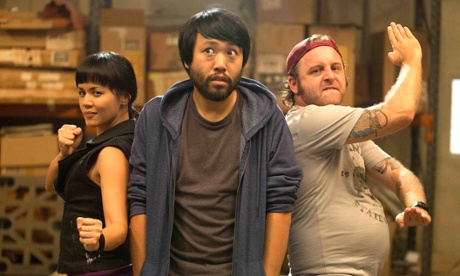
So it’s with a deep sense of Asian pride that I’m enjoying ABC2’s six-part kung fu comedy Maximum Choppage. Finally here is a show I can relate to, albeit 30-odd years too late.
Set in Cabramatta, a Sydney suburb known for its large Asian population, the show centres around Simon Chan (played by thecomedian Lawrence Leung). Friends and neighbours believe Simon has just returned from a martial arts school in Beijing – in fact he was attending Marshall’s art school in Melbourne. The show follows our hapless protagonist as he battles a corrupt mayor, who has enlisted gangs to scare out local businesses and make way for a new multi-level car park. The town, along with Simon’s mother, rally behind their heaven-sent hero.
Maximum Choppage is undeniably groundbreaking – in an act of “soft power” it puts a new spin on a working-class suburb better known for its history of drugs and gangs. White characters take a back seat to Asian leads: the show’s real hero is an Asian female; there’s a male Asian character with a white girlfriend; and the token dork is a white character with an Asian fetish called Egg (white on the outside, yellow on the inside). With its purported 90% Asian Australian cast, the show is both a breath of fresh air for Asian actors and a welcome change to the monoculture that is Australian television.
While the show does an admirable job of exposing national audiences to Asian Australian culture, it also indulges in a few cringe-worthy oriental stereotypes. In the first episode the characters sing a bad karaoke rendition of Kung Fu Fighting; the “tiger mother” speaks in a heavy accent (“kill dem!” is one of her catchphrases); and there’s a character called Le Bok (like Reebok – supposedly Asians can’t say their Ls properly) who employs children to make sneakers. When we poke fun at a culture we’re trying to portray are we perpetuating stereotypes?
Maximum Choppage is not the only show to use comedy to represent culture and delve into racial themes. Fat Pizza, Legally Brown, Black Comedy and the web series How to Talk to Australians all feature casts of ethnic-minority Australians poking fun at themselves. In Legally Brown the comedian Nazeem Hussain takes comic advantage of his religion, skin colour and ethnicity. In pranks he pretends to be a famous Indian celebrity (signing autographs for those gullible enough to fall for his trickery) or dresses like a terrorist then goes around kissing babies.
But such jokes can often miss the mark. When Chris Lilley’s Jonah from Tonga aired in 2014, the show divided Australia’s Pacific Islander community – many deemed it offensive, racist and degrading, though younger audience members were more inclined to enjoy the show. Perhaps the issue was that with so few shows portraying Polynesian culture, the burden of representation came heavy. The fact that Lilley was a white actor posing in brownface didn’t help much.
It’s time we moved forward. In the US shows such as How to Get Away with Murder, Black-ish and Empire feature multicultural casts and complex, dramatic characterisation. While some have seen their stories twisted to suit a more mainstream audiences – a complaint made by the Chinese American Eddie Huang, whose memoir Fresh Off the Boat was turned into an eight-part series – the networks are to be congratulated for taking a chance. (It’s prompted one TV writer to complain that the influence of these shows have made it harder for white actors to land roles.)
While diversity is gradually being introduced to Australian commercial television, it remains tokenistic: chefs on reality programming, a few non-white cast members on Big Brother and the occasional role in a TV drama. True screen diversity requires support for artists who reflect this country’s cultural diversity – support to create their own work and, more importantly, control it. Redfern Now, the first drama series written, directed and produced by Indigenous Australians is an excellent example of this.
Humour is a great way of injecting Australian television with some much-needed diversity. Too much of it only leads to enforced stereotypes, no matter how intelligently they’re being riffed upon.
• The final episode of Maximum Choppage airs on 31 March on ABC2