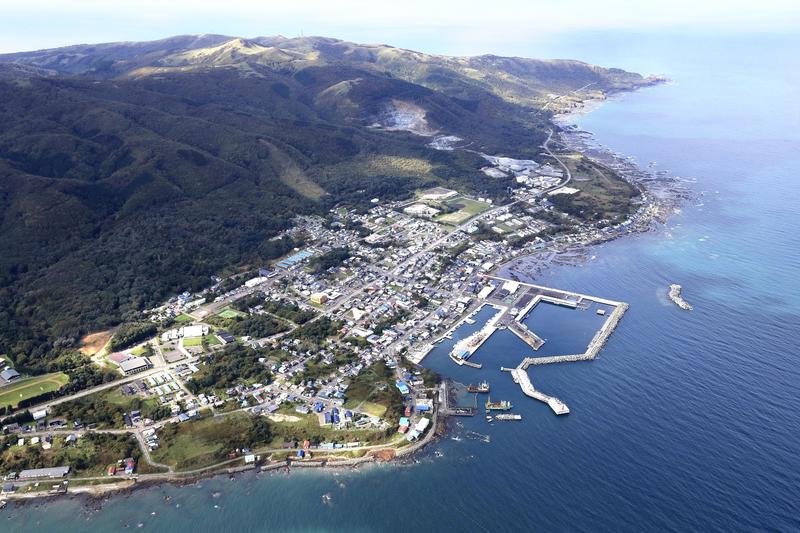
A longstanding standoff over the issue of nuclear waste generated by nuclear power plants has taken a step forward, with two Hokkaido municipalities seeking to start procedures to host a final disposal site.
On Friday, Suttsu in Hokkaido officially filed an application with the central government for a survey to study the viability of locating a final waste repository in the town. The Hokkaido village of Kamoenai is also expected to follow suit soon.
The central government plans to seek applications also from other local governments. However, there has been strong opposition, particularly from residents. Prospects for selecting a final disposal site remain unclear.
-- Concerns over future
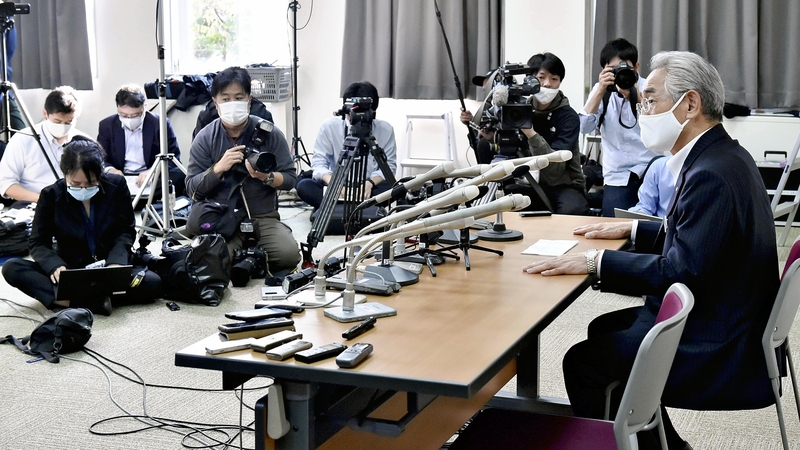
At a press conference to announce the town's plan on Thursday, Suttsu Mayor Haruo Kataoka, 71, repeatedly stressed the need to accelerate discussions on nuclear waste.
"My judgment isn't wrong," Kataoka said, indicating his intention to push ahead with the study related to disposal sites without preconceptions.
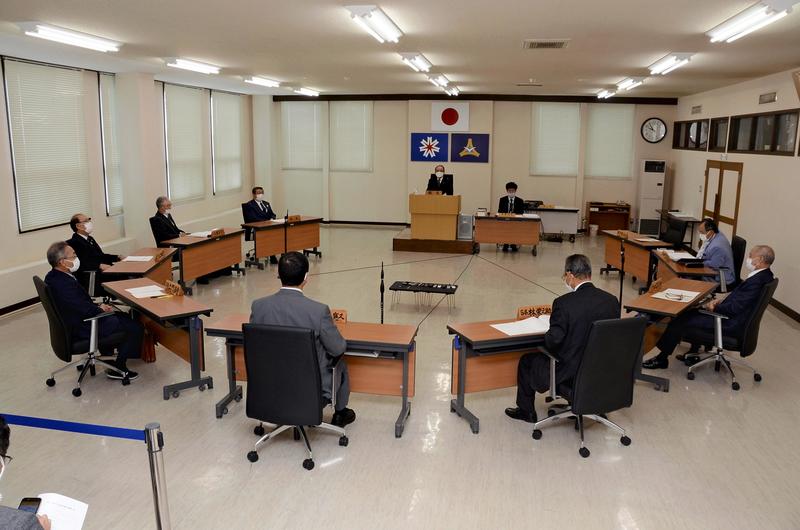
About 1-1/2 hours before the press conference, Masayuki Takahashi, 70, mayor of Kamoenai which is about 40 kilometers away from Suttsu, expressed his intention to "respect the result," referring to the village assembly's adoption of a petition to accept such a survey.
The town and village, both of which are located in western Hokkaido and whose main industry is fishing, share concerns over the future.
Population decline is showing no sign of slowing down in Kamoenai, which has a population of about 820, and Suttsu, about 2,900. As tax revenues have fallen, "subsidies of up to 2 billion yen that can be obtained just by applying for the survey are attractive," a source familiar with the matter said.
-- Prefecture cautious
However, the survey will be conducted in three stages before a final disposal site is selected. All of the procedures will take about 20 years to complete, including two years for a bibliographic survey to study data and documents, four years for an outline survey to check geographical features, and 14 years for a detailed survey.
"I won't be alive [when the process ends]," Kataoka said.
Before the survey can proceed to the next stage, the prefectural governor's de facto consent will be required. However, Hokkaido Gov. Naomichi Suzuki has maintained a cautious stance on the matter. Another major challenge is a Hokkaido ordinance expressing a stance against accepting high-level radioactive waste.
Some Suttsu and Kamoenai residents have already voiced strong opposition. Moves indicate both municipalities are considering holding referendums on the issue. As Kataoka himself has remarked that "subsidies are one of the reasons" for applying for the survey, some members of the central government have raised questions about his seriousness.
-- Uninhabited island plan
The central government began seeking applications for hosting a final disposal site based on the Designated Radioactive Waste Final Disposal Law, which was enacted in 2000. The town of Toyo, Kochi Prefecture, announced its candidacy in 2007, but the bid was aborted due to fierce opposition from residents.
In 2015, the central government introduced a system through which local governments were asked to apply for surveys to be conducted to be chosen as disposal site hosts, but discussions on the location of such facilities remained stalled. As a result, the central government is also calling on other local governments, in addition to Suttsu and Kamoenai, with the aim of eventually selecting a site from among about 10 municipalities. There is also a plan to include an uninhabited island as a candidate site.
The central government is using Canada as a model case for selecting a disposal site. Last autumn, Canada narrowed its list of candidates from more than 20 to two, a process that took about a decade. The matter will be carefully considered over a long period of time in Japan, too.
However, this is a race against time.
The volume of spent nuclear fuel generated in Japan by such facilities as nuclear power plants is equivalent to about 26,000 pieces of vitrified glass logs, in which radioactive waste is immobilized at final disposal sites.
The central government's plan for a final repository has a capacity of about 40,000 logs. The current figure has already exceeded more than half of the planned volume.
Waste equivalent to about 2,500 logs has been stored at such locations as the High-Level Radioactive Waste Storage and Management Center in Rokkasho, Aomori Prefecture. However, such facilities are regarded as temporary storage facilities.
The waste is supposed to be transported out of prefectures within 50 years. The first batch will have to be transported by 2045. By that time, the central government and utility companies will need to have a final repository in operation. They cannot afford to delay the selection process.
Read more from The Japan News at https://japannews.yomiuri.co.jp/