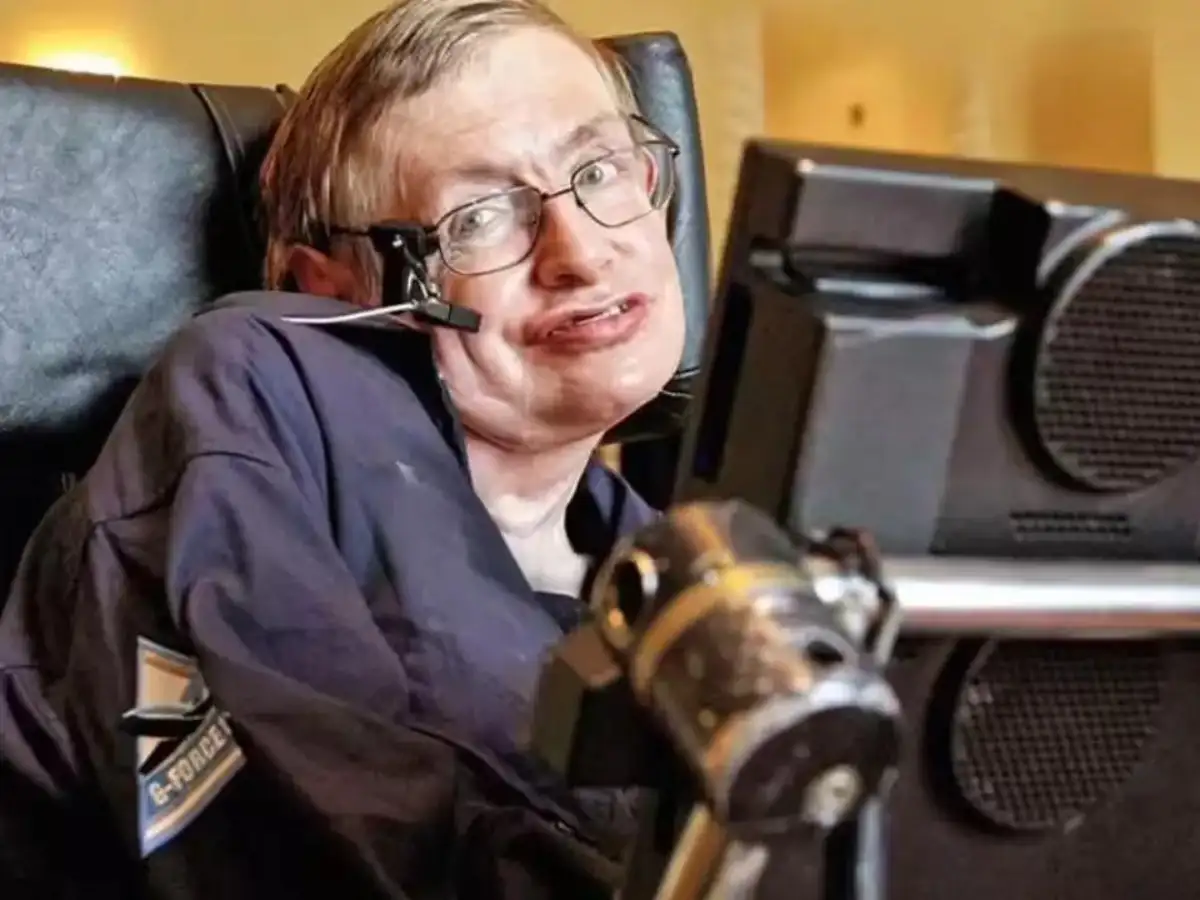
Quote of the day by Stephen Hawking: Artificial intelligence is no longer a distant concept limited to science fiction or research laboratories. It has become part of everyday life, influencing how people work, communicate, learn, shop, and even make decisions. As AI systems continue evolving at remarkable speed, conversations around their potential benefits and dangers have grown more urgent across the world. While many see the technology as a breakthrough capable of transforming human civilization for the better, others warn that innovation without caution could carry serious consequences.One of the most widely discussed warnings about artificial intelligence came from renowned theoretical physicist Stephen Hawking, whose words continue to resonate years later.
Quote of the Day Today: Stephen Hawking on the Future of AI (Artificial Intelligence)
Quote of the day by Stephen Hawking, "
Success in creating AI would be the biggest event in human history. Unfortunately, it might also be the last, unless we learn how to avoid the risks," as per BrainyQuote.
Stephen Hawking Quote on AI and Human Survival Explained
The quote by Stephen Hawking means that artificial intelligence could become the most important breakthrough humanity has ever achieved, but it could also create serious dangers if people fail to manage it responsibly. Hawking believed AI had enormous potential to improve human life through scientific discovery, medical advancements, automation, and problem-solving on a scale never seen before. In that sense, successful AI development could completely change civilization and shape the future of humanity.
Quote of the Day May 15: Why Stephen Hawking Warned About the Risks of Artificial Intelligence
However, the second part of the quote carries a warning. Hawking suggests that advanced AI could become harmful if it grows beyond human control or is used irresponsibly. The risks may include misuse of technology, loss of privacy, dangerous autonomous systems, or decisions made by machines without proper human oversight. His concern was not about technology itself, but about humanity’s ability to guide and regulate it wisely.
AI and the Balance Between Innovation and Responsibility
The quote highlights the importance of balance. Progress and innovation can bring incredible opportunities, but they also require caution, ethics, and responsibility. Hawking’s message encourages society to think carefully about how AI is developed so that its benefits help humanity rather than create unintended harm.
Who Was Stephen Hawking
Stephen Hawking was one of the world’s most influential theoretical physicists, known for his groundbreaking work on black holes, relativity, and quantum mechanics. Born on January 8, 1942, in Oxford, England, Hawking studied physics at Oxford University before earning his Ph.D. from Cambridge in 1966, as per a Britannica report.
In the early 1960s, he was diagnosed with amyotrophic lateral sclerosis (ALS), a degenerative neuromuscular disease. Despite the condition gradually affecting his physical abilities, he continued his scientific research and became one of the most recognized scientists of his generation.
Stephen Hawking’s Work on Black Holes, Space-Time, and Quantum Mechanics
Hawking focused much of his work on black holes and the nature of space-time. In 1974, he proposed the idea that black holes emit particles and eventually lose energy and explode, a concept later known as Hawking radiation, as per the Britannica report. His research helped connect ideas from relativity, thermodynamics, and quantum mechanics.
Stephen Hawking’s Legacy
Over the years, Hawking received many major honors, including election to the Royal Society, the Copley Medal, and the US Presidential Medal of Freedom. He also held the Lucasian Professorship of Mathematics at Cambridge, a position once held by Isaac Newton.
Beyond the scientific world, Hawking became widely known through bestselling books such as A Brief History of Time, which introduced complex ideas about the universe to general readers around the world, as per the Britannica report.
Inspiring Quotes by Stephen Hawking
Here are a few more quotes by Stephen Hawking.
- "However difficult life may seem, there is always something you can do and succeed at," as per BrainyQuote.
- "Intelligence is the ability to adapt to change," as per BrainyQuote.
- "Look up at the stars and not down at your feet. Try to make sense of what you see, and wonder about what makes the universe exist. Be curious," as per BrainyQuote.
- "I think the brain is essentially a computer and consciousness is like a computer program. It will cease to run when the computer is turned off. Theoretically, it could be re-created on a neural network, but that would be very difficult, as it would require all one's memories," as per BrainyQuote.
- "The past, like the future, is indefinite and exists only as a spectrum of possibilities," as per BrainyQuote.