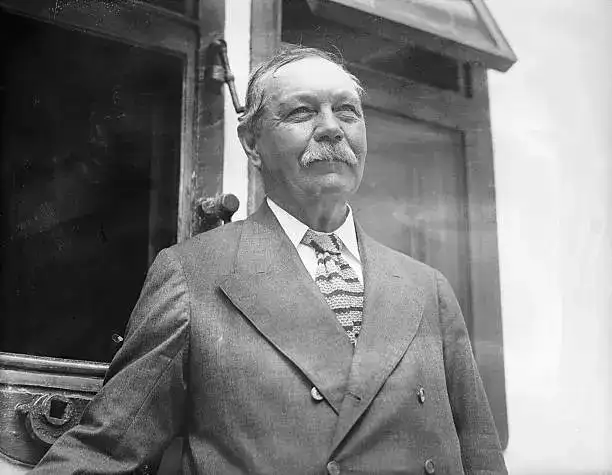
Quote of the Day: Arthur Conan Doyle remains one of literature's most fascinating contradictions: a rigorously trained physician who championed fairies, a man of science who devoted his final years to séances, and a storyteller whose fictional detective prized cold logic above all else while his creator chased ghosts across continents. Born in Edinburgh 167 years ago today, Conan Doyle built his career on observable evidence and diagnostic precision, yet spent his fortune pursuing proof of the afterlife. He gave the world Sherlock Holmes, that temple of reason housed at 221B Baker Street, then publicly defended photographs of pixies frolicking in an English garden. This tension between the empirical and the ethereal defined both the man and his work, lending his fiction an unusual psychological depth and his life an air of restless searching.
Quote of the Day
The line appears in A Scandal in Bohemia , the first of the short stories featuring Holmes, published in The Strand Magazine in 1891. It is delivered by the detective himself as he explains why Irene Adler, "the woman," as Watson famously calls her, outwits him. Holmes has deduced where Adler hides a compromising photograph; he is certain she will rush to retrieve it once threatened. She does. And then she vanishes, letter in hand, having anticipated his every move.
Quote of the Day Meaning
On the surface, the remark sounds patronising, a product of Victorian assumptions about feminine guile. Yet within the narrative it functions as something closer to grudging admiration. Holmes, accustomed to reading the world like an open ledger, discovers a mind whose pages he cannot turn. Adler keeps her own counsel, trusts her own judgement, and executes her own plan, without male assistance or approval. The word "secreting" carries a double charge: it suggests both concealment and the biological act of producing something from within. Women, Holmes implies, generate their own hidden strategies rather than borrowing them.
Conan Doyle understood secrecy. His mother, Mary Foley Doyle, maintained a lodger, Dr Bryan Waller, whose precise relationship to the family remained discreetly unspoken; biographers still debate it. His first wife, Louisa Hawkins, suffered from tuberculosis for over a decade while Conan Doyle quietly fell in love with Jean Leckie, a passion he kept chaste and largely secret until Louisa's death in 1906. Secrets, in his experience, were rarely sinister. They were survival, dignity, private architecture.
The quote also illuminates his ambivalence toward his most famous creation. Holmes embodies transparency: every clue decoded, every motive laid bare. Yet Conan Doyle himself hid from the detective's shadow, resenting how the public's appetite for Holmes eclipsed what he considered his finer work, the medieval pageantry of The White Company , the Napoleonic swagger of Brigadier Gerard. He tried to kill Holmes at Reichenbach Falls in 1893. Public outcry forced a resurrection. The detective, it turned out, had secrets of his own: he had merely feigned death.
The Spiritualist Crusade
After 1918, Conan Doyle poured his energy and earnings into spiritualism. He believed the war dead, including his son Kingsley, who died in the influenza pandemic following wounds sustained at the Somme, could communicate through mediums. Critics, including his former friend Harry Houdini, accused him of credulity. Fellow spiritualists winced when he endorsed the Cottingley fairy photographs, images later admitted to be fakes. Yet Conan Doyle never wavered. For a man who had spent his youth cataloguing observable symptoms, the leap into the unseen was perhaps less contradiction than continuation: a search for evidence of survival, conducted with the same fervour he once brought to diagnostics.
His funeral in 1930 reflected this conviction. Mourners were encouraged to celebrate, not grieve. A week later, thousands packed the Royal Albert Hall for a séance at which a medium claimed to have reached Sir Arthur on the other side. Whether he answered remains, fittingly, a secret.
A Legacy of Contradictions
More than 90 years after his death, Conan Doyle’s influence remains enormous. Sherlock Holmes continues to inspire films, television adaptations, novels and modern detective dramas around the world. The character’s methods shaped generations of fictional investigators and even influenced forensic storytelling itself.
But Conan Doyle’s lasting importance goes beyond detective fiction. He understood that human beings are puzzles filled with contradictions. Logic may solve crimes, but emotions often explain them.