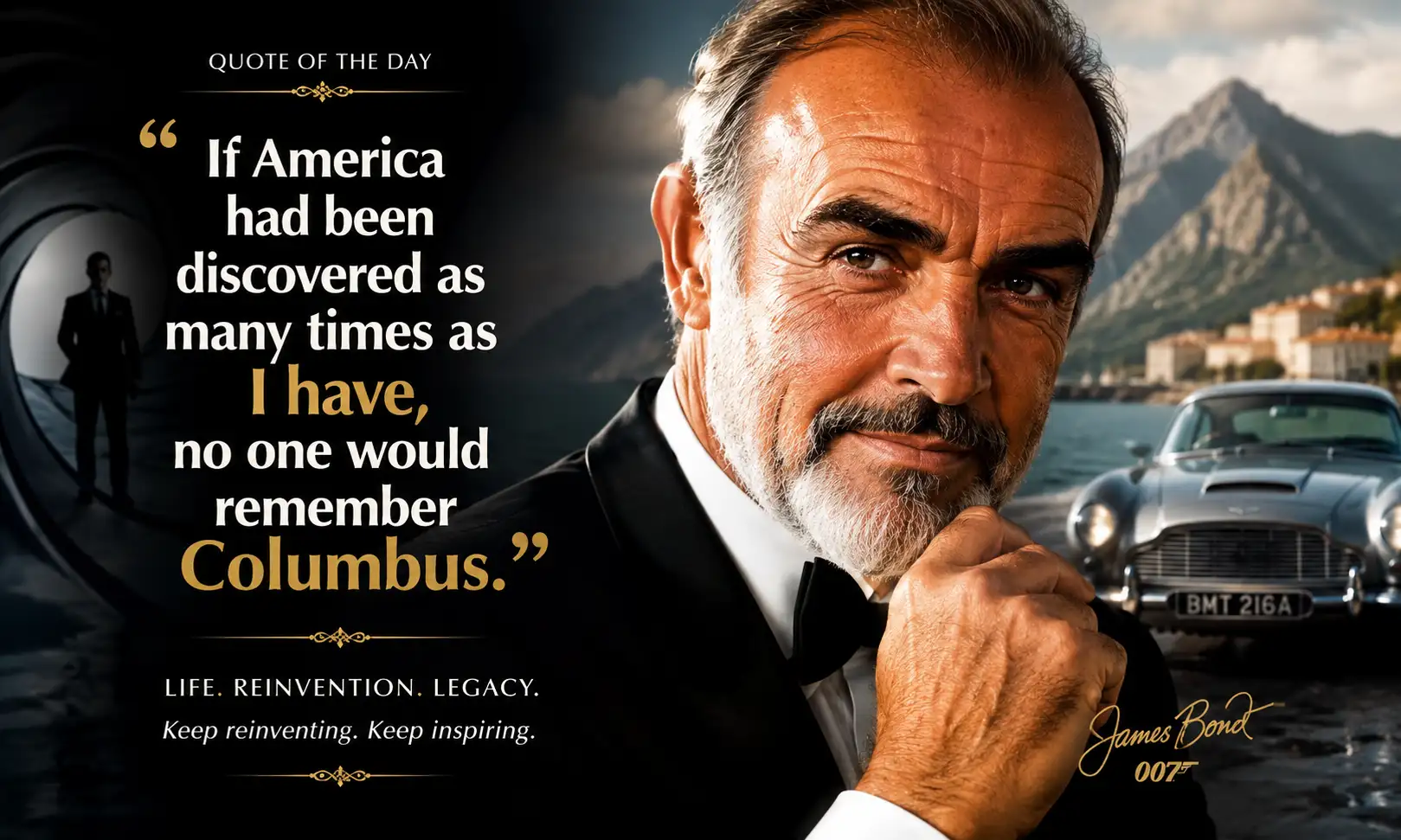
Quote of the Day: "If America had been discovered as many times as I have, no one would remember Columbus." — Sean Connery
There's a particular kind of wit that only arrives after decades of weathering other people's opinions. Sean Connery had it in abundance. This line—delivered with the dry precision he brought to everything—isn't simply a joke about fame. It's a meditation on overexposure, on what happens when greatness becomes so routine it starts to feel ordinary.
Columbus discovered America once, and history immortalized him. Connery, by contrast, was "discovered" over and over—cast, recast, typecast, reborn, dismissed, and celebrated again across six decades. Each reinvention should have felt miraculous. Instead, it became expected. The quote captures that strange paradox: sometimes being extraordinary too many times is its own curse.
There's also something quietly defiant here. Connery is not complaining. He's observing, with a raised eyebrow, the absurdity of how we measure greatness. Columbus gets a day. Connery got James Bond, Indiana Jones's father, a Russian submarine commander, and an Oscar—and still had critics asking whether he was past his prime.
The genius of the line is that it flips the power dynamic. He's not bitter about being underestimated. He's amused by it.
Quote of the Day by Sean Connery Meaning
To truly grasp the weight of Connery's words, we have to look past the charming bravado. He was addressing the double-edged sword of typecasting and public perception. After skyrocketing to global fame as the definitive James Bond in Dr. No (1962), Connery found himself trapped in a golden cage. The public didn't want Sean Connery; they wanted 007.
Breaking free required immense friction. He walked away from a massive franchise, risked financial stability, and took gritty, unglamorous roles in films like The Offence and Zardoz . When he spoke of being "discovered" multiple times, he was referring to the grueling process of forcing critics and audiences to see his depth as an actor, culminating in his 1988 Academy Award for The Untouchables .
Psychologists refer to this struggle as managing "identity foreclosure"—a state where an individual settles on a identity before exploring other options. Connery refused to let Hollywood finalize his identity. His quote highlights the difference between an inheritance of fame and a lifetime of earned relevance. Columbus stumbled upon a destination by accident; Connery charted his course through deliberate, calculated transformation.
Who Was Sean Connery, and Why Did He Keep Getting Rediscovered?
Thomas Sean Connery was born in 1930 in Edinburgh, Scotland, into a working-class family. His father drove a lorry. His mother cleaned houses. He left school at thirteen. By his early twenties, he had worked as a milkman, a laborer, and a part-time model before theatre gave him a direction.
When he was cast as James Bond in 1962, the producers hesitated. Ian Fleming, who created Bond, reportedly thought Connery looked like a lorry driver. He wasn't polished enough. He wasn't the right class. He became, instead, the definitive Bond—one every subsequent actor has been measured against for sixty years.
But Connery's career doesn't fit neatly into a single chapter. After Bond, he spent years fighting to be seen as more than a tuxedo and a raised eyebrow. He took risks—strange films, difficult roles, projects that failed. Then came The Name of the Rose in 1986, The Untouchables in 1987 (which finally brought him an Academy Award), and Indiana Jones and the Last Crusade in 1989. Three different reinventions in four years. Each one felt like a discovery.
The pattern repeated throughout his life. Critics would write him off. Then he would appear in something unexpected and redefine himself again. He retired quietly in the early 2000s and died in 2020 at ninety, having never fully stopped surprising people.
Why Do We Underestimate People Who Reinvent Themselves?
Connery's quote touches something deeper than personal biography. It points to a flaw in how we process remarkable people.
Psychology offers a useful concept here: the habituation effect . When something remarkable happens repeatedly, the brain stops registering it as remarkable. The first extraordinary performance earns awe. The tenth earns expectation. The twentieth earns impatience. This is why child prodigies so often struggle—not because their talent fades, but because the audience has already normalized it.
Columbus gets credit partly because discovery was a singular event. There was no second voyage that overshadowed the first. But someone like Connery, who delivered across fifty years and dozens of performances, found that each triumph diluted the perceived value of the ones before it.
There is also a class dimension worth acknowledging. Connery never lost his Edinburgh accent—not even as Bond, despite producers initially objecting to it. In an industry that has always valued a certain kind of polish, his refusal to sand down his origins was itself a kind of quiet rebellion. Perhaps some of the underestimation he experienced throughout his career carried the residue of where he started.
What Can We Learn From Connery's Perspective on Fame and Longevity?
The life lesson embedded in this quote is not cynical. It's clarifying.
Connery is telling us that the world has a limited appetite for sustained excellence. Society prefers a single watershed moment—a discovery, a debut, a breakthrough—over the accumulating weight of consistent reinvention. It is easier to celebrate a beginning than a career.
This matters because most meaningful work looks more like Connery's life than Columbus's. It arrives in iterations. It gets dismissed, revised, rediscovered. The people who last longest are not necessarily those who had the most spectacular debut, but those who had the stubbornness to keep going after the world assumed they were finished.
There's something worth sitting with in his wry tone. He's not asking for more credit. He's not resentful. He seems to find the whole thing slightly funny—which might be the most useful response available to anyone who has spent decades doing serious work in public.
Greatness, Connery suggests, is partly the willingness to be rediscovered without needing the fanfare of a first arrival every time. Columbus only had to do it once. The harder feat, it turns out, is doing it again and again, with nobody quite noticing how extraordinary that is.
Sean Connery (1930–2020) was a Scottish actor and producer, widely regarded as one of the greatest film actors of the 20th century. He won the Academy Award for Best Supporting Actor for The Untouchables in 1988.