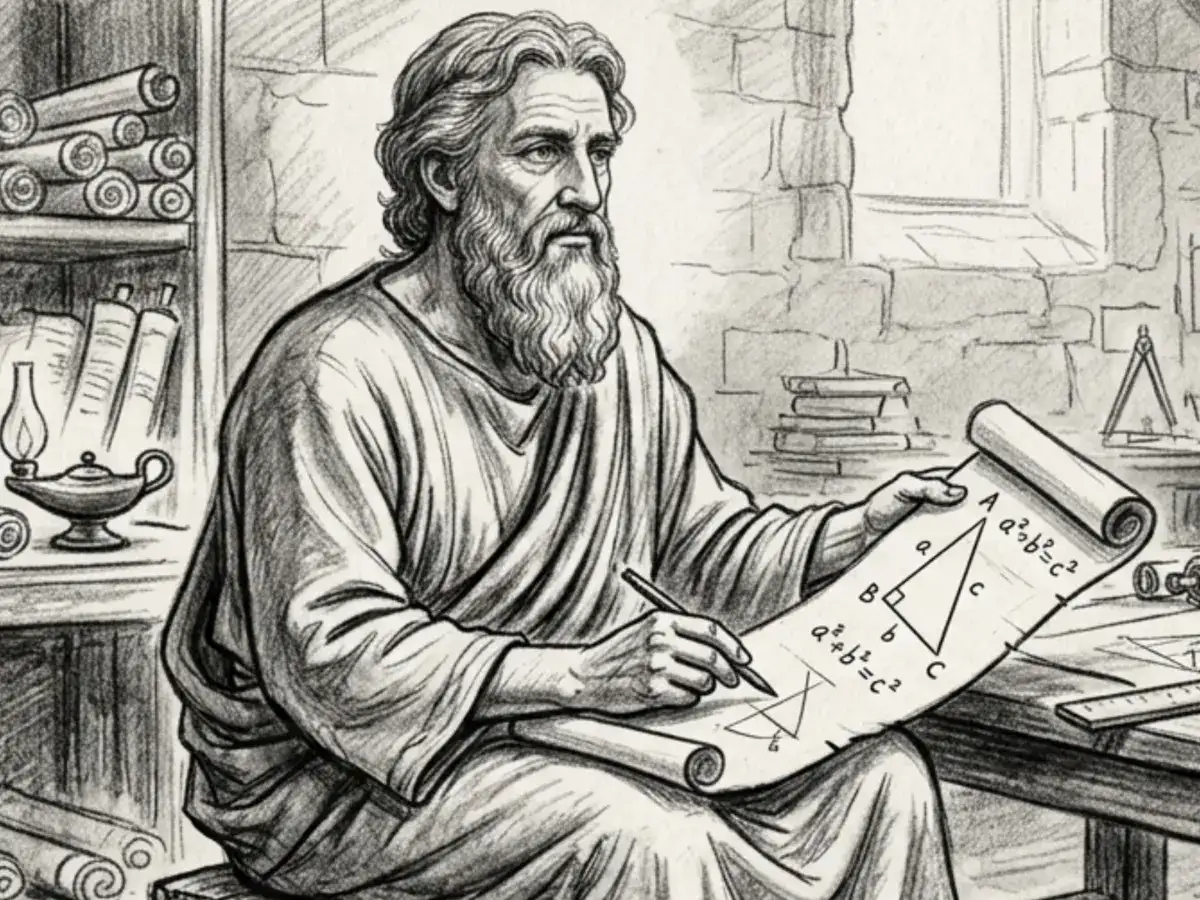
Quote of the Day: Pythagoras, the ancient Greek philosopher and mathematician, is remembered not only for his groundbreaking contributions to mathematics but also for his profound reflections on the soul and human character. His quote, “Choose rather to be strong of soul than strong of body,” highlights his belief in the primacy of inner strength over physical power. Born around 570 BCE on the island of Samos, Greece, Pythagoras traveled widely, studying in Egypt and Babylon before settling in Croton, southern Italy, where he founded a philosophical and religious school.
He emigrated there around 532 BCE to escape Samos’s tyrannical rule and established an ethico‑political academy that shaped generations of thinkers. His legacy spans mathematics, where he is associated with the Pythagorean theorem; philosophy, where he introduced the idea that numbers underpin the universe, influencing Plato and Aristotle; music and cosmology, where he developed theories linking mathematics to harmony and the “music of the spheres”; and religion, where he advocated for the immortality and transmigration of the soul.
Together, these achievements reflect a life devoted not only to intellectual discovery but also to the cultivation of moral and spiritual strength, making his words about the soul’s resilience as relevant today as they were more than two millennia ago.
Quote of the Day by Pythagoras: “Choose rather to be strong of soul than strong of body”
Pythagoras Quote: Context, meaning and interpretation
The quote reflects Pythagoras’s emphasis on moral and spiritual development over physical prowess, as he and his followers lived ascetic, disciplined lives that valued wisdom, virtue, and inner purity.
In this context, the quote underscores the belief that true resilience lies in the soul’s strength rather than bodily might, with being strong of soul meaning the cultivation of wisdom, self‑control, justice, and compassion, while being strong of body refers to physical fitness and power, which are temporary and limited.
The message suggests that inner strength endures beyond physical decline, guiding moral choices and resilience in adversity, reminding us to prioritize character over appearance by investing in virtues like honesty, courage, and empathy. It teaches that resilience comes from within, that balance is key, physical health matters but should serve the higher goal of nurturing the soul, and that in today’s world of fitness culture and external validation, inner integrity remains the true measure of strength.