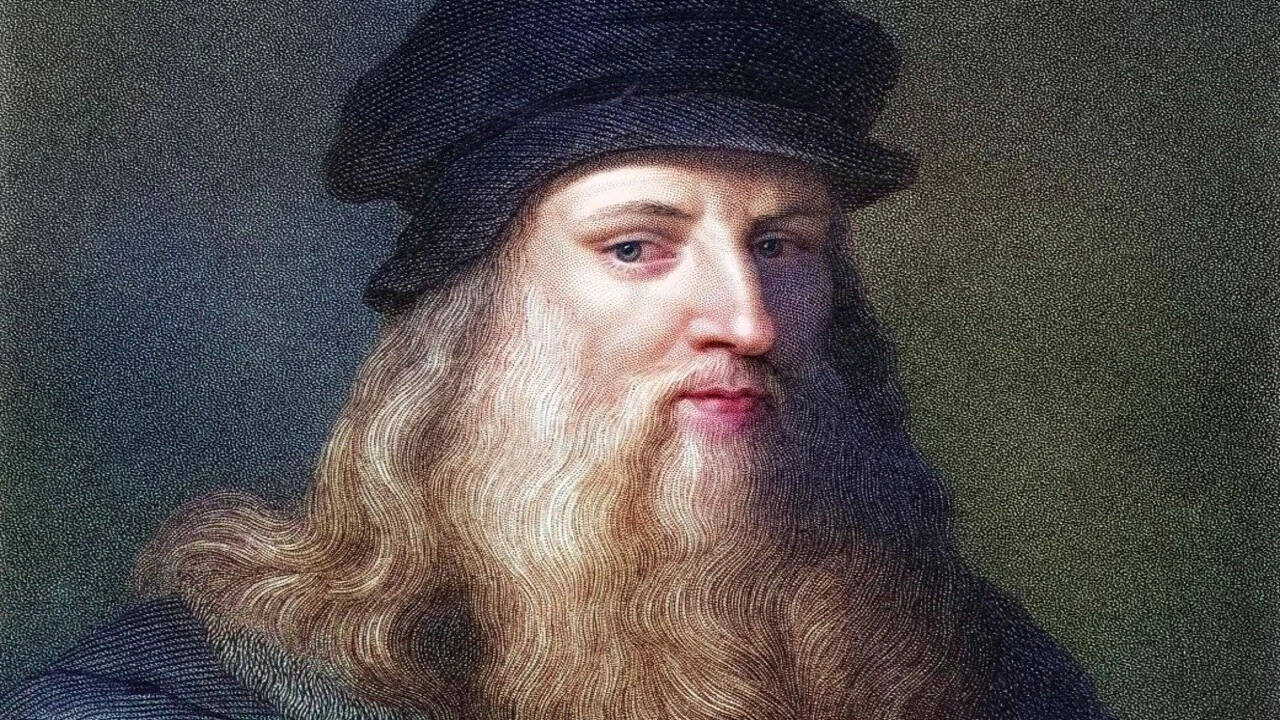
Leonardo da Vinci is remembered as one of history's greatest painters, though reducing him to an artist alone hardly captures the scale of his curiosity. He studied anatomy by dissecting human bodies, designed machines centuries ahead of their time, filled notebooks with observations about birds, rivers, engineering and mathematics, and moved comfortably between art and science in a way that still feels extraordinary today. For Leonardo, knowledge was never something to be collected and stored. It had to be exercised, questioned and applied. The famous observation comparing rusting iron, stagnant water and the human mind reflects that lifelong belief that ability survives only through use.
Get breaking news anytime, anywhere. Download the TOI app now!
The quote appears in his notebooks, where Leonardo repeatedly returned to the idea that nature offered lessons for every aspect of human life. He rarely separated the physical world from human behaviour. If metal weakened after years of neglect and water became impure when it stopped flowing, then the mind, he believed, followed a similar law. Intelligence was not a possession that remained unchanged once acquired. Like a muscle, it demanded regular effort. Left untouched for long enough, it gradually lost its sharpness.
The mind was meant to be exercised
Few historical figures embodied their own philosophy as completely as Leonardo did. His notebooks contain thousands of pages filled with sketches, scientific observations, engineering designs and questions that he could not answer during his own lifetime. He studied the movement of water to understand rivers, examined the structure of plants to improve architectural designs and observed birds in flight while imagining machines that might one day carry humans through the air. Each subject led naturally to another because curiosity, for him, was never confined by professional boundaries.
That approach feels surprisingly modern. Neuroscientists now know that the brain continues changing throughout life. Learning a language, practising a musical instrument, solving unfamiliar problems or mastering a new skill strengthens neural connections and builds cognitive flexibility. The opposite also holds true. Abilities that remain unused for years become harder to recover because the brain gradually abandons pathways it no longer needs. Leonardo arrived at a remarkably similar conclusion centuries before psychology or neuroscience existed, relying not on laboratory experiments but on careful observation of the natural world.
His comparison also carries another layer of meaning. Rust does not appear because iron is weak; it appears because iron has been left unattended. Stagnant water loses freshness because it has stopped moving. In the same way, intellectual decline is not always the result of age or limited ability. More frequently, it begins when curiosity is replaced by routine and questions give way to certainty. The mind grows dull not because it lacks capacity but because it is no longer asked to stretch beyond what it already knows.
Why curiosity has always mattered
History repeatedly shows that periods of discovery emerge from societies that encourage people to keep learning instead of remaining satisfied with inherited knowledge. The Renaissance, of which Leonardo became the defining figure, flourished because scholars, artists and scientists challenged accepted ideas by returning to ancient texts, experimenting with new techniques and observing the world directly. Progress came from refusing to believe that everything worth knowing had already been discovered.
That principle remains visible in everyday life. Languages disappear when they are no longer spoken. Traditional crafts vanish when younger generations stop practising them. Even practical skills such as writing by hand, mental arithmetic or playing a musical instrument become noticeably weaker after years without use. The same pattern extends to judgement itself. People who continue reading widely, engaging with unfamiliar ideas and questioning their own assumptions usually retain a flexibility of thought that routine alone cannot provide.
Leonardo's own life offers perhaps the strongest argument for his quotation. Many of the inventions sketched in his notebooks could not be built with the technology available during his lifetime. Even so, he continued drawing, refining and testing ideas because the value of thinking did not depend entirely on immediate success. Curiosity was worthwhile in itself. Every question opened the possibility of another.
A lesson that grows more relevant with time
Modern life places an extraordinary amount of information within easy reach. Facts can be retrieved in seconds and answers appear almost instantly on a screen. Leonardo's words remind us that possessing information is different from developing understanding. A mind becomes sharper through the effort of analysing, connecting and applying ideas rather than simply collecting them.