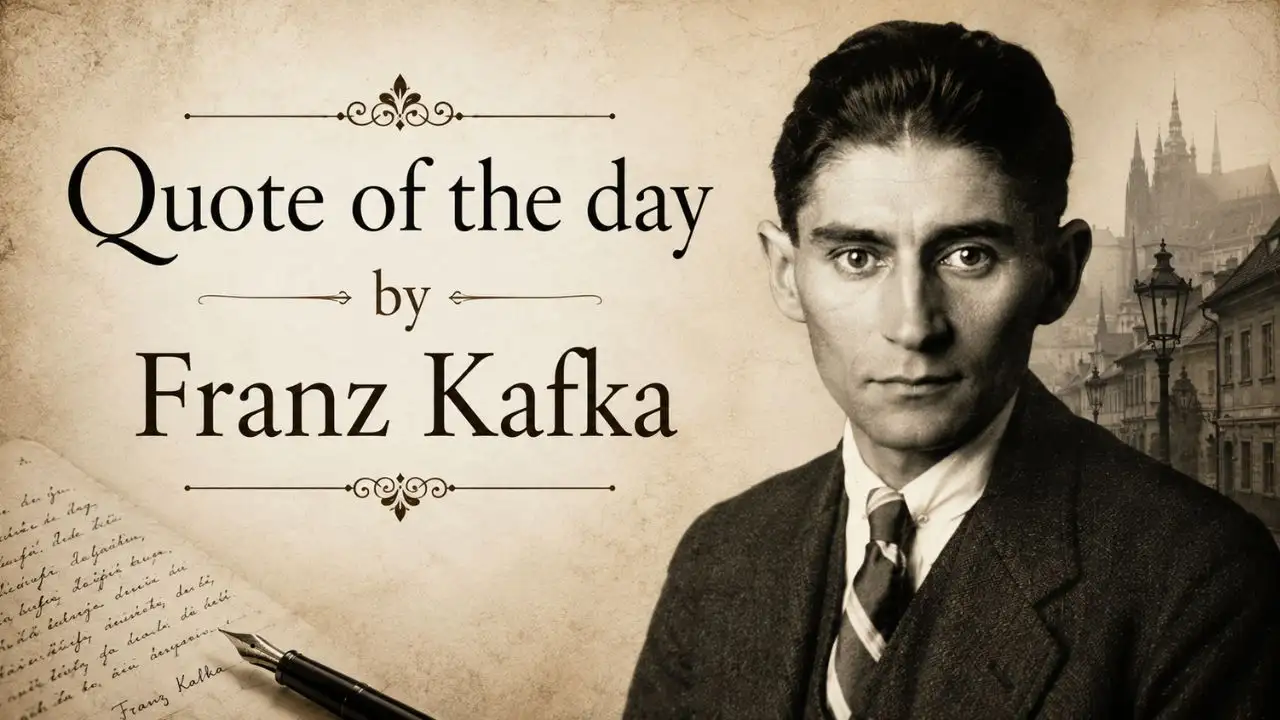
Quote of the Day by Franz Kafka: Few writers understood the tension between truth and authority as deeply as Franz Kafka. His works continue to resonate because they explore uncertainty, isolation, and the uncomfortable realities of modern life. One of his most haunting observations challenges our relationship with truth itself and asks whether necessity can sometimes outweigh certainty.
Franz Kafka's Quote
The quote reads, " It is not necessary to accept everything as true, one must only accept it as necessary.' 'A melancholy conclusion,' said K. 'It turns lying into a universal principle.”
Franz Kafka’s reflection on truth and necessity remains strikingly relevant in an age of information overload, political narratives, and social pressures. His words invite us to question blind acceptance while recognizing the systems that shape human behavior. The quote is both a warning and a meditation on the fragile boundary between truth and survival.
What does Franz Kafka mean by accepting what is necessary rather than what is true?
The quote comes from one of the most important conversations in The Trial, Franz Kafka’s unfinished 1925 novel about Joseph K., a man arrested and prosecuted by an invisible judicial system without ever learning the nature of his crime.
Near the novel’s conclusion, a prison chaplain tells Joseph K., “It is not necessary to accept everything as true, one must only accept it as necessary.” The statement reflects the logic of the mysterious court: individuals are expected to submit to institutions not because they understand or believe them, but because they seem unavoidable. Joseph K. immediately pushes back, calling it “a melancholy conclusion” because it transforms falsehood into a universal rule.
This exchange captures the essence of what later became known as the Kafkaesque condition: ordinary people trapped within vast, impersonal systems whose authority feels absolute yet whose reasons remain obscure. The tension between truth and necessity lies at the heart of The Trial. Kafka is not endorsing blind obedience; rather, he exposes the moral danger of accepting something merely because society presents it as inevitable.
In today's world of bureaucracy, algorithms, institutions, and competing narratives, the passage remains startlingly relevant. It asks a question that still troubles modern life: When does accepting what is "necessary" become a surrender of truth itself?
Kafka understood that human beings frequently comply with authority out of necessity. Rules, traditions, and bureaucratic structures can become so deeply embedded that questioning them feels impossible. The danger, as K. recognizes, is that necessity can eventually replace truth altogether. The result is a world where people stop asking whether something is right and focus only on whether resisting it is practical.
How did Franz Kafka's life shape his vision of alienation and uncertainty?
Born on July 3, 1883, in Prague, then part of Austria-Hungary, Franz Kafka grew up in a prosperous Jewish family yet experienced profound feelings of isolation throughout his life, as per Britannica.
His relationship with his domineering father left a lasting psychological imprint that influenced much of his writing. In his famous Letter to Father, Kafka described feelings of inadequacy, fear, and emotional distance that echoed through his fictional worlds.
Though educated, intelligent, and professionally successful as an insurance official, Kafka lived what many scholars describe as a double existence. By day he worked within bureaucratic institutions; by night he transformed those experiences into literature that exposed the absurdities and anxieties of modern systems.
His characters often struggle against invisible authorities, undefined accusations, and unreachable goals. Joseph K. in The Trial becomes the ultimate symbol of humanity's search for meaning within structures that refuse explanation.
These themes emerged not merely from imagination but from Kafka's own experience of feeling disconnected from family, society, religion, and even himself.
Why do Kafka's words still matter today?
More than a century later, Kafka's insights feel remarkably contemporary. Modern life is filled with systems that people participate in because they appear necessary. Governments, corporations, digital platforms, and social expectations all demand a degree of compliance. Individuals often accept procedures without understanding their origins or questioning their legitimacy.
Kafka reminds readers that necessity should never automatically become truth. His warning is especially powerful in an era where misinformation spreads rapidly and institutions compete for public trust. The temptation to accept convenient narratives simply because they provide order remains as strong as ever.
Yet Kafka does not advocate despair. His work celebrates the human impulse to keep searching, questioning, and seeking understanding even when definitive answers remain elusive. That relentless pursuit of meaning is perhaps his greatest legacy.
The deeper lesson behind Franz Kafka's quote
The enduring power of Kafka's observation lies in its moral challenge. Human beings must live within systems and realities that often cannot be fully controlled. Some compromises are unavoidable. But surrendering the distinction between truth and necessity carries enormous risks.
When societies stop asking whether something is true and ask only whether it is useful or inevitable, deception gains legitimacy. As K. laments, lying itself can become universal. Kafka encourages us to preserve our capacity for doubt, reflection, and moral inquiry. Even when answers remain uncertain, the act of questioning keeps human freedom alive.
His words remind us that necessity may govern circumstances, but truth must continue to guide conscience.