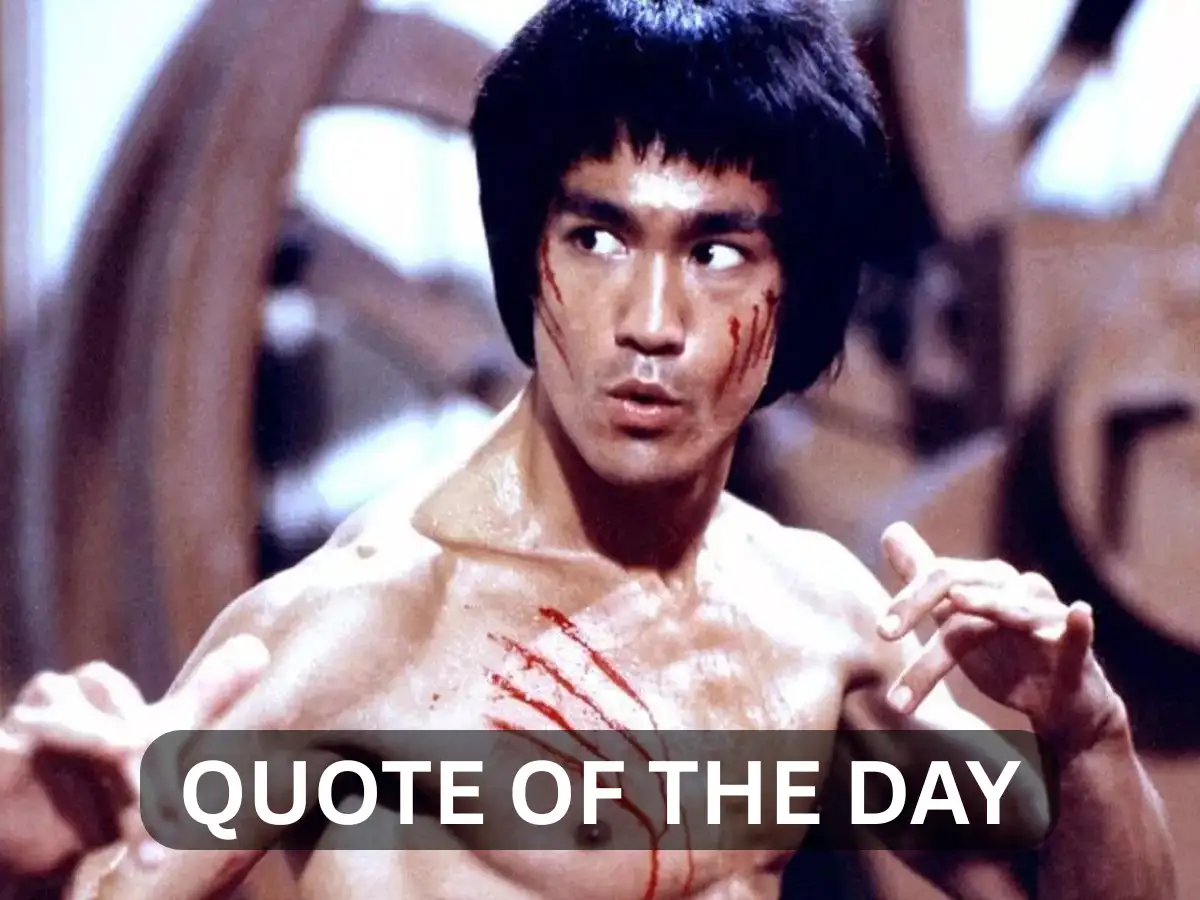
Quote of the Day by Bruce Lee: Some Quote of the Day reflections remain timeless because they speak directly to the fears and struggles people experience in everyday life. Few personalities embodied discipline, resilience and fearless ambition as completely as Bruce Lee. Known across the world for revolutionizing martial arts cinema, Lee also left behind a philosophy centered on self-belief, growth and determination. His words continue to inspire athletes, artists, entrepreneurs and ordinary people striving to overcome limitations.
At moments when failure feels discouraging, the right words can become a reminder that progress is impossible without risk. Bruce Lee’s reflections on ambition and courage continue to resonate decades after his death because they encourage people to aim higher instead of settling for comfort or fear.
Quote of the Day Today
The Quote of the Day today by Bruce Lee is:
“Don't fear failure. — Not failure, but low aim, is the crime. In great attempts it is glorious even to fail.”
The quote reflects Bruce Lee’s lifelong belief that human potential is discovered only through bold effort and relentless self-improvement. Rather than treating failure as shameful, Lee believed the greater mistake was refusing to pursue meaningful goals altogether. The statement mirrors not only his philosophy but also the extraordinary journey of his own life, from troubled teenager to global cultural icon.
Early Life of Bruce Lee
Bruce Lee was born on November 27, 1940, in San Francisco, California, though he spent most of his childhood growing up in Hong Kong. His Chinese name was Li Jun Fan. He was introduced to the entertainment world early because his father was an opera singer and part-time actor. As a child, Lee appeared in several films and was often cast as troubled street kids or juvenile delinquents.
Despite his early acting exposure, Lee’s teenage years were turbulent. He became involved with local gangs and frequently got into street fights. Concerned about his behavior and repeated encounters with police, his parents encouraged him to study kung fu so he could channel his aggression more productively. Martial arts soon became more than self-defense for Lee; it became a lifelong discipline and philosophy.
At the same time, Lee developed an interest in dancing. In 1958, he won the Hong Kong cha-cha championship, an achievement that helped refine the speed, rhythm and balance that later became central to his martial arts style. The combination of dance and kung fu contributed to the fluid movement that made his fight scenes unlike anything audiences had seen before.
Moving to America and Finding Direction
After turning 18, Bruce Lee moved to the United States and settled in Seattle with family friends. There he completed high school before studying philosophy and drama at the University of Washington. During these years, Lee began teaching martial arts and opened his first martial arts school in Seattle.
In 1964 he relocated to Oakland, California, where he founded another school and began developing his own martial arts philosophy known as jeet kune do. Unlike traditional martial arts systems, jeet kune do combined ancient kung fu with influences from boxing, fencing and philosophy. Lee believed martial arts should adapt to the individual rather than force people into rigid systems.
His unique approach quickly attracted attention. During a karate tournament demonstration in the Los Angeles area, Lee impressed a television producer with his speed and charisma. Soon afterward, he was cast as Kato in the television series The Green Hornet (1966–67). Though the series lasted only one season, Lee’s performance stood out and introduced him to wider audiences.
Hollywood Struggles and Career Breakthrough
Following the cancellation of The Green Hornet, Bruce Lee struggled to find meaningful acting opportunities in Hollywood. At the time, Asian actors were often limited to stereotypical supporting roles, and Lee became frustrated with the lack of serious opportunities.
To support himself, he began giving private jeet kune do lessons to Hollywood celebrities, including Steve McQueen. Lee also appeared in the film Marlowe (1969), where audiences noticed his extraordinary physical abilities during a memorable action sequence, as per Britannica.
Still dissatisfied with Hollywood, Lee returned to Hong Kong in 1971. What followed changed martial arts cinema forever. He starred in films including The Big Boss and Fist of Fury, both of which shattered box-office records throughout Asia. Lee’s combination of athleticism, screen presence and emotional intensity made him an instant sensation.
With growing influence, Lee formed his own production company and took greater creative control over his work. He wrote, directed, coproduced and starred in The Way of the Dragon (1972), demonstrating that he was far more than an action star. He wanted martial arts films to carry emotion, philosophy and personal identity.
Enter the Dragon and International Stardom
Bruce Lee’s greatest international breakthrough came with Enter the Dragon (1973), the first major collaboration between Hong Kong and American film studios. The movie became a worldwide phenomenon and transformed Lee into an international superstar, as per Britannica.
Tragically, Lee died on July 20, 1973, in Hong Kong, only six days before the film’s local release. He was just 32 years old. The official cause of death was swelling of the brain caused by an allergic reaction to headache medication, though speculation about the circumstances continued for years.
At the time of his death, Lee had been working on Game of Death, which was later completed using stand-ins and editing techniques. Despite his short life, Lee’s influence became enormous after his passing. His films developed a passionate global following, and he became one of the most recognizable pop culture figures of the 20th century.
How Bruce Lee Changed Popular Culture
Bruce Lee did more than popularize martial arts movies. He fundamentally changed how Asian characters were portrayed in Western entertainment. Before Lee, Asian actors were rarely presented as strong, intelligent or charismatic leading figures in mainstream American cinema.
Lee broke those stereotypes through confidence, physical mastery and screen presence. His performances inspired generations of martial artists, filmmakers and actors across the world. Modern action cinema, from martial arts choreography to fitness culture, still carries traces of Lee’s influence, as per Britannica.
His philosophy also extended beyond fighting. Lee often spoke about adaptability, discipline and personal growth. Many people connected with him not simply because he could fight, but because he represented self-transformation. He believed human beings should constantly evolve and refuse to remain trapped by fear or limitation.
Quote of the Day Meaning
The meaning behind Bruce Lee’s Quote of the Day lies in the difference between failing and never truly trying. Lee argued that failure itself should not be feared because every ambitious goal carries the possibility of setbacks. The real tragedy, according to him, is setting goals so small that they require no courage.
The quote encourages people to pursue meaningful challenges even when success is uncertain. In Lee’s philosophy, attempting something great already holds value because it demands commitment, discipline and belief. Failure becomes part of growth rather than evidence of weakness.
This mindset reflected Lee’s own journey. He faced rejection in Hollywood, criticism from traditional martial arts communities and cultural barriers in the entertainment industry. Yet he continued pushing boundaries instead of lowering his ambitions. His eventual success came precisely because he refused to settle for limited expectations.
The quote also serves as a reminder that personal growth depends on constant striving. People who avoid risks often remain trapped in routines that offer comfort but little fulfillment. Lee believed life required movement, experimentation and continuous improvement. Even unsuccessful attempts could strengthen character and reveal new possibilities.
Legacy of Bruce Lee
More than fifty years after his death, Bruce Lee remains one of the most influential martial artists and film stars in history. His movies continue to attract new audiences, while his philosophy is widely quoted in sports, business and self-development discussions.
Lee’s influence extended to future generations of actors and martial artists, and his life story continues to inspire biographies, documentaries and films. His son, Brandon Lee, also pursued acting before tragically dying during the filming of The Crow (1994).
Bruce Lee’s enduring popularity comes from the rare combination of physical excellence and intellectual depth. He was not only a fighter or actor but also a thinker who challenged people to confront fear, pursue growth and refuse mediocrity.
Other Iconic Quotes by Bruce Lee
Beyond today’s Quote of the Day, Bruce Lee shared many memorable reflections that continue to inspire people around the world:
“Do not pray for an easy life, pray for the strength to endure a difficult one”
“Adapt what is useful, reject what is useless, and add what is specifically your own.”
“I fear not the man who has practiced 10,000 kicks once, but I fear the man who had practiced one kick 10,000 times.”
“Be happy, but never satisfied.”
“A wise man can learn more from a foolish question than a fool can learn from a wise answer.”