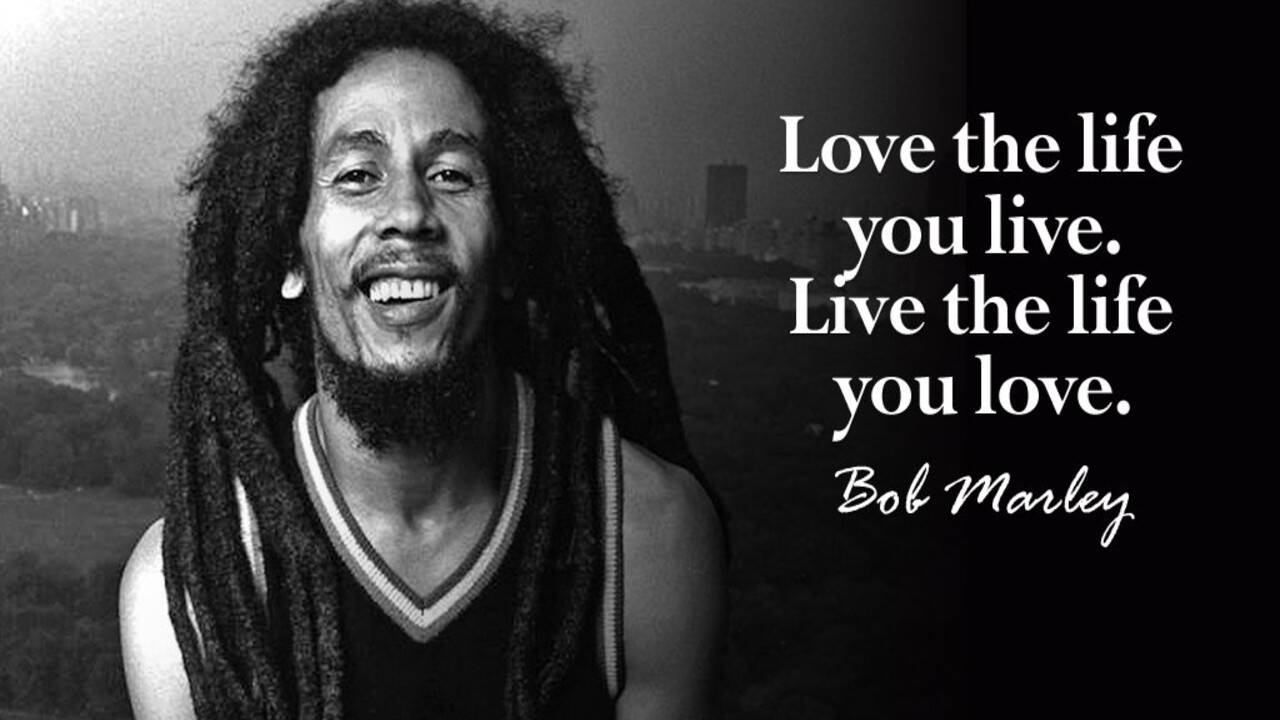
“Love the life you live. Live the life you love.”
Get breaking news anytime, anywhere. Download the TOI app now!
Some quotations become famous because they sound beautiful. Others stay in public memory because people keep returning to them at different stages of life, finding a new meaning each time. Bob Marley's "Love the life you live. Live the life you love." belongs to both. At first reading, it appears almost effortless, as though it were simply encouraging people to be happy. Spend a little longer with it, however, and the sentence begins to ask a far more demanding question: is the life we spend our days building actually one we would choose if nobody else were watching?
Marley was never interested in separating music from life. Long before reggae became a global phenomenon, his songs explored dignity, identity, injustice, freedom and faith, drawing deeply from his Rastafarian beliefs and his experiences growing up in Jamaica. Many of his best-known lyrics carried political conviction alongside personal reflection, and that wider worldview gives this quotation its weight. It is less about chasing pleasure than about living in a way that allows conviction and everyday life to move in the same direction.
More than a call to ‘follow your passion’
The quote is frequently treated as another version of “follow your dreams,” though that interpretation misses much of what makes it enduring. Loving the life you live does not necessarily mean living a life free from routine, hardship or responsibility. Marley himself spent years travelling, performing relentlessly and speaking about issues that carried real personal risks. His life was defined as much by discipline and commitment as by artistic success.
The two halves of the sentence work together in an interesting way. “Love the life you live” asks people to recognise value in the life already unfolding around them instead of postponing fulfillment until some future milestone. “Live the life you love” shifts the responsibility back onto the individual, suggesting that admiration alone changes very little unless it is reflected in everyday choices. Read together, the quotation rejects the idea that satisfaction arrives by accident. It grows from the relationship between appreciation and action.
That balance feels especially relevant at a time when people are constantly presented with carefully edited versions of other people's lives. Success is measured in promotions, destinations, followers and possessions that can be photographed and shared within seconds. The comparison is almost irresistible because it is continuous. Before long, attention shifts away from the life someone is actually living towards one that exists largely on a screen.
Marley's words pull in the opposite direction. They ask a question that social media rarely encourages: what does a meaningful life look like when there is no audience to impress? The answer is unlikely to be identical for everyone, which is precisely the point. A meaningful life cannot be borrowed from someone else's photographs or ambitions. It has to be built from values that make sense to the person living it.
The everyday choices that shape a life
It is tempting to imagine that people transform their lives through dramatic decisions, though most lives change much more gradually than that. Careers develop through skills learned over many years. Friendships are sustained through conversations that seem ordinary while they are happening. Families are shaped by countless shared meals, celebrations and disagreements that eventually become memories. Looking back, it is often the repeated habits rather than the dramatic turning points that define a life.
That idea appears across many philosophical traditions. Aristotle wrote that character is formed through repeated actions. Buddhist teachings encourage mindfulness within ordinary experience instead of endless attachment to future desires. Existentialist thinkers argued that identity emerges through choices made day after day rather than through abstract intentions. Marley expressed a similar truth without philosophical language, reducing it to a sentence that almost anyone could remember.
His own career reflected that consistency. Songs such as One Love , Redemption Song and Get Up, Stand Up were different in style and subject, although they shared a remarkably coherent vision of humanity, justice and hope. Listeners could disagree with his politics or beliefs, but few doubted that the man and the music belonged together. The life he lived gave credibility to the words he sang.
Why the quote continues to resonate
The popularity of this quotation has less to do with optimism than with honesty. Most people, at some point, have wondered whether the routines filling their calendar still reflect the person they hoped to become. The answer is rarely found through a single dramatic decision. More often, it begins with paying attention to the habits, relationships and priorities that quietly shape one ordinary day after another.
Perhaps that is why the sentence has travelled so far beyond Bob Marley's music. It does not promise an easier life or suggest that fulfilment lies just around the corner. Instead, it offers a simple standard against which people can measure their own choices. A life worth loving is rarely assembled all at once. It is built gradually, through decisions that bring beliefs and actions a little closer together until the distance between the two is hardly visible at all.