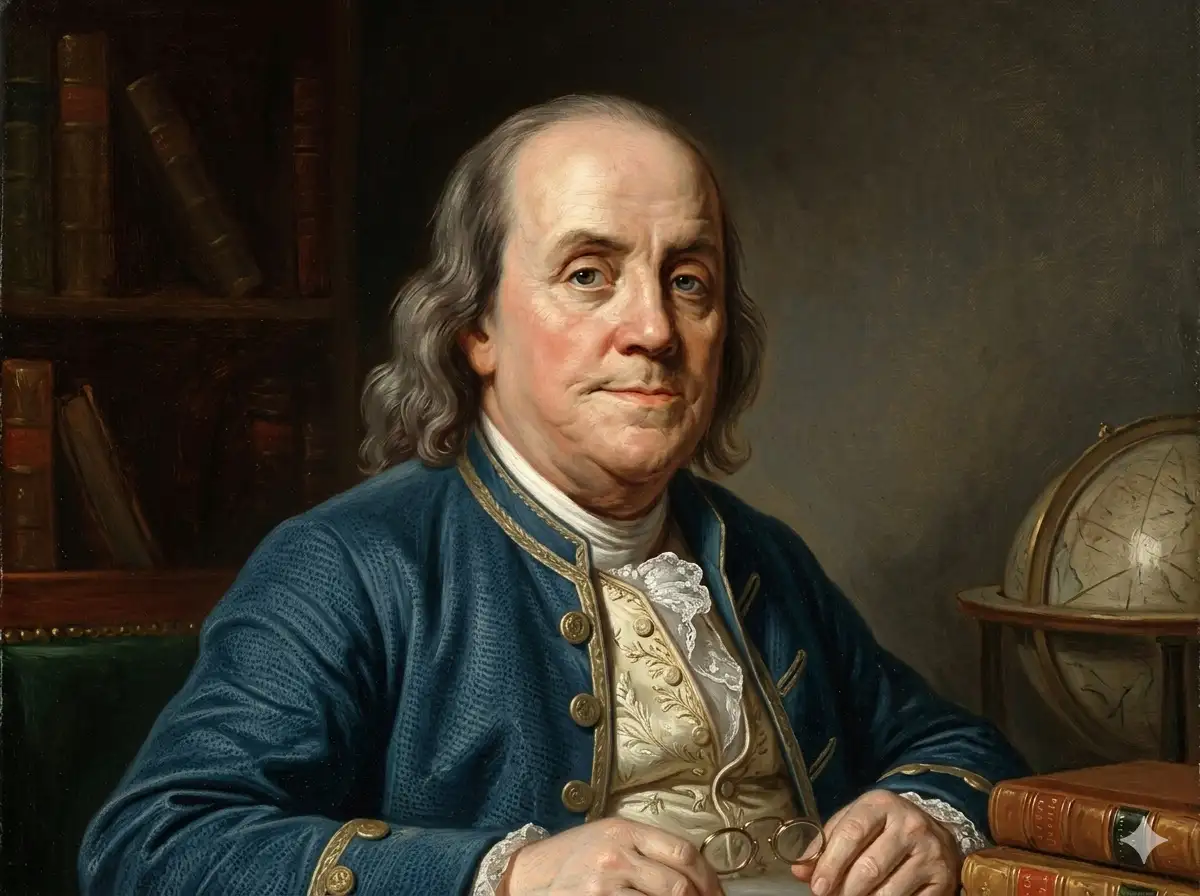
Quote of the day by Benjamin Franklin continues to inspire readers across generations. Franklin’s words, “We are all born ignorant, but one must work hard to remain stupid,” focus on learning, education and self-awareness. The quote explains that ignorance is natural at birth, but refusing to learn can limit growth and success. Benjamin Franklin’s own life reflected this belief. From working as a printer’s apprentice to becoming a writer, inventor, scientist, diplomat and Founding Father of the United States, Franklin used reading, writing and public service to shape his future. The quote remains relevant in discussions about knowledge, intelligence, education and personal development.
Quote of the day by Benjamin Franklin and its deeper meaning
Benjamin Franklin’s quote is,
“We are all born ignorant, but one must work hard to remain stupid.”
It explains the difference between ignorance and refusal to learn. According to the quote, every person begins life without knowledge. Learning develops over time through education, reading, observation and experience.
Franklin believed that people can improve themselves if they stay open to knowledge. However, if a person avoids learning, ignores facts or refuses to grow, they remain trapped in ignorance. The quote also shows that intelligence is connected to effort and curiosity.
The saying continues to remain relevant in schools, workplaces and daily life. In a world filled with information, the quote reminds people to think critically, ask questions and continue learning throughout life.
Benjamin Franklin’s early life and struggle for education
Benjamin Franklin was born on January 17, 1706, in Boston, Massachusetts. He was the 10th son among 17 children in his family. His father worked in soap and candle making. Franklin received limited formal education and left school at the age of 10.
At the age of 12, Franklin became an apprentice to his brother James, who worked as a printer. During this period, Franklin developed strong reading and writing habits. He spent long hours reading books and improving his prose writing skills.
Franklin admired essays from The Spectator, written by Joseph Addison and Richard Steele. He copied and rewrote passages to improve his writing style. This self-education later helped him become an author, publisher and public thinker.
In 1722, Franklin wrote essays under the name “Silence Dogood.” These writings appeared in his brother’s newspaper, the New-England Courant. The essays discussed society, education and public issues. Readers praised the work without knowing Franklin was the writer.
Franklin’s journey from Boston to Philadelphia
After disagreements with his brother, Franklin secretly left Boston and traveled to Philadelphia at the age of 17. He arrived tired and hungry, carrying bread rolls while walking through Market Street. This moment later became one of the most famous scenes from his autobiography.
Franklin soon found work as a printer in Philadelphia. He later traveled to London after promises of financial support from Pennsylvania Governor Sir William Keith. However, Franklin discovered the promises were not fulfilled after reaching England.
While living in London, Franklin continued working in printing and writing. He also explored ideas related to philosophy, politics and society. In 1726, he returned to Philadelphia and restarted his printing career.
By 1728, Franklin entered a printing partnership. Two years later, he became the sole owner of his business. His career expanded through newspapers, printing contracts and publishing ventures.
Poor Richard’s Almanack and Franklin’s rise to fame
One of Franklin’s best-known works was Poor Richard’s Almanack. Published between 1732 and 1757, the almanac included weather forecasts, sayings, advice and humorous observations.
Franklin used the name Richard Saunders for the publication. Many of his sayings focused on hard work, discipline and financial responsibility. The almanac became popular throughout the American colonies.
Franklin also published the Pennsylvania Gazette, which became one of the leading newspapers of the colonial period. Through his publications, Franklin influenced discussions on politics, education and society.
His success in publishing helped him become financially secure by his early 40s. Franklin later retired from active business and focused on science, public service and civic projects.
Achievements in science, electricity and inventions
Benjamin Franklin made major contributions to science, especially in the study of electricity. His experiments helped people understand the relationship between lightning and electricity.
Franklin conducted famous experiments involving a kite during thunderstorms. He introduced terms still used in electrical science, including “conductor,” “charge,” and “discharge.”
He also invented or improved several devices, including:
- Lightning rod
- Franklin stove
- Bifocal glasses
- Glass harmonica
- Odometer
Franklin’s scientific work gained international recognition. His book Experiments and Observations on Electricity was published in several languages across Europe. Even with scientific success, Franklin believed public service was more important than personal achievement.
Franklin’s role in American history and diplomacy
Benjamin Franklin played an important role in the founding of the United States. He helped draft and sign the Declaration of Independence. He also contributed to the Articles of Confederation and participated in the Constitutional Convention.
During the American Revolution, Franklin traveled to France to secure diplomatic and military support for the American colonies. He successfully gained French recognition and financial assistance for the revolutionary cause.
Franklin became one of the most recognized American figures in Europe. His diplomacy helped shape the peace agreement between Britain and the United States in 1783.
He later returned to America in 1785 and spent his final years involved in public discussions, including opposition to slavery. Franklin died on April 17, 1790, in Philadelphia at the age of 84.
Life lessons from Benjamin Franklin’s quote
Benjamin Franklin’s quote offers several lessons that remain useful today:
Importance of lifelong learning
The quote encourages people to continue learning throughout life. Education does not end with school. Reading, observation and experience all help people grow.
Accepting mistakes and improving
Franklin’s words suggest that people should not fear ignorance. Instead, they should work toward understanding and improvement.
Knowledge supports success
Franklin’s own life showed how self-education can create opportunities. His journey from printer’s apprentice to scientist and diplomat reflects the value of effort and discipline.
Critical thinking matters
The quote reminds people to question information and seek truth rather than remain comfortable with misinformation or limited understanding.
Why the quote remains relevant today?
The quote remains important in modern society because people constantly deal with information, technology and changing ideas. Social media, online discussions and public debates often test people’s willingness to learn and verify facts.
Franklin’s message encourages individuals to stay informed, improve skills and avoid intellectual laziness. Teachers, students, professionals and leaders continue using the quote in discussions about education and personal growth.
The quote also reflects Franklin’s own life. Despite limited formal schooling, he became one of the most influential figures in American history through reading, writing, experimentation and public service.