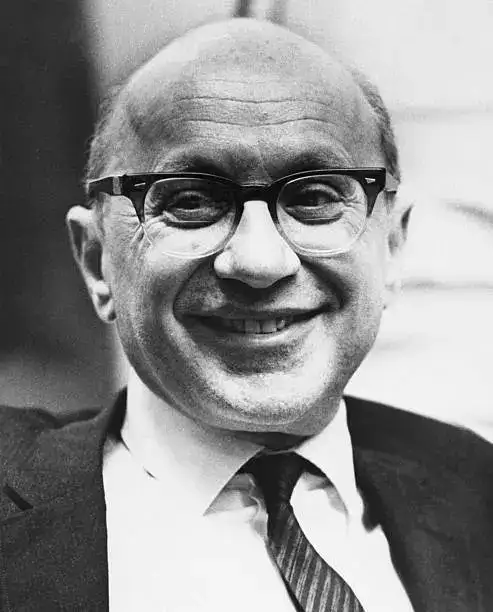
Quote of the day: Few economists shaped modern debates about money, government and free markets as deeply as Milton Friedman. Known for his sharp intellect and plainspoken style, Friedman spent decades challenging conventional political and economic thinking in the United States. Whether he was debating inflation, criticizing excessive regulation or defending individual freedom, he had a way of turning complicated ideas into memorable one-liners that ordinary people could understand. Long after his death in 2006, many of his quotes continue to circulate because they speak not only about economics, but also about efficiency, accountability and human nature. One of his most famous observations remains especially relevant in an era of rising bureaucracy and public frustration over systems that often appear slow and wasteful.
Quote of the day today
“If you put the federal government in charge of the Sahara Desert, in 5 years there'd be a shortage of sand.”
The line is classic Friedman, witty, provocative and packed with criticism of inefficient systems. At first glance, it sounds humorous. But beneath the sarcasm lies a serious argument about bureaucracy, overmanagement and the dangers of centralized control.
Who was Milton Friedman?
Born in Brooklyn, New York, in 1912, Friedman rose from modest beginnings to become one of the most influential economists of the 20th century. He studied at Rutgers University and later at University of Chicago, where he built the foundation of ideas that would later define monetarism.
Throughout his career, Friedman argued that economic freedom was closely tied to political freedom. He believed markets generally functioned better when governments interfered less. His ideas challenged the dominance of Keynesian economics during the mid-20th century and helped reshape public policy discussions around inflation, taxation and government spending.
In 1976, he received the Nobel Prize in Economics for his contributions to consumption analysis, monetary theory and economic stabilization policy. Beyond academia, Friedman became a public intellectual through books, newspaper columns and television appearances. His PBS series and book Free to Choose turned him into a household name among people interested in economics and politics.
Quote of the day meaning
Friedman’s quote uses exaggeration to make a larger point. The Sahara Desert is one of the largest sources of sand on Earth. By suggesting that even sand could become scarce under government management, he was criticizing what he viewed as inefficiency, waste and excessive bureaucracy in large centralized systems.
The deeper meaning is not literally about deserts or sand. It is about how organizations can sometimes become so burdened by rules, paperwork and poor incentives that they fail to manage even abundant resources effectively.
Friedman believed competition and individual initiative usually produce better outcomes than rigid top-down control. According to his philosophy, when too much power is concentrated in one institution, efficiency suffers because there is less accountability and less pressure to innovate.
The quote also reflects frustration many people feel in everyday life. Whether it involves paperwork delays, slow public systems or complex regulations, people often connect with the idea that large institutions can become disconnected from practical results.
Why this quote still feels relevant today
Even decades after Friedman first made the remark, the quote continues to spread widely on social media because it taps into modern anxieties about inefficiency and control.
Around the world, people regularly debate whether governments should play a larger or smaller role in areas such as healthcare, education, housing and technology. Supporters of government programs often argue that public institutions protect citizens and reduce inequality. Critics, meanwhile, warn that too much bureaucracy can create waste, dependency and slow decision-making.
Friedman’s statement survives because it condenses an entire political philosophy into one vivid image. People may disagree with his ideology, but the quote forces audiences to think about how power should be managed and whether institutions remain accountable to the public they serve.
The philosophy behind Friedman’s thinking
Friedman became one of the leading voices of monetarism, a theory emphasizing the role of money supply in controlling inflation and economic stability. He strongly criticized excessive government intervention in markets and believed individuals should have more control over their economic choices.
He supported ideas such as school vouchers, flexible exchange rates and lower barriers to free enterprise. He also opposed many forms of price controls and argued that attempts to artificially manipulate markets often created unintended consequences.
One of his most influential arguments involved inflation. Friedman famously declared that “inflation is always and everywhere a monetary phenomenon,” placing responsibility on central banks and monetary policy rather than blaming businesses or consumers alone.
His views influenced political leaders including Ronald Reagan and Margaret Thatcher, both of whom embraced free-market reforms during the 1980s.
Critics and controversies
Although Friedman’s supporters praise him for defending economic freedom, critics argue that some of his ideas underestimated inequality and social consequences. His association with economic reforms in Chile during the rule of Augusto Pinochet remains controversial.
Others argue that completely free markets do not always protect vulnerable populations and that governments play an essential role in providing stability, public services and consumer protections.
Still, even many critics acknowledge Friedman’s enormous impact on modern economic thought. His ability to communicate complicated theories in simple language helped economics reach audiences far beyond universities and think tanks.
Why people continue sharing his words
Part of Friedman’s lasting appeal comes from his direct style. Unlike academic thinkers who relied heavily on technical language, Friedman often used humor and vivid analogies to make his points memorable.
His quotes continue circulating because they are adaptable to modern frustrations. Whether discussing inflation, bureaucracy or institutional failures, many readers feel his observations still apply in daily life.
The “Sahara Desert” quote in particular survives because it blends comedy with criticism. It makes people laugh, but it also pushes them to ask difficult questions about efficiency, responsibility and the balance between freedom and control.