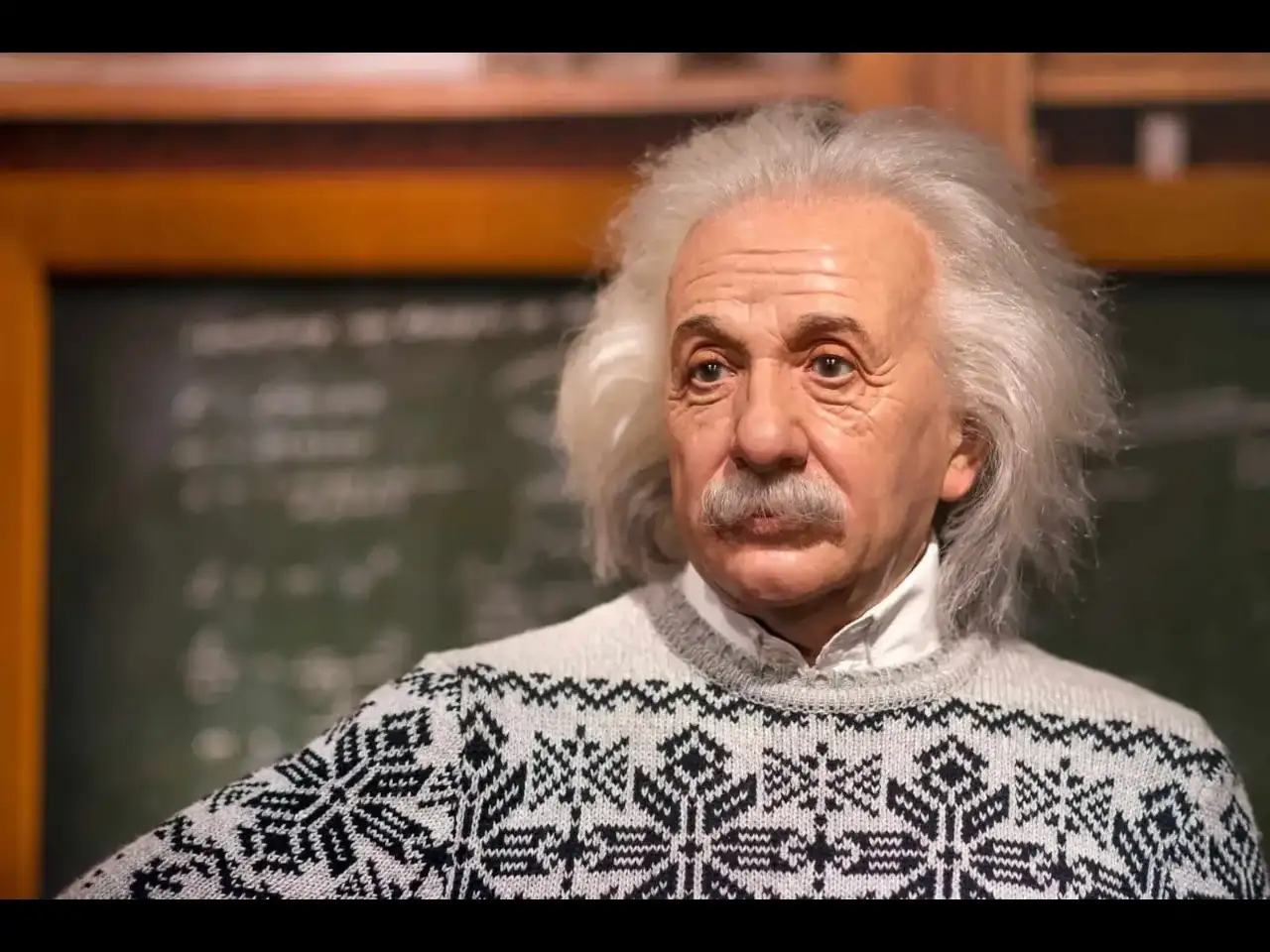
Quote of the day by Albert Einstein: Albert Einstein once wrote, “He who can no longer pause to wonder and stand rapt in awe is as good as dead; his eyes are closed.” At first glance, the sentence feels quiet and simple. But the deeper one sits with it, the more it begins to unfold like a mirror held before modern life. Einstein was not speaking only about science or intelligence. He was speaking about the condition of the human soul.
A person may continue breathing, working, speaking, and moving through daily routines, yet still lose the ability to truly see life. That loss does not happen loudly. It happens slowly. It begins when the mind becomes too crowded to notice beauty, too distracted to feel gratitude, and too certain to remain curious. Wonder disappears not because the world loses mystery, but because people stop paying attention to it.
There is something sacred about awe. It humbles the ego without humiliating the self. It reminds human beings that existence is larger than ambition, larger than fear, larger than personal struggles. A silent sunrise, the movement of stars, the depth of a human conversation, or even a single profound thought can awaken something sleeping inside the mind. Wonder reconnects people with the feeling that life is not merely a task to survive, but an experience to witness deeply.
Einstein understood that intelligence without wonder becomes cold. Knowledge without humility becomes dangerous. The wisest people are often not the ones who claim certainty, but the ones who still feel astonishment before existence itself. The moment a person believes there is nothing left to learn, nothing left to admire, and nothing left to question, life begins losing its color from within.
Quote of the Day Today May 12
“He who can no longer pause to wonder and stand rapt in awe is as good as dead; his eyes are closed.” —
Albert EinsteinThe famous Albert Einstein quote about wonder continues inspiring millions because it speaks about something modern life is slowly losing — the ability to pause, reflect, and truly feel awe. People move fast. Minds stay busy. Attention breaks every second. Yet Einstein’s words remind readers that curiosity, awareness, and imagination are what keep human beings emotionally alive. The quote is not only about intelligence. It is about consciousness. It is about keeping the inner eye open even while the world becomes louder and more distracted.
Einstein believed wisdom begins with curiosity. A person who still feels amazed by life remains open to learning, growth, and deeper understanding. The Albert Einstein quote on awe and wonder reflects the idea that knowledge alone is never enough. Human beings also need silence, reflection, beauty, and meaning. The moment people stop questioning life and stop noticing its mystery, existence becomes mechanical. That is why this quote continues trending across searches related to mindfulness, self-awareness, emotional intelligence, philosophy, and mental clarity.
In today’s world, many people consume endless information but rarely experience inner stillness. Einstein’s quote feels powerful because it reminds readers to reconnect with wonder. A sunrise, a meaningful thought, a deep conversation, or even a quiet moment can awaken the mind again. The quote encourages people to slow down and truly see life instead of rushing through it.
Meaning of the quote of Day
Albert Einstein believed that a person truly lives only when they remain curious, emotionally awake, and capable of feeling wonder. His famous quote, “He who can no longer pause to wonder and stand rapt in awe is as good as dead,” does not speak about physical death. It speaks about inner emptiness. It reflects the moment when life becomes routine, mechanical, and emotionally disconnected from meaning. Einstein reminds readers that the ability to feel awe is what keeps the human spirit alive.
The meaning of this Albert Einstein quote also connects deeply with modern life. People stay busy every day. Minds remain crowded with pressure, speed, and constant distraction. Yet many silently lose touch with curiosity, imagination, and reflection. Einstein’s wisdom suggests that intelligence is not only about knowledge or success. True wisdom comes from noticing life deeply, asking meaningful questions, and remaining open to mystery. A person who still feels amazed by existence continues growing inwardly.
The quote also carries a powerful lesson about awareness. Human beings often search for happiness in achievements while forgetting to appreciate simple moments of beauty and truth. Einstein encourages people to slow down and truly observe the world around them. Wonder creates humility. Awe creates perspective. Curiosity keeps the mind alive. That is why the meaning behind this quote continues inspiring readers searching for mindfulness, self-awareness, emotional clarity, philosophy, and deeper purpose in everyday life.
The clash of giants: Albert Einstein vs. Niels Bohr
Few intellectual rivalries in human history were as profound, dramatic, and world-changing as the clash between Albert Einstein and Niels Bohr. Their debates were not political. They were not personal. They were battles over reality itself — over whether the universe was orderly and predictable or fundamentally uncertain at its core.
What made their conflict extraordinary was that both men were geniuses who deeply respected one another. Yet they stood on opposite sides of the greatest scientific revolution of the 20th century: quantum mechanics.
Their arguments reshaped physics, philosophy, technology, and humanity’s understanding of existence.
At the beginning of the 20th century, classical physics seemed nearly complete. Scientists believed the universe behaved like a giant machine governed by clear laws discovered by Isaac Newton.
Then came a scientific earthquake.
Experiments involving atoms, light, and radiation began producing bizarre results that classical physics could not explain. Tiny particles behaved unpredictably. Light acted both like a wave and a particle. Cause and effect seemed to break down.
This new field became known as quantum mechanics.
Ironically, Einstein himself helped create it. In 1905, he explained the photoelectric effect by proposing that light came in packets called quanta, later known as photons. That work helped lay the foundation for quantum theory and earned him the Nobel Prize.
But as quantum mechanics evolved in the 1920s, Einstein became increasingly uncomfortable with where it was heading.
That is where Niels Bohr entered the story.
Bohr became the leading defender of the new quantum interpretation. He argued that uncertainty was not a flaw in science but a fundamental feature of nature itself.
Einstein disagreed fiercely.
Einstein believed the universe had an underlying order that humans could eventually understand.
To him, physics should describe objective reality — a world that exists independently of whether someone observes it.
Quantum mechanics appeared to destroy that idea.
According to the emerging Copenhagen interpretation championed by Bohr, particles did not possess definite properties until they were measured. Observation itself seemed to shape reality.
All About Albert Einstein
Albert Einstein was one of the greatest thinkers in human history. He was a German-born theoretical physicist whose ideas changed the way people understand space, time, energy, gravity, and the universe itself. Born in 1879, Einstein became globally famous after developing the Theory of Relativity, a scientific breakthrough that transformed modern physics forever. His equation, E = mc², remains one of the most recognized formulas in the world and continues influencing science, technology, and human understanding today.
But Einstein was much more than a scientist. He was also a philosopher, thinker, humanitarian, and powerful voice for curiosity, imagination, peace, and human consciousness. His writings and quotes continue inspiring millions because they go beyond science and speak directly about life, awareness, creativity, learning, and wisdom. Einstein believed imagination was as important as knowledge, and he often encouraged people to remain curious about existence rather than becoming trapped in rigid thinking.
The reason Albert Einstein still remains relevant across generations is because his ideas touched both the mind and the human spirit. He explored the mysteries of the universe while also reflecting deeply on human nature, truth, wonder, and meaning. His quotes about curiosity, awe, intelligence, and imagination continue trending globally because they feel timeless in a fast-moving modern world. Even today, Einstein is remembered not only for his genius, but for reminding humanity to never stop questioning, learning, and standing in awe of life itself.
Even during difficult periods in his life, Einstein continued believing in learning, reflection, and independent thinking. He valued imagination more than memorization and encouraged people to question accepted ideas instead of blindly following them. This mindset shaped not only his scientific career but also his philosophy on life, creativity, wisdom, and human awareness, making him one of the most respected intellectual figures in history.
Albert Einstein’s work and discoveries
Albert Einstein became world famous after developing the Theory of Relativity, one of the most revolutionary scientific ideas ever introduced. His work transformed how people understand space, time, gravity, motion, and energy. Einstein’s equation, E = mc², showed the deep connection between mass and energy and became one of the most important formulas in modern science. His discoveries influenced physics, astronomy, technology, and scientific research across generations.
Beyond science, Einstein’s work also reflected deep philosophical thinking. He believed that curiosity and imagination were essential for human progress. His writings and speeches often explored truth, peace, morality, creativity, and the mysteries of existence. Einstein approached science not as cold calculation, but as a search for deeper understanding, beauty, and wonder hidden within reality itself.
Other famous quotes by Albert Einstein
- “Imagination is more important than knowledge. For knowledge is limited, whereas imagination embraces the entire world.”
- “The important thing is not to stop questioning. Curiosity has its own reason for existing.”
- “Life is like riding a bicycle. To keep your balance, you must keep moving.”
- “Try not to become a man of success, but rather try to become a man of value.”
- “In the middle of difficulty lies opportunity.”
- “A person who never made a mistake never tried anything new.”
- “We cannot solve our problems with the same thinking we used when we created them.”
- “Education is not the learning of facts, but the training of the mind to think.”
- “Logic will get you from A to B. Imagination will take you everywhere.”
- “Peace cannot be kept by force; it can only be achieved by understanding.”
- “The true sign of intelligence is not knowledge but imagination.”
- “Anyone who has never made a mistake has never tried anything new.”
- “Once we accept our limits, we go beyond them.”
- “I have no special talent. I am only passionately curious.”
- “Look deep into nature, and then you will understand everything better.”