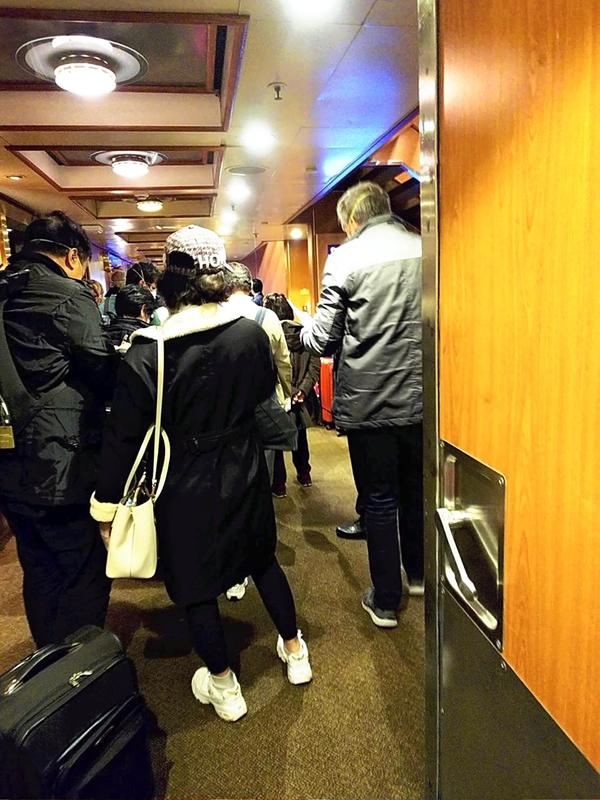
Some passengers who had been quarantined for two weeks aboard the Diamond Princess cruise ship have started to disembark at Yokohama Port, but many question marks hang over the government's decision to keep them aboard in an attempt to prevent the new coronavirus from spreading.
As of Wednesday, 621 people on the ship -- about one-sixth of all passengers and crew -- had been infected with the virus. The government placed the ship in quarantine to contain the virus, but the steadily increasing number of infections despite this step has sparked a barrage of criticism, especially from overseas.
"The number of infections was rising day by day, and I was terrified that I might also catch the virus," an 84-year-old man from Mobara, Chiba Prefecture, said after disembarking from the Diamond Princess on Wednesday morning. He was traveling by himself and was confined to his cabin during the quarantine. "I became more and more anxious" each time an onboard announcement was made about the growing number of infections, the visibly tired man said.
The government's initial response was heavily tilted toward border control measures designed to prevent infected people from entering Japan. It cannot be denied that the government failed to appreciate the serious state of infections on board.
Early on Feb. 5, after confidentially learning that 10 people had tested positive, Chief Cabinet Secretary Yoshihide Suga; Health, Labor and Welfare Minister Katsunobu Kato; and Land, Infrastructure, Transport and Tourism Minister Kazuyoshi Akaba held an emergency meeting at a Tokyo hotel and decided to call for passengers on the liner to be confined to their cabins for two weeks.
At that time, specialist hospitals nearby had suitable beds for about 20 people. But the number of infections jumped to 41 on Feb. 7 and to 65 on Feb. 10. The virus spread faster and on a scale greater than Suga and other government officials had anticipated.
Despite this, the government has insisted that keeping the passengers and crew on the ship and making them stay in their cabins was an appropriate response.
"Many Japanese passengers were aboard, so sending the vessel away wasn't an option," a senior government official told The Yomiuri Shimbun. "But even so, letting people off the ship right away would have caused panic across the nation."
Defense Minister Taro Kono even said on his Twitter account that the U.S. government considered an onboard quarantine to be the "best method."
The miscalculation lay in leaving the crew's handling of this situation up to the captain, which resulted in inadequate steps being taken to prevent the virus from spreading. According to the government, crew members reportedly shared toilet and bathing facilities. As of Tuesday, 68 crew members had caught the coronavirus.
In addition, passengers used Twitter and other channels to air complaints about a lack of support for their daily lives during the quarantine. This resulted in nurturing a strong perception domestically and overseas that the government was one step behind in dealing with this issue. Although there was no obligation under international law to provide such support, the government scrambled to change passengers' sheets, replenish supplies of medicine for chronic illnesses, lend smartphones and extend other help.
Timing of infections
At a press conference Wednesday, Suga revealed a plan to review the government's response to the situation. The timing of when the infections spread on the cruise ship will be a central focus of this review. This is because determining if the government's handling of this issue was a success will hinge on whether the virus spread before or after Feb. 5, when the government ordered that passengers be confined to their rooms.
According to Shigeru Omi, deputy head of the government's expert panel on coronavirus countermeasures and a former regional director of the Western Pacific Regional Office for the World Health Organization, an analysis of about 200 people who caught the virus indicated that the onset of symptoms peaked on Feb. 7 and then declined. Considering the virus' incubation period, many of these passengers must have been infected before they were confined to their cabins, Omi said.
However, some experts have expressed doubts about this view. Kobe University Prof. Kentaro Iwata, an expert on infectious diseases who boarded the Diamond Princess on Tuesday, posted a YouTube video in which he expressed alarm about conditions on the ship and said he was "scared" by what he saw. Another doctor who boarded the liner said: "Many crew members were coughing, had a fever or showed other symptoms. It seems they were sharing rooms and weren't being isolated."
Tohoku University Prof. Hitoshi Oshitani, a virology expert and a member of the government's coronavirus panel, also called for a cool-headed response. Passengers who have disembarked "won't cause a mass outbreak," Oshitani said Wednesday.
Prof. Atsuo Hamada of Tokyo Medical University Hospital's Travel Clinic also said, "The infection rate on that ship was high. Issues such as interactions between crew members and passengers must be reviewed."
Read more from The Japan News at https://japannews.yomiuri.co.jp/