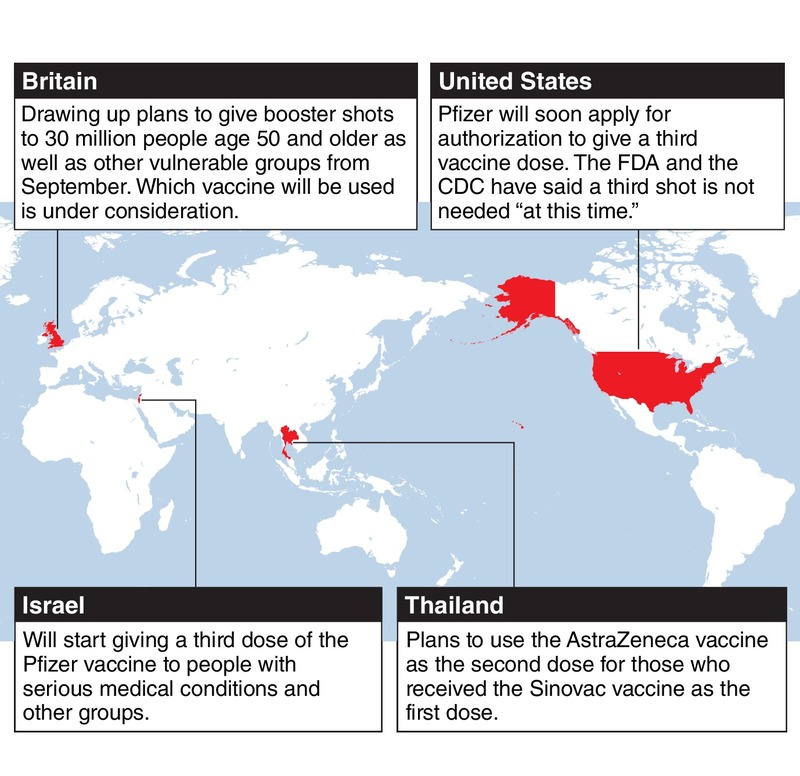
WASHINGTON/BANGKOK -- Booster shots and mixing doses of different vaccines are some of the strategies being taken around the world as nations grapple with the coronavirus crisis. Yet question marks hang over the effectiveness and safety of these steps intended to combat new virus variants and waning vaccine-induced immunity over time.
The booster shots and mix-and-match approach are still essentially a process of trial and error as the virus continues to spread about seven months after vaccines started being injected around the world.
On July 8, U.S. pharmaceutical giant Pfizer Inc. and German biotechnology company BioNTech SE announced that clinical trials showed that a third shot of their vaccine, which initially required a two-shot course, produced higher levels of virus-fighting antibodies. Both companies said they believe a third dose "may be beneficial to maintain the highest levels of protection," and they plan to apply to the U.S. Food and Drug Administration for authorization for these booster shots "in the coming weeks."
U.S. pharmaceutical company Moderna, Inc. and other drugmakers are also conducting clinical trials to check the effectiveness of booster shots.
There are indications that the effects of each vaccine lasts for under one year. Their ability to combat the highly transmissible delta variant, which was first detected in India earlier this year, holds the key to bringing the spread of infections under control.
In Israel, which was a world leader in rolling out a vaccination program, the Pfizer vaccine was 94% effective in preventing symptomatic infections in May and June. But in the month since then, when the delta variant became more prevalent, the efficacy rate reportedly had dropped to 64%.
The Israeli government has started giving a third dose of the Pfizer vaccine to people with serious medical conditions and other groups. Britain is drawing up plans to give booster shots to 30 million people age 50 and older and other vulnerable groups from September. According to Reuters, France, Switzerland and Finland also are considering plans to start giving a third injection of the vaccine.
-- Supply concerns
The U.S. Food and Drug Administration and the Centers for Disease Control and Prevention issued a joint statement this month that said, "Americans who have been fully vaccinated do not need a booster shot at this time."
This reluctance to push ahead with a booster dose was based on a series of research findings that showed existing vaccines still offer some protection against the delta variant. In addition, other concerns remain.
The CDC is "keenly interested in knowing whether or not a third dose may be associated with any higher risk of adverse reactions," a senior CDC official reportedly said recently.
Diverting more vaccines to provide a third dose could negatively impact the distribution to people yet to receive even their first injection.
At a press conference on July 12, World Health Organization Director General Tedros Adhanom Ghebreyesus called for the supply of vaccines to developing nations to be given priority. "The global gap in vaccine supply is hugely uneven and inequitable," he said.
-- Chinese vaccine missing mark?
In Southeast Asia, where the coronavirus is rapidly spreading, Thailand is adopting another tactic to fight the epidemic -- it will use doses from two different vaccines.
On July 12, the Thai Public Health Ministry announced a plan to use a vaccine produced by Chinese pharmaceutical giant Sinovac Biotech Ltd. for the first dose, and then a second shot of the vaccine by AstraZeneca PLC. This came after revelations that many Thai medical workers became infected despite receiving the Sinovac vaccine.
The Thai government says it will also give another shot of the AstraZeneca or other vaccines to medical workers who were fully inoculated with this Chinese vaccine.
The WHO has cautioned against mixing and matching vaccines, saying there is a lack of data about their effectiveness and safety.
In Thailand, some people also have questioned the plan to mix the two vaccines. However, the health ministry appears determined to stick to this plan. It insists that this is the "best strategy" at this time, given that no noticeable side effects were detected among the 1,200 people who have already received a shot of both vaccines.
Read more from The Japan News at https://japannews.yomiuri.co.jp/