David Cameron: smooth, smiley but unconvincing
If Liam Byrne could turn back time, I think we all know which four words he wouldn’t write. That “there’s no money left” note has played a bigger role in the Conservative election campaign than many cabinet ministers and Thursday night was no exception, David Cameron at one point whipping it from his pocket with the air of a kid hoping to get off double PE.
Yet the audience eyed him with flinty scepticism, worrying away doggedly at the same unwelcome question: why won’t you tell us how you’d cut welfare? Are you, as one man said, “deceiving the country” by refusing to disclose what you know?
Cameron tried several times to quash rumours that he would cut child benefit or child tax credit if re-elected but never once gave the only answer that actually matters: a straight, unequivocal, read-my-lips “No I won’t.” That won’t go unnoticed.
On the plus side, the prime minister was smooth, smiley and assured, having toned down the more hysterical elements of the past few days’ Passionate Pumped Up Cameron (although the slight fluffing of his first answer suggests he is getting tired.)
For Tory waverers-to-Ukip, there was a renewed vow to make a referendum on Europe a red line, effectively ruling out another Liberal Democrat coalition (though since most of those Lib Dems likely to survive are if anything even less keen, that’s perhaps not as significant as it once was). And it felt as if the heat is going out of immigration a little; Question Time audiences are usually obsessed with it but newer anxieties are perhaps crowding it out.
But they don’t trust him. In fairness, many voters probably don’t trust any of them. And yet the wariness, the unwillingness to give him the benefit of the doubt as many did in 2010, is palpable and should worry Tory HQ as it heads down the final straight.
Best line: Linking economic competence to being able to fund the NHS. “It’s the economies that tank and bomb that can’t support the health service that I think we all need.”
Best audience line: In response to the prime minister’s polite “I don’t agree with you, sir,” the blunt answer: “Well you’re wrong.”
Gaby Hinsliff
Ed Miliband: too little too late
One week to go, the polls turning the wrong way – this was the moment when Ed Miliband had to haul the waverers back into line. He is good off script. There must have been a bit of optimism that he could pull it off. He didn’t.
The headline lesson of the non-debate debate was that negative campaigning works. The questions Miliband faced illustrated just how effective the Lynton Crosby songbook can be. Labour had left the door open on its record in power. It failed to see the threat to its Scottish powerbase from the SNP soon enough or to anticipate the consequences for the future of a Labour majority or a Labour government intelligently enough.
On the evidence of Question Time, the Conservative campaign of fear has triumphed. Miliband was halfway through his allotted 28 minutes before he got on to the attack. He never managed to make the moral case for Labour that David Cameron was invited to address. It may not be appealing to imagine national policy being entirely in the hands of the small business lobby, but Miliband failed to explain why it shouldn’t be.
The thread that ran through the whole show was the one that dominates the campaign: trust. The audience – like the electorate – wanted two incompatible objectives. They wanted to be reassured that what Labour said would be delivered. But on all the evidence, voters are not sure they want what either of the main parties are offering. At last Miliband delivered the only real message he had to get across: if you want a Labour government, vote Labour. It’s a sign of how much Miliband has grown into the job in the last month that his performance was fine, just not as good as we’ve come to expect.
And maybe there was a hint of an overture to the SNP when he reiterated his pledge of no coalition, no deals but added: “Not while they want a referendum in the next five years”. Could this be the opening to government?
Best line: “If you want a Labour government, vote Labour.”
Takeaway point: Just don’t, Liam Byrne, ever make a joke, ever again. Or at least not in writing. And Ed Balls, never, ever tell someone something’s just a joke. Especially if you can see they don’t get it.
Anne Perkins
Nick Clegg makes the best of a bad job
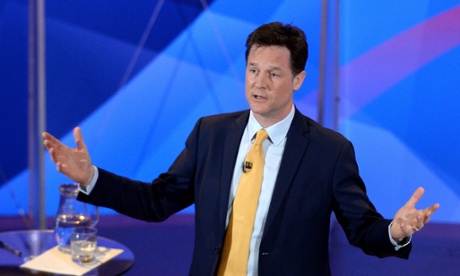
Through experience and necessity, Nick Clegg has developed the same sales patter as a high street dentist: you may not like me, you may not want to deal with me, but get over it – you are going to need me. And that was the pitch he took into the Question Time debate.
The choice, he said, was ideologically driven cuts from the Conservatives or uncontrolled borrowing and spending from Labour. Think of yourselves, and then think of me. Think of your future. But the audience were not as interested as Clegg in the future. They were much more interested in his past.
The first question set a hostile tone. “Your promise on student fees has destroyed your reputation,” spat the questioner. “Why would we believe anything you said?” Clegg saw the way of things. “Nice easy way to start,” he said. The Chinese say if you bow, bow low. Clegg did that. “I got it wrong. I was between a rock and a hard place.”
He stayed there for 27 minutes. Cameron and Miliband face partisan probing and disbelief, but Clegg meets disdain. The two other leaders saw their policies pulled apart. Once Clegg stepped out, the target was him.
“I wonder if you have plans for next week when you become unemployed and your party becomes an irrelevance,” was one slingshot. “Charming,” replied Clegg. “No, I don’t.” Even a one-time Lib Dem voter took the chance to get stuck in. You had a choice and you made Cameron prime minister, he said, aggrieved. “We didn’t vote to put David Cameron into No 10.”
Clegg made the best of it. We could have been the next domino to fall, like Spain or Greece, he said. We are not Spain or Greece, was the questioner’s sharp rebuke. We are the only party you can trust on the EU, Clegg said. That wasn’t popular either. Clegg noted that both Miliband and Cameron refused to discuss the possibility of another coalition. If either believe an overall majority is likely, they belong in a darkened room, he said. And by the time his grilling was over, he was ready to join them.
Best moment: Clegg’s unashamed defence of Danny Alexander’s leak of the welfare cuts document. And leaving the podium without stumbling.
Hugh Muir