Summary
- Ed Miliband has hardened his opposition to a deal with the Scottish National party, saying that he was “not going to have a Labour government if it means deals or coalitions with the SNP”. As Patrick Wintour reports, speaking during the final TV leaders event prior to next week’s election, the Labour leader came under pressure over the previous Labour government’s record on the deficit, his attitude to the private sector and his potential dependence on the SNP.
-
A snap ICM poll for the Guardian has found that David Cameron was judged to have performed best in the BBC’s Question Time Leaders Election Special, featuring Miliband, Cameron and Nick Clegg. (See 10.15pm.)
That’s all from me for tonight.
Thanks for the comments.
Nigel Farage has posted a tweet after his Ask Nigel Farage appearance.
After #AskNigelFarage I stayed to chat with the audience for 5mins or so. But then I had to dash! #behindthescenes pic.twitter.com/NHC4W2PQeD
— Nigel Farage (@Nigel_Farage) April 30, 2015
Here is the full quote from Nicola Sturgeon, the SNP leader, on Ed Miliband saying he would not do a deal with her party, even if it meant losing the chance to be prime minister.
I heard Ed Miliband and he sounded awfully like he was saying – and I hope I’m wrong about this because I think people across Scotland and the rest of the UK would be appalled if I’m right, he sounded as if he was saying that he would rather see David Cameron and the Conservatives back in government than actually work with the SNP.
Now, if he means that then I don’t think people in Scotland will ever forgive Labour for allowing the Conservatives back into office. But if he is a minority government, then he will not be able to get policies through without winning support from other parties.
Leanne Wood, the Plaid Cymru leader, has also been on the BBC tonight. Here are the key points from Ask Leanne Wood.
-
Wood said Ed Miliband was being “highly irresponsible” in saying he would rather see a Tory government than do a deal with the SNP.
"What he (Ed Miliband) is doing is leaving the door open for another Tory government - that is highly irresponsible" @LeanneWood #Plaid15
— Rhuanedd Richards (@Rhuanedd) April 30, 2015
Plaid would talk to Labour to secure better deal for Wales, says Leanne Wood in BBC TV special http://t.co/m7UIYmpCkl pic.twitter.com/BwPyY6c1f7
— BBC Wales News (@BBCWalesNews) April 30, 2015
-
She renewed her demand for another £1.2bn in funding for Wales.
.@LeanneWood: The UK spends around £740bn a year. £1.2bn extra a year for Wales - parity with Scotland - is not too much to ask. #Plaid15
— Plaid Cymru (@Plaid_Cymru) April 30, 2015
But she said this was not a red line.
@LeanneWood says the demand for £1.2bn is not a "red line" as she doesn't want to walk away if offered £1.1bn http://t.co/P9eRQp25xk
— David Williamson (@dp_williamson) April 30, 2015
-
She said that independence was still Plaid’s long-term aim.
.@LeanneWood: I have been completely clear that independence is Plaid Cymru's long term aim but must improve our economy first #Plaid15
— Plaid Cymru (@Plaid_Cymru) April 30, 2015
But she was vague on when, prompting this response from the Welsh Conservatives.
.@LeanneWood refuses to say when she'd want a referendum on independence. Is it because only 3% of people support? #bbcdebate #GE2015
— Welsh Conservatives (@WelshConserv) April 30, 2015

Plaid Cymru, like the SNP, has condemned Ed Miliband for saying he would rather give up his chance of becoming prime minister than do a deal with the SNP. This is from Plaid’s Rhun ap Iorwerth, a member of the Welsh assembly.
This rather alarming admission from Ed Miliband this evening has revealed the Labour party’s true colours.
Many voters - including Labour voters - will be concerned to hear the Labour leader confirm that he would rather hand the keys to Number 10 back to David Cameron than form an alliance with progressive forces in Westminster.
Ed Miliband is clearly more interested in protecting his own party than establishing allegiances to act as a force for good for all corners of the UK.
With our message of ending austerity and investing in our economy, Plaid Cymru in Wales, the SNP in Scotland and the Green Party in England offer a positive alternative to people in all corners of the UK.
Farage says rise of SNP shows Ukip could thrive even if Britain voted to stay in EU
The BBC is now showing Ask Nigel Farage.
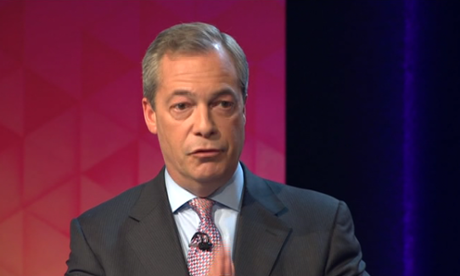
Farage has just said that, even if Britain were to vote in a referendum to stay in the EU, Ukip would still have a role. In fact, he argued, the rise of the SNP since last September’s referendum showed that Ukip could thrive even if it lost the in/out referendum.
If it’s a full, free and fair referendum I will accept the result. Would it make UKIP redundant? No, because just look at what’s happened in Scotland. The Scots – the Scots rejected their independence referendum and yet the SNP have gone to remarkable heights since then.
The Guardian/ICM poll drilled into various character traits of the two potential prime ministers.
Ed Miliband is ahead on five of the nine questions asked here. By 51% to 32% the viewers trusted him, not Cameron, to govern “in the interests of the many and not the few”, and – by 45% to Cameron’s 38% – to have “the courage to say what’s right, rather than what is popular”. By 42% to 30% the Labour leader is seen as the more understanding of “people like me”, and where 45% charge Cameron with being “more spin than substance” only 37% describe Miliband that way. Miliband will be pleased, too, that the viewers were more inclined to see him than Cameron – by 39% to 33% – as having “changed his party for the better”.
The prime minister, however, maintains an edge on another four fronts. By a crushing 57% to 20% he is seen as more likely to be “respected around the world”, and is also – by 46% to 22% – seen as being the one who would fare better “in a crisis”. By 44% to 33%, Cameron is also seen as more strongly “backed by his party”, and by 49% to 32% as being the more decisive.
Updated
Here’s tomorrow’s Guardian front page.
Tomorrow's Guardian front page. Miliband: No SNP deal pic.twitter.com/O1rUVG97qa
— Paul johnson (@paul__johnson) April 30, 2015
Here are the full Guardian/ICM tables.
More from Ask Nicola Sturgeon.
Overall, Twitter says it was a bit dull.
Well that Scottish #bbcqt section with @NicolaSturgeon was bloody dull. Which, in an election, is a good thing for a party leader in front.
— Severin Carrell (@severincarrell) April 30, 2015
@severincarrell @NicolaSturgeon Should have bused up the Leeds audience. Actually, the BBC should put the Leeds audience on a retainer.
— Gillian Bowditch (@GillianBowditch) April 30, 2015
But Sturgeon was pressed quite heavily on the prospects of holding a second referendum.
Another referendum in 10 years? @NicolaSturgeon "I don't know the answer to that"
— Peter MacMahon (@petermacmahon) April 30, 2015
"We've had the vote. Move on" narked audience member tells @NicolaSturgeon re Indyref2
— Tom Gordon (@HTScotPol) April 30, 2015
And some commentators were not impressed.
This is from LabourList’s Conor Pope.
Sturgeon is getting mauled from the audience for not ruling out second referendum. She is really unconvincing on it #BBCQT
— Conor Pope (@Conorpope) April 30, 2015
From Gerry Hassan, an academic
#Sturgeon has played #GE2015 superbly. But she has left a weak flank on #indyref2. Should have closed down. #AskNicola
— Gerry Hassan (@GerryHassan) April 30, 2015
From the Scotsman’s David Maddox
If "once in a generation" isn't now true of a referendum why should people believe Sturgeon say "this election is not about independence"?
— David Maddox (@DavidPBMaddox) April 30, 2015
From Charlie Whelan, Gordon Brown’s former spin doctor
Story tonight Sturgeon getting pasted on Scottish TV over second referendum
— charlie whelan (@charliewhelan) April 30, 2015
Several of the Labour spinners were asked to clarify whether Ed Miliband was just ruling out a deal with the SNP or the Lib Dems as well.
Caroline Flint, the shadow energy and climate change secretary, said:

Look, the thing at the moment is that the Tories have manufactured this SNP debate because they want us to lose seats in Scotland.
What has to be clear to everyone in Scotland is that if you want a fairer Britain with progressive politics you need a Labour government.
She added:
The Liberals [Lib Dems] are irrelevant to this debate. We are not going to be in hock to the SNP and there are too many differences between us. This is about over the next seven days, getting a majority for Labour.
The Lib Dems - who knows where they’ll end up.
Updated
More from the ICM post-Question Time poll:
Viewers were pressed on what issues would be especially important to them when it came to casting their vote after they had watched show.
Labour will be pleased that all three of the most salient questions are those on which it feels it is making the weather – the NHS was top, named as a priority by 53%, followed by “the prospect of cuts to public services, benefits and tax credits”, a priority for 37%, and “squeezed living standards”, a choice for 24%.
Anxiety about excessive government debt (named by just 21%) and “the likelihood of tax rises (15%) registered with fewer people, which may concern the Tories, as these are both charges they lay at Labour’s door. The Conservatives will, however, be pleased that their threats about “the possibility of a smaller party holding the next government to ransom” are cutting through with a significant minority of voters. Some 20% name this as a concern that will be at the forefront of their mind in casting a vote – not as high as with big Labour issues like health, but a remarkably strong showing for a “process” issue of this sort.
Updated
More from the spin room.
Great line from Lucy Powell on Miliband's minor trip: "Ed slipped on David Cameron's sweat." #GE2015 #bbcqt
— Ben Glaze (@benglaze) April 30, 2015
TheySay Twitter analysis says Cameron 'won' debate
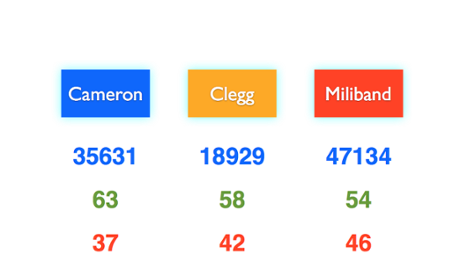
According to a Twitter sentiment analysis from TheySay, David Cameron “won” the debate, in the sense that he generated proportionately more positive tweets.
Here are the scores.
Cameron: +26 (percentage positive minus percentage negative)
Clegg: +16
Miliband: +8
And here are the raw figures. The blue figures are the raw number of tweets, the figures in green are proportion positive, and the figures in red proportion negative.
And here is some more detail comment, from TheySay’s Karo Moilanen.
On Cameron
Cameron was the clear winner of the 3-way debate in that his positive sentiment ratings (at 63%) towered above Miliband and Clegg.
After an initial deep drop in sentiment, Cameron’s positive sentiment started a steady climb which increased even during Miliband’s questioning and which lasted all the way till Clegg’s round.
Negative feelings expressed towards Miliband concurrently generated a lot of tacit positive sentiment for Cameron.
On Miliband
Miliband’s performance clearly evoked the most extreme reaction on Twitter, with the highest levels of anger, fear, uncertainty, agitation, speculation, and, once again, humour. Miliband generated the most traffic on Twitter (ca. 1.2 times more than Cameron). Despite his huge volume, Miliband lost to Clegg by a rather large margin, with the lowest positive sentiment ratings at just 54%. The first half of Miliband’s questioning saw a huge drop in sentiment which improved momentarily before diving again. Miliband’s sentiment improved right at the end of the programme. Miliband’s answers to the tough economic questions led to a surge of negative sentiment, doubt, agitation, fear, and anger.
On Clegg
Clegg delivered a surprisingly competitive, robust performance which reached the second highest positive sentiment levels at respectable 58%.
Typically, Clegg’s twitter volume was a pale shadow from Cameron and Miliband (e.g. Cameron generated 1.9 more traffic than Clegg).
After a lacklustre start, Clegg’s ratings started a steady climb which ended at levels of greater than Miliband.
UPDATE: But the Sun’s Twitter sentiment “worm” concluded that Ed Miliband won.
Updated
Question Time: were the audience the biggest winners? – video
The British public outfox David Cameron, Ed Miliband and Nick Clegg during the BBC’s Question Time. In a special election edition of the famed political discussion show, the leaders of the three major British political parties find themselves well and truly stumped by a succession of pointedly intelligent questions from the audience.
The crucial thing about Ed Miliband’s emphatic line on “no deal at any cost” is that he’s ruling out any attempt to sabotage a viable Tory minority government by forming an anti-Tory bloc with the SNP - a proposal that Nicola Sturgeon, Alex Salmond and deputy leader Stewart Hosie have been pushing hard.
It’s a hardline stance which in one sense deals with a politically tricky dilemma for Miliband, since an SNP-brokered effort to block the party chosen by more English voters would provoke an English backlash, but it could be risky for Labour in Scotland in the longer term.
Tim Farron, the Lib Dem former president and left-leaning possible leadership contender, said he thought Miliband’s performance was “very poor” and Cameron was “shifty” about the cuts.
Asked about the Labour leader ruling out deals, Farron said:
I thought Miliband was ruling out reality.”
Deborah Mattinson, founder of BritainThinks, has provided this analysis from the focus group verdict on Question Time (see 9:56pm):
Smaller response on the panel than we’ve seen in previous debates reflecting their weariness as we get closer to the poll. 16 people took part.
Overall, Cameron received the most positive response – he seemed professional and competent. Dean from Ealing declared it: “all round a good performance”, while Husna from Dewsbury says: “I won’t vote for him but can’t deny that he’s a good politician.” They particularly liked his “earning and learning” line.
Miliband is now expected to do better, and, on that basis, slightly under delivered, especially at the start. His response about not over promising and under delivering, though, showed passion and seemed refreshing. Muna from Ealing said: “I like that he actually answered the question even if it’s uncomfortable to watch.” Some were relieved at his ruling out of any arrangement with the SNP but others were puzzled by what the implications were.
Clegg was the biggest surprise – most had written him off but, after a tetchy start, he came over as honest and direct, perhaps reflecting their view that he no longer had much to lose. As David said: “knowing he can’t win next week he talked honestly and openly about his views.”
All liked the Question Time format and thought the audience were suitably tough on everyone.
Our focus group in Taunton Deane watched the Q&A live. They found Cameron the winner but were also positively surprised by Clegg, making their constituency choice harder. He succeeded in landing the idea that he could moderate the worst selves of either side.
Updated
An instant Guardian/ICM poll found that David Cameron had come out on top. 44% of viewers of the Question Time programme felt that the PM had done “best on the night”, compared to 38% for Ed Miliband and 19% for Nick Clegg. These figures exclude those who said nobody or didn’t know.
Ranged against an often hostile studio audience, viewers at home were inclined to say that all three of the political leaders had done well rather than badly – and by fairly similar majorities. David Cameron was seen as doing “very or “quite” well by 65%, Miliband by 61% and Clegg by 63%.
Relatively few votes are likely to have been changed by the evening: only 6% of the sample indicated that their mind had been changed by what they saw, as against 87% who said it would make no difference to how they voted. Among this small sub-sample, of 79 respondents, Clegg did the best – with 32% of switchers indicating that they might now lean Lib Dem, as against 25% who said Conservative, and just 20% who said Labour. Among the overall weighted sample, a 5 percentage point Labour lead at the start of the show had diminished by a single point to 4%.
Miliband will be pleased that, in contrast to much negative personal polling, he drew the prime minister level – with 43% each – on coming across as having “the more appealing personality”. But in line with Cameron’s overall advantage, he bested Miliband – by 47% to 42% – on having the better arguments.
On the crucial “best prime minister” test, Cameron retained his usual comfortable lead, although not by the dramatic margin sometimes seen – he prevails on this score by 48% to Miliband’s 34%.
ICM interviewed 3,972 adults aged 18+ online on April 28-30. All agreed to watch the BBC Question Time Election Leaders Special and to complete a second interview immediately after it finished, which 1,288 did in the first few minutes. The data has been weighted to the profile of all GB adults, including in relation to recalled 2010 General Election voting.
Updated

Lucy Powell, Labour’s election campaign chief, disputed the idea that Cameron outperformed Miliband:
There was a very low bar for Cameron about his performance level. We’ve actually seen him tonight, which is a new event in the campaign. He gave a poor performance and that was quite a low bar for him to get to his best performance.
She said she disagreed with former Labour home secretary David Blunkett about the possibility of an SNP tsunami in Scotland:
Let’s hope not because if that happens it is a sure fire way to see David Cameron back in Downing Street.
She said:
(Ed) was really clear that if it means being prime minister by having to do a deal with the SNP he’s not going to do that.”
Updated
I’ve updated the post at 9.42pm with details of the sample size from our poll.
Nicola Sturgeon has echoed the SNP central line on Miliband’s outright rejection of any deals or pacts with the SNP, even if it prevented him forming a minority government, arguing before a BBC audience that Scottish voters “would not forgive” Labour if it allowed the Tories a second term.
And pressed again on whether a second referendum was on the agenda, she stated:
This election is not about independence. Even if the SNP won every single seat in Scotland next week, that’s not going to result in another referendum. I can’t be clearer and I can’t be straighter with the Scottish people than that.
Updated
George Osborne was the most senior Tory to appear in the spin room, where he defended Cameron’s evasiveness on welfare cuts:

Sure they were tough questions on welfare, but actually, David Cameron turned that around.
The chancellor said:
He used those welfare questions to set out a really positive approach, very different from Ed Miliband who got trapped on the economy questions.
Asked whether the large number of questions on welfare showed the Conservatives were weak on that issue, he said:
You’d have to ask the BBC that. They chose the questions.”
Osborne claimed the prime minister “nailed it”, adding:
After an hour it was very clear only one of them had the leadership qualities.
Pressed on why he would not name specific welfare cuts, the chancellor said:
David Cameron has been answering those questions. It was a compelling performance and we will see what happens in the next seven days.
Updated
Nicola Sturgeon says Miliband would prefer Tory government to deal with SNP
BBC Scotland is currently showing its Ask Nicola Sturgeon programme.
In it, Sturgeon has already responded to Ed Miliband’s point about not doing a deal with the SNP.
Sturgeon says "Ed Miliband "sounded as if he was saying he would rather see Cameron and the conservatives back in govt than work with snp."
— Tim Reid (@TimReidBBC) April 30, 2015
SNP leader @NicolaSturgeon - Scotland would never forgive Labour for preferring a Tory govt to a deal with the SNP. pic.twitter.com/TuGPksyVAk
— James Cook (@BBCJamesCook) April 30, 2015
According to the YouGov tracker figures, these are the most recent figures when people are asked who would make the best prime minister.
David Cameron: 40%
Ed Miliband: 26%
Nick Clegg: 6%
Tonight’s ICM figures show a similar pattern - Cameron comfortably ahead of Miliband, with Clegg trailing well behind - suggesting that the way people judged the debate may have been influenced by what they thought anyway about who was best.
Updated
Focus group verdict on Question Time
Our BritainThinks focus group’s verdict on the campaign
What do the real voters think? We have 60 in five key seats giving their view throughout the campaign as part of our polling project with BritainThinks. They each have an app and are telling us what they think of stories as they crop up.
Below are some of their thoughts on how each of the leaders did, yet most of the responses came in as David Cameron took the Question Time set:
SNP says Scotland would never forgive Miliband for letting in Tories
The SNP has already attacked Ed Miliband for his comments about not doing a deal with it after the election. This is from Stewart Hosie, the SNP’s deputy leader.
If Ed Miliband is saying that he would rather let the Tories back into government than work with the SNP to keep them out, people in Scotland and indeed elsewhere in the UK would never forgive the Labour Party.
This makes it even more important that Scotland unites to elect a big team of SNP MPs, so that we are in a decisive position at Westminster and Scotland can never again be ignored.
Labour already had huge problems in Scotland - Ed Miliband has just made them a whole lot worse.
Guardian ICM poll - 44% says Cameron won, 38% Miliband, Clegg 19%
Here are the results of our poll. A colleague has just sent me this.
An instant Guardian/ICM poll found that David Cameron had come out on top. 44% of viewers of the Question Time programme felt that DC had done “best on the night”, compared to 38% for Ed Miliband and 19% for Nick Clegg.
ICM interviewed 3,972 adults aged 18+ online on April 28-30. All agreed to watch the BBC Question Time Election Leaders Special and to complete a second interview immediately after it finished, which 1,288 did in the first few minutes. The data has been weighted to the profile of all GB adults, including in relation to recalled 2010 General Election voting.
Updated
Rowena Mason, our political correspondent, has been in the spin room and has the reactions from the journalists:
William Hague, Liz Truss, Caroline Flint, Lucy Powell have just arrived in the spin house. Journos stopped listening to end of Clegg...
— Rowena Mason (@rowenamason) April 30, 2015
Ed Miliband makes clear he would rather not have a Labour government than a confidence and supply with SNP. Spin room perks up with interest
— Rowena Mason (@rowenamason) April 30, 2015
Silence in the spin room as Cameron gets a hard time on welfare and food banks. pic.twitter.com/2tPra6BNci
— Rowena Mason (@rowenamason) April 30, 2015
Updated
Nick Clegg - Snap verdict
You would have expected Nick Clegg to have had the toughest time, but it did not feel like that. The audience continued to ask sharp, aggressive questions, but somehow there was less passion in the last 30 minutes, probably because there is so much less at stake. Clegg is a diminished figure, and it shows. He also put in a creditable performance - no one bombed tonight - but Clegg seemed happier in multi-candidate debates, where he could differentiate himself from the others and present himself as the moderate choice.
Overall, it has been at least 60 minutes of good TV, but this does not feel like an event that is going to shift perceptions. It would not surprise me if the polling figures we get broadly reflect what the polls are saying about voting intention.
Unusually, though, this “debate” has generated a story: what Ed Miliband said about not doing a deal with the SNP.
Here are some tweets on Clegg.
Clegg is sounding irritable with the questions he's asked. Not a mistake Miliband or Cameron made #bbcqt
— Tim Montgomerie ن (@montie) April 30, 2015
This is like the most testing kind of X Factor. Nick Clegg doing quite well, so far, though he has had an easier ride than Ed M.
— tom bradby (@tombradby) April 30, 2015
Clegg getting applause here for saying he'll be brake on other two parties but it a tough slog for him, and he needs to get votes tonight
— Allegra Stratton (@BBCAllegra) April 30, 2015
Air is hissing out of the balloon with Nick Clegg
— Adam Boulton (@adamboultonSKY) April 30, 2015
More difficult for Clegg tonight - doesn't have the other leaders on stage to define himself against.
— Allegra Stratton (@BBCAllegra) April 30, 2015
Whisper it softly, and expect no Cleggmania, but the Lib Dem leader is doing quite well - especially on income tax threshold. #bbcqt
— The Economist (@EconBritain) April 30, 2015
Updated
Q: If you cannot remain in government, will you stay as leader of the Lib Dems?
Clegg says he is only 48. He has got bags of energy.
That is not quite a yes.
Dimbleby stops him. They have run out of time.
No Question Time next week, he says. But he says there will be a programme on Friday.
And that’s it.

Updated
Clegg has lost some in the spin room.
Loud chat at the back of the spin room. Not everyone listening to Nick Clegg.
— Adam Boulton (@adamboultonSKY) April 30, 2015
Fact check: does the party with most seats get to form a government?
Nick Clegg says that party with most seats next week has the right to
form a government. But this is not necesssarily the case. The House of Commons website says:
In a situation of no overall control the government in power before the general election gets the first chance at creating a government, If they cannot do so, the prime minister will resign.
Cameron gets the first chance whether or not the Conservatives are the largest party.
This is from the Sunday Times’ Tim Shipman.
Clegg pretending he won't give in on a referendum. Can and Mili pretending they will get a majority. This is one giant disingenuous meringue
— Tim Shipman (@ShippersUnbound) April 30, 2015
Q: Do you support Trident?
Clegg says he supports Trident, but he would change the way it operates. We can scale it down to an extent, he says.
Clegg says we are stronger when we do things together.
Q: But what happens if the EU breaks up?
Clegg says he cannot imagine any situation in which it would make sense to leave the EU.
Would any big Japanese or Chinese firms invest here if we were bobbing along in mid-Atlantic.
Q: If you believed in democracy, you would back a referendum?
Clegg says he has legislated for a referendum.
Fact check: foodbanks
Trussell Trust, a British charity, says sanctioning those on benefits is increasing driver of demand for foodbanks:
83% of Trussell Trust foodbanks surveyed recently reported that benefits sanctions, which have become increasingly harsh, have caused more people to be referred to them for emergency food. Half of referrals to foodbanks in 2013-14 were a result of benefit delays or changes.

Updated
Q: Is free movement in the EU creating a problem in the UK?
Clegg says it did create a problem when free movement became the same as freedom to claim benefits.
He decided as deputy prime minister to break the link between being an EU citizen and being able to claim benefits.
Q: Where do you stand on an EU referendum?
Clegg says he and Cameron legislated for a referendum when powers are handed over to Brussels. Cameron has now changed his mind.
Q: The logic of your position is that you would not support a Tory referendum.
Clegg says the Tories change their mind so much, he does not know what they will think next Tuesday.
Clegg says Britain was in a real crisis in 2010. We could have gone the way of Greece.
Q: We were nothing like Greece.
Clegg says he does not accept that. Our banking crisis was much more severe.
Q: Why did you not form a government with Labour in 2010?
Clegg says there was the small matter of democracy, and how people voted.
Earlier Nick Clegg said his decision to back tuition fees was a difficult one for him. James O’Shaughnessy, Cameron’s former head of policy, says Clegg is not telling the truth.
Clegg talking crap on tuition fees. He wasn't between 'rock and hard place'. I was in the room when he decided to vote for it. He was keen.
— James O'Shaughnessy (@jamesosh) April 30, 2015
Two reasons Clegg made LDs vote for £9k fees: 1. He thought that, as it came from LD dept (BIS), they should. 2. He agreed with policy.
— James O'Shaughnessy (@jamesosh) April 30, 2015
He is also quite blunt about Miliband.
Won't do "a deal" with the SNP, won't "barter away" his manifesto. Not only are they blatant lies, they are massive hostages to fortune.
— James O'Shaughnessy (@jamesosh) April 30, 2015
Q: How can we trust you given the fact that you broke your promise last time?
Clegg says that is why he has been so clear on what the Lib Dem red lines would be. The Lib Dems, for example, would not accept education cuts. They are demanding more spending.

Updated
Clegg says he is not pretending he will win a majority, unlike David Cameron and Ed Miliband.
Q: Someone has to be PM. Who will you make PM if you have to decide.
Either Cameron or Miliband, says Clegg.
But it might be such a mess that there will be no PM?
Clegg says he does not accept that.
The real question is, who is going to be in Number 10 with Cameron or Miliband. Do you want Cameron dependent on the swivel-eyed brigade, or Miliband at the beck and call of the SNP
Nick Clegg
Q: Is leaking details of coalition talks likely to get you invited into coalition again?
Nick Clegg says this is not a leak. Danny Alexander has spoken about this quite openly.

Updated
Fact check: was the UK's deficit worse than Greece's?
Clegg said we could have been Greece in 2010.
Technically speaking it is true that Britain and Greece had a similar deficit (roughly 11% of GDP) five years ago. However, that is where the similarities end. Britain was never on the verge of going bust.

First, once Greece’s deficit was revised based on more solid statistical procedures it ended up at 15.7% of GDP.
Second, the UK entered the financial crisis with relatively low public debt (less than 70% of GDP – that’s pretty much in line with Germany at the time).
Greek public debt was above 120%, the highest in the EU, and its economy contracted by more than 5% in 2010 and by nearly 10% the year after – more than any other country in Europe.
Third, Britain had, and still has, far stronger and more stable institutions than Greece. In 2010, the estimated tax evasion costs for the Greek government amounted to well over $20bn (£13.5bn) per year. That means it can’t pay its bills.
Fourth, and most importantly, Greece did go bust and had to request a bailout that now totals about €240bn (£175bn). Since the initial bailout programme, two rounds of relief have also been applied to Greece’s debt burden, which extended the maturity of the country’s debt to an average 16.5 years, double that of Germany and Italy.
Sir Nicholas Macpherson, the permanent secretary to the Treasury, has said:
The UK is not Greece. It has much stronger institutions and – most important of all – a floating exchange rate.
Updated
Ed Miliband - Snap verdict
At least one thing is clear; there is no competition for the title of audience from hell. Guido Fawkes is delighted.
This audience has no qualms about calling Cameron and Miliband liars. Excellent. #BBCqt
— Guido Fawkes (@GuidoFawkes) April 30, 2015
But Guido is a leading light in the “they’re all crooks” school of political journalism. Having praised the audience for their tough questions earlier, I’m starting to have second thoughts. The fact that someone thinks we might have weathered the recession better if Gordon Brown had not sold the gold says it all.
But how did Ed Miliband do? Like Cameron, he responded well to tough questioning. He interacted more with the audience, which grated sometimes, but he was also funnier, and overall he was confident and robust. Unlike Cameron, he “committed news”, in his comments about not doing a deal with the SNP, even if it would cost him power. As I have said before, after 7 May there may well be considerable debate about what a “deal” actually means. If he does form a government dependent on SNP votes, he has just handed the Daily Mail et al one enormous stick with which they can beat him.
Here are two other Twitter comments that caught my eye.
@Ed_Miliband impressively calm in response to good questioning, but making speeches rather than answering directly.
— Joey Jones (@joeyjonessky) April 30, 2015
Ed Miliband standing firm on SNP despite tough questioning from Dimbleby and audience. Playing a tough hand with confidence. #bbcqt
— The Economist (@EconBritain) April 30, 2015
Updated
Fact check: net migration target
Both Labour and Tories want to restrict EU access to benefits, tackle wage-cutting and ensure public employees in public-facing positions speak english - Cameron has downgraded net migration target to an ambition - Miliband says missed targets corrode trust.
Updated
This is proving to be a tough crowd for @Ed_Miliband as he's confronted by sceptical Yorkshire businessmen & women. Public beat pros again
— Nick Robinson (@bbcnickrobinson) April 30, 2015
Q: What are you going to do to control immigration?
Miliband says he has changed Labour’s stance on immigration.
He would stop employers bringing migrants in to undercut local Labour.
There have only been two prosecutions in this area, he says.

Updated
Q: A ban on zero-hours contracts will stop me running my business?
Our next question to @Ed_Miliband is on Labour's approach zero hours contracts: #bbcqt #GE2015 pic.twitter.com/fSNoBhW2N4
— BBC Question Time (@bbcquestiontime) April 30, 2015
What is your business?
Tourism, says the man. I need people when the sun is shining.
Miliband explains the plans to give someone the right to a contract if they have worked regularly for 12 weeks.

Updated
Q: What would you do on the welfare bill?
Miliband says there is a cap on welfare spending. Labour has accepted that.
It has also put forward plans to cut winter fuel payments for the wealthy.
But he wants welfare to go down, and for people to be paid more.
Q: So do you expect employers to fund the welfare bill?
Miliband says he is not expecting employers to fund the welfare bill.
But, because we are one of the low pay capitals of Europe, we have a high welfare bill.
Q: Does your party think that living on benefits is a valid lifestyle choice?
No, says Miliband.
Q: Don’t you realise how much more people would trust you if you told the truth? (The questioner is asking about Miliband saying he wants a majority.)
Miliband repeats the point about not bartering aways his principles.
He does not want to make a false promise. He saw what happened to Nick Clegg.
Q: Why do you trust your view more than the public’s on an EU referendum?
Miliband says, when he looks at the problems facing Britain, an EU referendum is not a priority. There are more important issues.
Q: But why won’t you trust people?
Miliband says leadership is about sticking to what you think is right.
We only get an election every five years. Do you want the country run for non-doms? Or do you want it run for people like the lady who asked about tax credits.
Here’s the FT’s Giles Wilkes on Miliband’s comment about not doing a deal with the SNP.
I suspect that Miliband's specific answers on the deals with the SNP will have the greatest bearing on future history of this evening
— Giles Wilkes (@Gilesyb) April 30, 2015
Fact check: Labour-SNP deal and Trident
Ed Miliband says we are not going to do a deal or have a coalition with the SNP or give into the SNP’s demands on Trident or the deficit.
But he did not rule out a vote by vote arrangement which could see the SNP keeping a minority Labour government on the road.
Trident could get through on the votes of Tory MPs as could deeper cuts than the SNP want in a Labour budget.

Updated
Miliband says he is not going to start bartering away his manifesto.
Nigel Farage has offered his verdict on the programme so far.
Cameron & Miliband scared of #SNP, just months after appeasing with money and power. Only UKIP MPs will revise the Barnett formula. #bbcqt
— Nigel Farage (@Nigel_Farage) April 30, 2015
Miliband rules out deal with SNP, even if that cost him chance of being PM
Q: Why are you lying about not doing a deal with the SNP?
Miliband says he is not going to do a deal with the SNP?
And that is his position, even if it means sacrificing his chance of being prime minister.

-
Miliband rules out a deal with the SNP, even if this costs him the chance of being prime minister.
That is the first proper news of the programme.
Dimbley asks for clarification. What does he mean by “deal”?
A confidence and supply arrangement, he says.
Updated
Q: If you cannot accept that you overspent, why should we trust you again.
Miliband says some parties want no cuts. That is not his policy.
Q: You are committed to more borrowing. That is going to affect my age group.
Miliband says he has a balanced plan.
He addresses Jenny, the woman who asked Cameron about tax credits. Cameron may have sounded like he was giving an assurance, but he was not. He says under Labour tax credits will not be cut. Tax credits and child benefit are now on the ballot, he says.
Q: Canada and Australia did not have these problems. We spent too much. And we sold off gold. You are just lying.
Miliband says he is not going to convince this man.
Q: If I have run out of money at the end of the week, I have overspent. You sold the gold. If we had that, we would be better off.
Q: Could you bridge the gap between the richest and the poorest?
Miliband asks the questioner her name. It’s Shirley.
Miliband mentions the non-dom rule. It has been here 200 years. He is going to get rid of it, he says.
Q: Do you accept Labour overspent when it was in power.
No I don’t, says Miliband.
Schools have been rebuilt, hospitals were rebuilt, Sure Start centres were build.
There was a global crisis. President Obama is not dealing with a high deficit because of Labour spending.
Updated
Ed Miliband
Q: You left a note saying there’s no money. How can we trust you on the economy?
Ed Miliband says he has a clear plan. He will cut the deficit, but in a fair way, with taxes for the rich. And he accepts that Labour did not regulate the banks properly.
Q: I run a business. But we have a plan, and the economy is improving. Ed Balls called that Liam Byrne letter a joke. You want to put him back in charge. That worries me.
Miliband asks what the business is. It’s a marketing business, he says.
He believes the economy succeeds when working people succeed.
He would cut business rates for small businesses like hers, he says.
Q: I asked why I should trust a chancellor who said that was a joke. If he worked in the corporate world, he would be fired.
Miliband says Ed Balls takes getting the deficit down incredibly seriously.

Updated
Fact check: EU migrants and benefits
David Cameron implies EU migrants come only for the benefits.
Four times as many Brits claim unemployment in UK as Germans in Britain. Cameron says that EU migrants get £8,000 a year in work benefits but didn’t mention that was mainly tax credits and they pay tax and national insurance.

Updated
David Cameron - Snap verdict
Ronald Reagan once said that you cannot hit a soft ball out of the park, I think, and David Cameron has illustrated that tonight rather well. During this campaign he has been shielded from aggressive scrutiny to a remarkable extent - he would not debate Ed Miliband head to head, he has not held a proper press conference, and he won’t even do Election Call - but tonight he faced very combative questions, and came out pretty well. In fact, it was striking how hostile they were. The audience are the winners so far. And it was interesting how many of the questions were about trust. Cameron was firmly on the defensive, and probably did not win anyone over, but he sounded more engaged than he has of late, and he held up well.
Here is a small selection of Twitter comment on Cameron.
Forget the specific answers: QT is a battle of tone. Cameron is markedly more energetic vs previous TV performances. Can EdM match him?
— Dan Sabbagh (@dansabbagh) April 30, 2015
A tenner says Cameron's first words backstage are something along the lines of "tough crowd". Great TV though. #bbqt
— Craig Woodhouse (@craigawoodhouse) April 30, 2015
TV #bbcqt debate so far: David Cameron has taken a hammering from the audience on welfare, but has fought back hard on NHS.
— The Staggers (@TheStaggers) April 30, 2015
Cameron’s top lip is a bit sweaty but he is doing quite well so far, addressing his ‘passion problem’ and making his arguments
— James Forsyth (@JGForsyth) April 30, 2015
This #bbcqt audience is seriously impressive...much more challenging than audience in Sky/Channel 4 event
— Ian Katz (@iankatz1000) April 30, 2015
Updated
Q: What would you be specific on in coalition talks?
Cameron says having an EU referendum is a red line.

Updated
I am at a pub with Tory activists in Westminster. They are very cheery about Cameron's performance so far.
— Chris Cook (@xtophercook) April 30, 2015
.@David_Cameron Freedom of movement was meant to be about the freedom to move & get a job; not about freedom to move & get benefits #bbcqt
— BBC Question Time (@bbcquestiontime) April 30, 2015
A questioner tells Cameron the questions he is getting have a moral dimension, but Cameron is only answering them in terms of economics.
This gets a round of applause.
Cameron says he sees jobs as a moral issue.
Cameron says he wants to see net migration come down to below 100,000.
Q: You made similar promises in 2010, and you lied. How can we trust you now?
Cameron says he reduced immigration from outside the EU.
Getting immigration down from within the EU is hard. But he now knows what he has to do to cut migrants’ access to benefits. He tells the questioner that he needs a mandate from people like him at the election to get a good deal in Europe.
Updated
Q: If we remain in the EU, how can you control immigration?
This is the Nigel Farage question.
Cameron outlines the changes he would introduce to restrict migrants’ access to benefits. They are big changes that will make a real difference.
Updated
Dimbleby takes Cameron back to the question. Why don’t people trust the Tories on the NHS?
Cameron says this is his life’s work. He has seven days left to prove this to people. But you need a strong economy to keep the NHS strong. The economies that “tank and bomb” cannot look after their health services.
Q: Is it really that difficult to hit the A&E targets?
That is a good point, Cameron says. The hospital here meets it. But there is a lot of pressure on the NHS, he says.
Social care should work with it better.
Cameron says, as long as he is prime minister, the NHS will remain free at the point of delivery.
Cameron's ducking on where £12bn of welfare cuts will fall pushes him into the negative - Sun's Twitter Worm; http://t.co/rkFSOHsp4j
— Tom Newton Dunn (@tnewtondunn) April 30, 2015
Q: Why did you introduce top-down reorganisation in the NHS?
Cameron says the NHS now is stronger than it was.

Updated
Q: Why do you think voters do not trust you on the NHS?
Our third #bbcqt question is about the NHS. #GE2015 pic.twitter.com/r8L70AML0g
— BBC Question Time (@bbcquestiontime) April 30, 2015
Cameron says he can only say what he believes. When his disabled son went to hospital, the NHS was always there for him. He received care, and love. He will always protect the NHS.

Updated
Labour HQ have been in touch. They think Cameron did not rule out cutting child tax credit, because, they say, he only said he did not want to cut it.
Q: Does your decision to propose a tax lock law reflect the fact we cannot trust you because of the lies you told last time?
Cameron says he does not want to keep putting taxes up.
If you want a government that puts taxes up, vote for the other guy.
Q: But why do you need another law?
Cameron says he wants to put it beyond doubt.
Q: George Osborne mocked the idea when Alistair Darling tried something similar in 2009.
Cameron says at the time the budget deficit was forecast to be the same as Greece’s. So, then, it was a meaningless promise.
Now is different.
The spin room winced a little as David Cameron was accused of deceit over welfare by an audience member.
Around a hundred journalists are packed into the tiled hall of Leeds art gallery, along with a smattering of spinners.
Politicians spotted so far include Paddy Ashdown and Tim Farron for the Lib Dems, as well as Paul Nuttall, deputy leader of Ukip (even though Farage is far away in Birmingham for his interview to be aired later).
Cameron says Ed Miliband is saying go on with the budget deficit forever.
Q: Why won’t you debate with him directly, instead of pointing fingers at him in his absence.
Cameron says he has debated Miliband 146 times in the Commons. He does not think a debate would be instructive. This format is better, he says.
Fact check: housing benefit
David Cameron said there were families claiming £70,000, £80,000 and even £90,000 a year in housing benefit. DWP figures show that there are just 6 families claiming more than £1,400 a year in housing benefit - each with more than nine children - totalling £73,000 a week. The DWP say only 698 families are getting more than the £500 a week housing benefit cap. The DWP said:
In real terms, housing benefit has fallen for the first time in a decade.
Updated
This is from Marcus Roberts, the former Fabian Society deputy general secretary.
Cameron has clearly drunk the 5 espressos Crosby gave him. But I worry that in his need to show "passion" he'll run over his questioners!
— Marcus A. Roberts (@marcusaroberts) April 30, 2015
Cameron rules out cutting child tax credit and child benefit
Q: Do you either know what you want to do on welfare and aren’t saying? Or don’t you know?
Cameron says he did not ask for the report mentioned by Danny Alexander.
He produces the “there’s no money” note left by Liam Byrne.
He is not answering Dimbleby’s question. Instead, he is saying he never wants to go back to the “even more debt” policies of Labour.
Q: Can you guarantee that you won’t cut child tax credit or child benefit?
Cameron says child tax credit has increased.
It is not going to fall.
And child benefit is a key benefit for families. It is not going to change.
-
Cameron rules out cutting child tax credit and child benefit.
But he does not seem to be ruling out cutting other tax credits.
Q: You quoted some families receiving £70,000 in benefits. How many families were actually on that?
Not many, says Cameron. But you have to keep welfare down. If you don’t want that, vote for Ed Miliband.
Q: You are refusing to give specifics. How could I vote for you?
This gets a large round of applause.
Cameron says he cut £21bn from welfare in the last parliament. Now he only needs to cut £12bn. The alternative is to take money from the NHS.
He says he does not want young people to be able to start their life on benefits, with a home provided by the state.
Q: But what about young people who don’t have support?
That is a good point, says Cameron. They need support. But it is not right that at the age of 18 you can sign on and get a flat. Other countries in Europe have abolished youth unemployment. We can do the same thing.
Starting a life on benefits is frankly no life at all.
David Cameron
David Cameron arrives.

Q: [From Jenny Johnson] Will you put to bed rumours that you will cut child benefit and tax credits.
Yes, says Cameron.
The report in the news today is one that he rejected at the time, and is rejecting again today.
But it is important to reform welfare, he says.
Cameron is standing up, rather than answering from the stool he was given to sit on.
Dimbleby says Cameron said he did not want to put to bed the rumours, when he meant he had.
Updated
Question Time Leaders Election Special
David Dimbleby is introducing the programme.

He explains how the audience was selected.
Updated
PM just overheard in studio, by us in spin room in warm up for @bbcqt saying "1,2,3 really good to be here, really big opportunity"
— Allegra Stratton (@BBCAllegra) April 30, 2015
Caroline Flint, the shadow energy secretary, is in the spin room for Labour. She is spinning on Twitter too.
Once again David Cameron is in the same place with the same audience but refuses to debate @Ed_Miliband face to face #bbcqt #labour
— Caroline Flint (@CarolineFlintMP) April 30, 2015
Tories unhappy 50% of #BBCDebate audience is left-wing, Labour that 50% is govt. LDs delighted they're on 25% for the first time in 5 years
— Alberto Nardelli (@AlbertoNardelli) April 30, 2015
More from the spin room.
Lib Dem big guns here tonight: Paddy Ashdown and Tim Farron. #bbcqt
— George Eaton (@georgeeaton) April 30, 2015
Loving the Art Deco spin room for leaders #bbcqt programme in Leeds . pic.twitter.com/wDvqTEHOfZ
— norman smith (@BBCNormanS) April 30, 2015
"Scotland forever" Royal Scots Greys Waterloo charge in Leeds Arts Gallery, tonight the #bbcqt spinroom pic.twitter.com/yH2vhDIlS9
— Torcuil Crichton (@Torcuil) April 30, 2015
Ah I'm informed the spin room is actually High Victorian Gothic not Art Deco #pleb #ignoramus #bbcqt
— norman smith (@BBCNormanS) April 30, 2015
8 mins #bbcqt. But what impact will tonight's debate have? Exclusive poll shows how important TV is for older voters. pic.twitter.com/34flPc4kTC
— May2015 Election (@May2015NS) April 30, 2015
Ed Miliband has used Twitter to post his own question to David Cameron.
There’s no question the Tories will cut child benefit if they win, the only question is will David Cameron be honest about it tonight #BBCQT
— Ed Miliband (@Ed_Miliband) April 30, 2015
Leaders arrive

Here is David Cameron arriving at Leeds town hall for the Question Time event:

And here is Ed Miliband walking up the steps of the town hall and in conversation with James Harding the BBC director of news, just a few minutes ago:

Updated
And here is the spin room.
Looking down on the spin room / 10th circle of hell pic.twitter.com/K49WnCE1EG
— Ross Hawkins (@rosschawkins) April 30, 2015
The Question Time leaders show spin room https://t.co/rgfdHmOcDf
— Ross Hawkins (@rosschawkins) April 30, 2015
The Question Time event is in Leeds town hall. As the BBC’s Ross Hawkins reports on Twitter, the building is full of sound advice for our leaders.
Honesty is the best - a slogan looming above the leaders' Question Time show tonight pic.twitter.com/rp5zMHaT6v
— Ross Hawkins (@rosschawkins) April 30, 2015
More Victorian civic advice from setting of Question Time leaders show pic.twitter.com/CFaBhdJcYZ
— Ross Hawkins (@rosschawkins) April 30, 2015

Ukip has accused the BBC of “capitulating” to the BBC by not allowing Nigel Farage to be included in the election Question Time. This is what Suzanne Evans, the Ukip deputy chair, said earlier.
Ukip is very disappointed that it seems that the broadcaster and the BBC have capitulated to David Cameron’s demands not to be seen alongside Nigel Farage, because he’s clearly, I think, running scared of him.
A week tonight we’ll be hours away from the election result. And, with the polls still suggesting that neither of the two main parties has achieved a breakthrough yet and that we’re heading for a hung parliament where David Cameron and Ed Miliband could both struggle to win a majority, tonight is the last big set-piece TV event of the campaign.
It is the Question Time Election Leaders Special. We are not going to see Cameron, Miliband and Nick Clegg debate head to head, but they will all be grilled by a Question Time audience, with David Dimbleby chairing and, hopefully, asking the incisive, deadly follow-up questions that make him such a good chair for events like this.
To add some edge, the Guardian will be conducting a poll after it is over, asking viewers who won. The results will be published first here, a few minutes after the show is over.
Later, Nigel Farage, the Ukip leader, Nicola Sturgeon, the SNP leader, and Leanne Woood, the Plaid Cymru leader, will also be grilled by BBC audiences on programme being shown in England, Scotland and Wales respectively.
The Question Time event has already generated a row about the composition of the audience, as my colleague Mark Sweney reports. Here’s an extract from his story.
The BBC has defended how it chose the audience for the leaders’ debate on Question Time, after its selection process was accused of both leftwing and pro-coalition bias.
The audience for BBC1’s Question Time Election Leaders Special on Thursday, which will feature David Cameron, Ed Miliband and Nick Clegg, will be made up of 25% of those who say they will vote Tory, 25% Labour supporters, 25% Liberal Democrat supporters, 15% who favour “other parties” and 10% who say they are undecided.
Election 2015 interactive: who is ahead in the polls where you live? Read more
The Telegraph and the Sun both said the composition of the audience exaggerates the proportion of people likely to vote Liberal Democrat, and that up to two-thirds of the 150-strong audience could be leftwing supporters.
Tory MP Andrew Brigden, a critic of the BBC, said that the selection process proved the “unashamed leftwing bias of the BBC”.
Quite why Bridgen thinks Lib Dem supporters are “leftwing” is a mystery. The Lib Dems lost most of their leftwing supporters for years ago.

Here is the timetable for tonight.
8pm: Question Time starts, with David Cameron being interviewed.
8.30pm: Ed Miliband is interviewed.
9pm: Nick Clegg is interviewed.
9.30am: BBC Scotland broadcasts Ask Nicola Sturgeon. It is going out live.
Around 9.45pm?: The Guardian’s Question Time poll should be out.
10.40pm: BBC Wales broadcasts Ask Leanne Wood.
10.50pm: The BBC in England broadcasts Ask Nigel Farage, although it is pre-recorded and a transcript should be available earlier.
I will be covering the Question Time event in full, and covering the best reaction and analysis afterwards, as well as posting the poll results. And I will be covering the highlights from the other three programme.
If you want to follow me on Twitter, I’m on @AndrewSparrow.
Updated