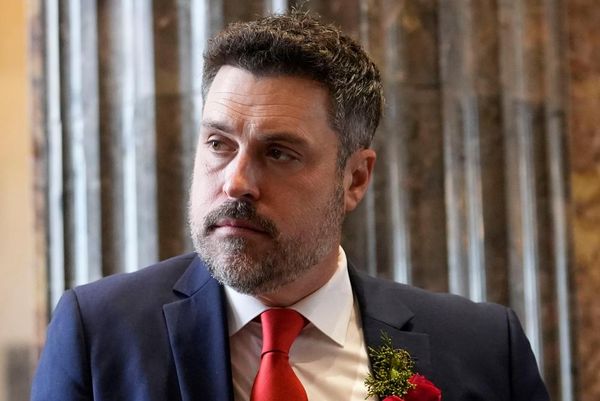
A doctor says he has been forced to find work overseas in the fallout from a high-profile abortion case that sparked the current push for law reform in Queensland.
Obstetrician David MacFarlane said his experience in the aftermath of treating “Q”, a 12-year-old who was forced to seek court approval for an unwanted pregnancy last year, was a cautionary tale for public doctors under the state’s present abortion laws.
MacFarlane said his advocacy for his patient had led to a “vexatious” complaint against him to the Australian Health Practitioner Regulation Authority (AHPRA) and an investigation that remains unresolved after nine months.
While he expected AHPRA would “fully exonerate” his professional conduct in the case, the need to disclose the ongoing investigation had led to him being refused locum work locally, MacFarlane said.
This prompted the obstetrician, who had practised without censure for almost 20 years, to recently seek work in New Zealand.
The independent state MP Rob Pyne, along with MacFarlane’s medical colleagues, condemned his treatment as a symptom of the problems with abortion’s legal status in Queensland.
Pyne’s proposed legislation to decriminalise abortion in Queensland – where it is legal only if a doctor rules it necessary for a woman’s mental or physical health – is due for a parliamentary vote as early as Thursday.
MacFarlane told Guardian Australia: “It’s not about me but about the need for the law to change, and what’s happened to me and what’s happened to Q highlights how urgent that is.
“It’s even more urgent now because, with the Q case, we’ve advertised to all young women [under 14 years] that if they get pregnant and they want an abortion, they’re going to have to go through this ordeal of going through the courts.
“And if any doctor in the public system tries to help them, they’re going to end up in trouble as well because hospital administrators are so deeply uncertain of where they stand in relation to current legislation.
“The outcome for me was a complaint, which is still unresolved and which would inhibit any other doctor from becoming involved in abortions here in Queensland, because no one would want to go through what I’ve been through.”
MacFarlane said the AHPRA complaint had been lodged by a “senior Queensland Health bureaucrat” and followed an email the obstetrician had sent to the health minister, Cameron Dick, raising Q’s plight before the court case.
MacFarlane said he was not at liberty to discuss details of the allegations against him but he denied any wrongdoing, saying he had followed Queensland Health guidelines on abortions involving minors.
However, in a submission to the first parliamentary inquiry into Pyne’s proposed reforms, MacFarlane said he had challenged a hospital executive who claimed he had legal advice a court order was necessary to authorise an abortion for a child under 14.
In a submission to a second parliamentary inquiry, MacFarlane said the upshot of Q’s court case was that “no reasonable practitioner can any longer feel safe to offer [appropriate abortion care to minors] and risk performing an illegal abortion”.
Queensland Health said it “cannot comment on ongoing investigations by AHPRA”.
Pyne said MacFarlane’s situation “puts a lie to the argument the laws are currently working”.
“Clearly the laws are not currently working and we want to support clinicians like him, we don’t want to be persecuting or prosecuting them,” he told Guardian Australia.
Pyne is pessimistic about the fate of his bills because the Liberal National party will vote as a bloc against them rather than hold a conscience vote.
Caroline de Costa, a professor at James Cook University’s school of medicine, said the case of Q and MacFarlane was a “particularly extreme example” of how the legal status of abortion was problematic for doctors, especially in the public system.
“The Q case last year should not have happened and what happened to the doctor should never have happened,” she said. “We should be very clear on what’s required. The uncertainty and the grey area that the law keeps doctors in is what leads to these kind of situations.”
MacFarlane said the current laws encouraged young women to seek abortions in private hospitals rather than “seeking help in the public hospital service in Queensland, which ought to be their right to access and expect sympathetic help and care from them”.
“It disadvantages women, especially poor women, and advantages private obstetricians and private gynaecologists, who charge significant amounts of money for doing these procedures,” he told Guardian Australia.
De Costa said the fact the parliamentary committee – in contrast to the Australian Medical Association and the Royal Australian and New Zealand College of Obstetricians and Gynecologists – could not endorse Pyne’s reforms was “extremely unsatisfactory for doctors”.
“This is because we still have to live with the 1899 criminal code, even though we want to practise in the 21st century and the two are incompatible and very difficult,” she said.
“There’s a constant fear or possibility that we will be held to account and so we do have to frame what we write in patient notes to make it fit the law and that will continue if they do not change the law.”
The anti-abortion group Cherish Life, which drew almost 4000 protesters to a march on parliament this month, is planning another protest when the bills are debated on Wednesday.
Cherish Life’s Queensland president, Julie Borger, said the reforms were “extreme”, citing legal advice the group had that proposed “protected areas” around abortion facilities were unconstitutional.
“Even family members trying to dissuade someone from proceeding with an abortion would be at risk of arrest and prosecution,” Borger said.
The group cites Galaxy polling that found 49% of Queenslanders opposed the decriminalisation of abortion, compared with 43% in favour.
By contrast, the 2016 Australian Election Study found 69% of voters nationally believed women should be able to obtain abortion “readily”, while 27% thought it should be available only in “special circumstances”.