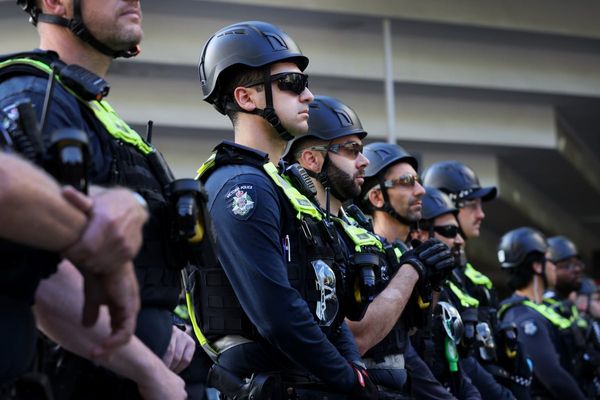
For many years when the haunting sound of the bagpipes was heard in policing, it usually meant a lament for a colleague lost.
It was an apt expression of sorrow and loss, and the plaintitive call of the pipes would hardly leave a dry eye in the room even among the most hardened of officers.
However, playing an instrument so often stereotyped was a decent enough excuse for detective inspector Stephen Ladd, who is ACT Policing's designated bagpiper, to decide to change it up a little.
"I've been playing a lot more than funerals of late. Investitures, graduations, celebrations; it makes a nice change," he said.
Inspector Ladd is one of two federal officers who this week received an Australian Police Medal in the Queen's Birthday Honours list.
Due to COVID-19 restrictions, he won't be invested until later in the year when he'll be joined by family and colleagues for the occasion.
He and his 63-year-old set of great highland pipes have become somewhat of an institution in ACT Policing over the past 15 years, although it wasn't a role which he intentionally set out to perform.
For much of his life in uniform he has been a crime investigator, only recently switching to head up the day-to-day management role in police Operations.
Traditions are strong in the police force and while the reasons for the bagpipes being so strongly connected to the uniform of those sworn to protect and serve are lost in the mists of time, it has its roots in the military.
Highland pipes were once classified as instruments of war during the Scottish clan uprisings against the British in the 1700s.
The instrument's mobility and the unique sound of the big highland drones, capable of being heard from a long distance across the lochs, moors and valleys, was said to provide inspiration for the clans as they went into battle.

When the Scots and the Brits eventually settled their differences, the famous Highland regiments retained their bagpipe tradition.
Inspector Ladd first heard the pipes as a boy, when visiting his grandfather in Newcastle.
Hailing from near Inverness, his grandfather was a proud McKenzie - "they dropped the 'a' in MacKenzie when they moved out here and I don't know why" - and would march up and down the hallway playing.
He began playing in his 20s but now wishes he had started much earlier.
"I really love it partly because it's such a tough instrument to learn and play," he said.
"It's a physical action because you have to maintain that steady air pressure inside the bag, squeeze it and then finger the notes at the same time.
"It took me a year just to learn how to get the fingering on the chanter right. When you hear the best guys play, it's quite special."
His own pipes have a strong sentimental attachment. They are same ones his late grandfather played while marching up and down the hallway all those years ago. They've since journeyed with him to tattoos around the world.
In 1993, the Canberra Pipes and Drums was asked to play at ceremonies for the Australian Federal Police and in 2005, it became the official band of the AFP.