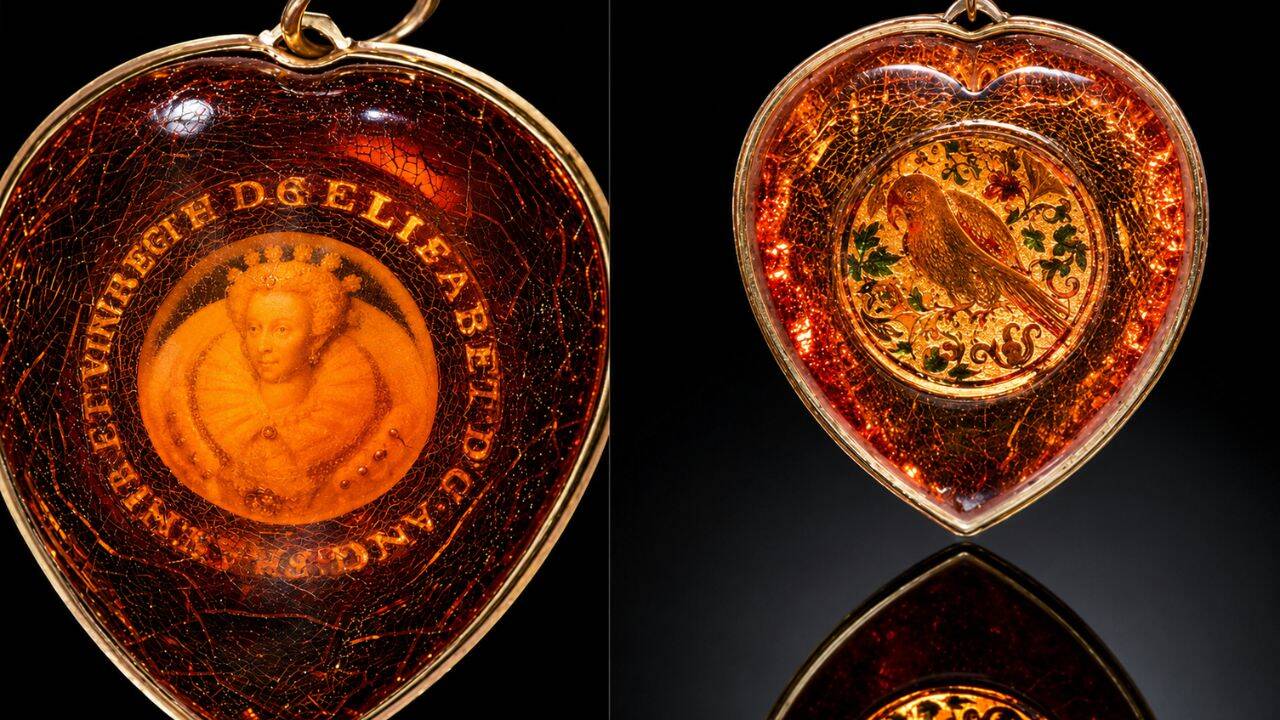
A small object has surfaced in London that sits somewhere between jewellery and historical record, though it refuses to settle neatly into either category. A pendant, no larger than something that could rest on a fingertip, carries within it a portrait of Queen Elizabeth I carved into amber. It is being linked to the final years of her reign, around 1600, a period already thick with imagery, ceremony and carefully managed appearances. What makes it unusual is not only its survival but the way it compresses court portraiture into something almost private. Objects like this rarely leave much trace in written sources, so when they do appear, they tend to unsettle assumptions about what travelled through European courts and how such objects were actually used.
Get breaking news anytime, anywhere. Download the TOI app now!
The pendant offered at Sotheby’s London on 1 July 2026 in Master Sculpture from Four Millennia, with an estimate of £100,000–150,000.
A royal portrait of Queen Elizabeth I preserved in amber and gold
The pendant itself is modest in scale, though its construction suggests no shortage of labour. At its centre sits a tiny carved likeness of Elizabeth I, set within a rounded body of amber mounted in gold. The monarch is shown in a familiar late-life image, the kind that circulated widely through engravings and court-approved reproductions.
Amber, at the time this pendant is believed to have been produced, was not simply decorative. It was traded across northern Europe, particularly from regions around the Baltic, and moved through workshops that treated it as a material almost halfway between stone and resin. Königsberg, a key centre in that trade, is often mentioned in connection with finely worked amber objects commissioned for courts and aristocratic households.
The material itself carried a kind of reputation that went beyond appearance. It was worn, handled, and sometimes kept in private collections with the belief that it held protective qualities. That sense of value, both material and symbolic, helped drive its use in objects intended for elite exchange. A pendant carrying a royal likeness would have fit comfortably into that world, where craftsmanship and political symbolism often overlapped without clear separation.
How a printed portrait became a royal carving
Inside the amber, the face of Elizabeth I is not an invention drawn from imagination alone. It follows a chain of visual references that were already well established by the end of her reign. An engraving by Crispijn de Passe the Elder is thought to sit behind the composition, itself based on a portrait tradition linked to Isaac Oliver.
What the carver appears to have done is translate a two-dimensional image into relief, compressing fine detail into a space only a few centimetres wide. The result is not a direct likeness in a modern sense, but a controlled representation shaped by the conventions of Elizabethan portraiture. The queen’s dress, posture and expression are all present, though softened by the constraints of scale and material.
The precision of the carving suggests a high level of technical skill rather than a decorative workshop approach.
How light inside amber creates a royal illusion
One of the more unusual aspects of the pendant lies in its construction from behind. A concave hollow has been cut into the amber so that light passing through it interacts with the carved portrait at the front. The effect is subtle but noticeable, giving the image a magnified appearance when viewed from certain angles.
It is not a trick in the modern sense, but it does rely on optical behaviour that would have been understood empirically rather than scientifically. Amber itself was later used in experimental magnifying devices in northern Europe, though that development came after this object was likely made.
The impression created is of depth within a very small space. The portrait appears to sit slightly suspended rather than pressed against a flat surface, as if the material is holding it rather than simply enclosing it.
Symbolism on the reverse face
Turning the pendant reveals a second layer of meaning. A small carved bird, often identified as a popinjay or parrot, sits on the reverse. In the visual language of the period, such imagery was rarely accidental. Birds of this kind could carry associations with purity and controlled speech, themes frequently linked to Elizabeth’s carefully constructed public image.
The queen’s identity as the “Virgin Queen” was not a casual label but a political and cultural framework reinforced across multiple forms of art and representation. Even in small objects, that idea could be echoed or reinforced through symbolic detail. The bird on the pendant fits within that pattern, though its exact intended meaning would have been understood differently depending on who first commissioned or received the piece.