When gunfire erupted in his mosque in Quebec City, Aymen Derbali’s instincts took over. The 41-year-old locked eyes with the shooter, inching slowly towards him through the 50 or so people still milling around after evening prayers.
His plan was simple: “I thought if he shoots in my direction, he wouldn’t use his bullets on anyone else.”
The gunman put seven bullets in Derbali before pausing to reload his semi-automatic rifle. As Derbali slipped out of consciousness, he noticed that his plan had worked; the momentary distraction had allowed several to escape the mosque.
Two months later, Derbali woke up in a Quebec City hospital – and only then did he learn the horrifying toll of the attack: six men, all of them fathers, were dead. He was one of 19 people who had been injured.
He also learned he would never walk again – the attack had left him paralysed from the waist down.

Doctors had managed to remove most of the bullets from his body. But two remained lodged in his spinal cord.
Shortly after the attack one year ago, police arrested a university student with a history of disparaging feminists online and celebrating the politics of Marine Le Pen and Donald Trump. Alexandre Bissonnette was charged with six counts of murder and six counts of attempted murder.
The brazen attack rocked a city that had long ranked among the country’s safest. Now it was home to Canada’s deadliest attack on a place of worship, and the tight-knit Muslim community was reeling.
In the following months, the initial outpouring of support was chipped away by a series of incidents that further rattled the traumatised community; a bitter row over a Muslim cemetery escalated to the torching of the mosque president’s car in the driveway of his home, as the mosque was targeted with a constant stream of hate messages and hate incidents targeting Muslims in the city doubled, from 21 in 2016 to 42 in 2017.

Provincial politicians were accused of sowing division with an attempt to introduce North America’s first ban on face-coverings.
Officials later rejected a proposal to designate the first anniversary of the attack as a day of remembrance and action against Islamophobia. “We believe that it is better to emphasise collectively our commitment against the phenomenon of racism and discrimination, rather than singling out one of its manifestations,” said Quebec premier Philippe Couillard.
In the rehabilitation centre that has become his new home, Derbali focused on recovering. He has managed to regain some movement in his arms and fingers and recently he began moving around in a motorised wheelchair.
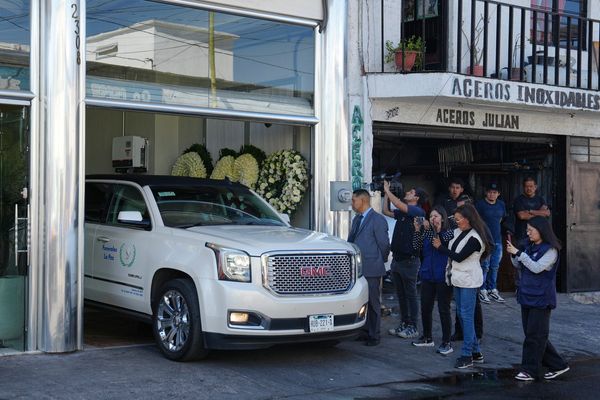
“I feel very lucky to be alive,” he said in an interview. Every time he visits the mosque, there are reminders of the attack: bullet holes still riddle the walls while the shoes of the six men who were killed remain on the racks outside the prayer room.
At the time of the attack, Derbali was working as an IT specialist, and was the family’s sole breadwinner.

He still doesn’t know when he will be well enough to return home to his wife and three young children. Complicating his discharge is the fact that the family live in a fourth-floor apartment, but doctors have said they cannot let him live in a home that is not wheelchair accessible.
So far he’s been able to visit, but only for a few hours at a time. “I remain all the time in the living room, I cannot access the bathroom or the bedroom,” he said.
After community members voiced concerns over Derbali’s situation, a Toronto-based non profit launched a fundraising campaign to secure an accessible home for the family.
“He is a hero,” said Amira Elghawaby of DawaNet. “Part of the motivation is not just to help him find an accessible home, but also to help him find one that keeps him closely connected to the community that he literally sacrificed his legs for.”

Donations from Canada and beyond have raised C$294,000 towards the campaign’s C$400,000 goal. The hope is to raise the full amount by 29 January – the one-year mark of the attack. “So that this family, instead of reliving the trauma of what happened, can look to the future,” said Elghawaby.
Derbali said the outpouring of support has been heart-warming. “This solidarity gives me more hope,” he said. “This is the most important for my family and for me – to be able to go back to my home, to continue a normal life with my family.”
What happened in Quebec City could have happened anywhere in the world, said Derbali, who moved to Canada from Tunisia in 2001 to study at Laval University.

But, pointing to the medical treatment he’s received and the many people across the country who have helped his family, he added: “This makes me even more proud to be Canadian.”
Asked if – knowing the consequences – he would have done things differently on the night of the attack, his answer was swift.
“I don’t regret what I did at all,” he said. “I would have done the same thing in any other circumstance; in a mall, a school, the street.”
The toll could have been much worse had he not followed his instincts, he said. “Thanks to that choice, many were able to escape.”