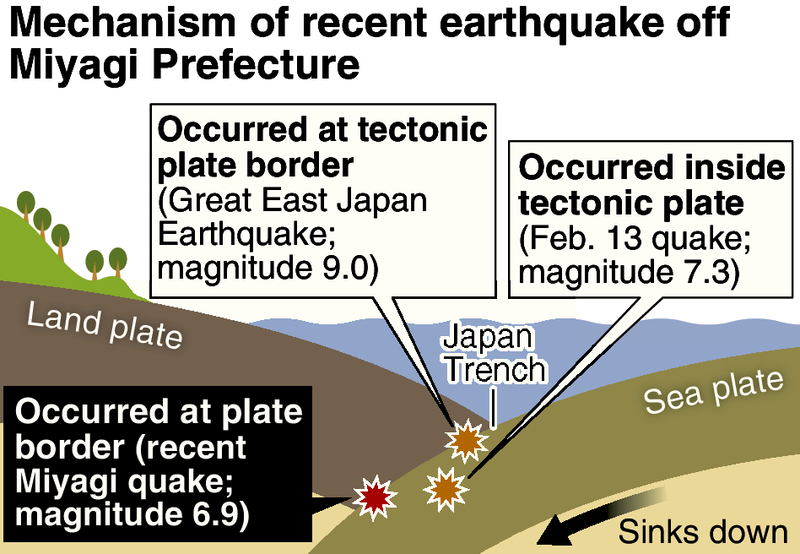
The March 20 earthquake that took place off Miyagi Prefecture occurred at the border of two tectonic plates, the same mechanism as the Great East Japan Earthquake, according to the Japan Meteorological Agency.
The latest earthquake, which had a magnitude of 6.9, took place on the border between a land tectonic plate and a sea plate that sinks down under the former. This was the same mechanism as the Great East Japan Earthquake (magnitude 9.0), and different from the magnitude-7.2 quake that occurred inside one of the plates off Fukushima Prefecture in February.
When the March 20 earthquake occurred, a tsunami advisory was issued in Miyagi Prefecture. But waves clearly defined as tsunami were not observed, and so the advisory was withdrawn.
The hypocenter of the earthquake was relatively deep at 59 kilometers underground, and thus the distortion of the sea floor, which can cause tsunami, was limited. Fortunately, tsunami did not occur in this case.
The energy produced by the earthquake off Fukushima Prefecture was about four times stronger than that of the March 20 earthquake off Miyagi Prefecture, but a tsunami advisory was not issued at the time of the February earthquake.
Because the height of tsunami waves is also affected by landforms, tsunami advisories and warnings are issued after a decision is made based on data on tsunami waves that occurred in the past in the relevant region.
Prof. Fumihiko Imamura of Tohoku University, an expert in tsunami engineering, thought the issuance of the tsunami advisory was justified.
"Deeply indented ria shorelines stretch along coastal areas of Miyagi Prefecture, and so tsunami waves tend to become high mainly in such places as deep inside bays," Imamura said. "Because the earthquake occurred in a time period near high tide, special care was necessary."
The quake recorded an upper five on the Japanese intensity scale of seven.
Prof. Shinji Toda of Tohoku University, an expert in seismology, said, "The tremors were strong because the hypocenter was close to land."
About the cause of the recent earthquake, Toda said: "It's possible that the earthquake in February extended distortions underground. I want people to remain cautious, because active volcanic activity continues in places around the area under which the ground moved significantly due to the Great East Japan Earthquake."
Injuries rise to 10
The Fukushima prefectural government announced Sunday, the day after the earthquake off Miyagi Prefecture, that a 77-year-old woman in Date in the prefecture suffered a minor injury when she fell inside her home. She was taken to a hospital by ambulance.
According to The Yomiuri Shimbun's compilations, this brought to 10 the total number of people taken by ambulance to hospitals, mainly because of injuries caused by the quake. There were eight people hurt in Miyagi Prefecture in addition to the 77-year-old woman, and one in Iwate Prefecture.
None suffered life-threatening injuries.
According to the Miyagi prefectural government and other sources, public facilities were damaged by the earthquake. For example, elementary and middle school buildings suffered cracks in their walls, and ceilings were damaged.
In Aoba Ward, Sendai, about 30 pieces of insulation fell from the ceiling of the Aoba Arena. As a result, use of the sports facility is suspended through Tuesday.
Read more from The Japan News at https://japannews.yomiuri.co.jp/