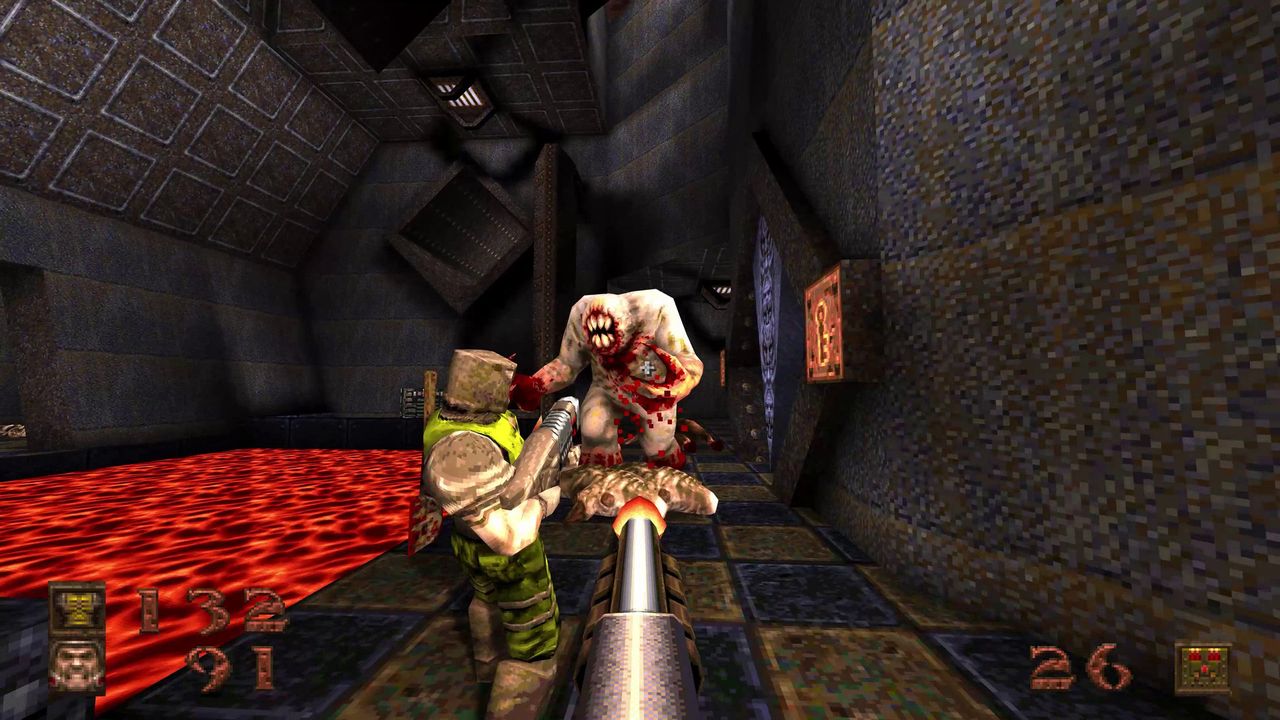
On this day in 1996, id Software unleashed Quake on the unsuspecting public. The game’s influence is difficult to overstate, with its pioneering 3D engine inspiring the first wave of 3D accelerator PC expansion card purchases, the establishment of online multiplayer competitive culture, and much more. Perhaps its impact on 3D gaming can only be matched by the same development team’s previous outing with Doom.
Happy 30th birthday, Quake! 🎂🎈 And thank you all for playing. See you later today on https://t.co/uOnB2dub9f. 9pm - 11pm GMT+1. 🎉#quake #johnromero #fps pic.twitter.com/1TBsQfs3wZJune 22, 2026
At launch, Quake drew criticism for its intense violence and gore, which also echoed Doom’s path to infamy among media and political pundits, and caused problems for ratings boards and regulators. However, id Software ignored such noise, insisting they simply made games they enjoy playing. Quake would be the last major id Software production with the ‘classic lineup’ due to burnout and various personal conflicts, notes Wikipedia.
Looking more closely at the technology behind Quake, it was clear the dev team eschewed ‘faking it with 2.5D tricks’ like in previous seminal PC FPS titles such as Doom, Duke Nukem 3D, System Shock, and others. Instead, Quake hit the scene with true 3D polygonal worlds and character models. The true 3D transformation meant that for the first time in FPS, games could enjoy real 3D collision and physics, as well as things like fully 360-degree vision and movement, and more.
With id Software’s new game engine arriving in the Pentium era, but still crushing the best CPUs of the time, it made a market for PC 3D accelerators. These add-in cards first became essential to PC gamers in the late 90s with full 3D engine titles arriving, led by Quake. So in the same era, we saw important hardware releases like the 3dfx Voodoo, ATI Rage, and Nvidia Riva cards. QuakeGL became the killer app to drive sales of these products.
As mentioned in the intro, 3D gaming engines and hardware aren’t the only long-lasting legacies we can attribute to Quake. The game also popularized online multiplayer gaming. Another huge influence Quake had was in inspiring (and allowing) the growth of a talented modding community. As well as numerous custom maps and campaigns, the moddability of Quake enabled total conversions like Team Fortress and Quake Rally, to drop a few names.
Quake would inspire imitators, tributes, and influence many more 3D gaming titles in the years and decades to come. There have also been several Quake sequels, remakes, and the game even sparked machinima film-making, where a game’s 3D world becomes a movie set. Many modern developers, including the founders of Valve, first cut their teeth on Quake modding.
Quake turns 30 today. 🎉 Three decades later, you can still dig into the source code that helped shape modern game engines, multiplayer networking, and modding communities. 🎮 https://t.co/mV5q4YdPRM pic.twitter.com/YJh95WTXp5June 22, 2026
Nowadays, folks have the luxury of the complete source code for winquake, glquake, quakeworld, and glquakeworld available on GitHub. It was released “for entertainment and educational purposes,” but under GPL, it can be used for possible commercial projects, too. Those into this kind of digital archaeology may also be interested in the GitHub repositories for Quake 2 and Quake III Arena.
In summary, Quake didn’t just splash down with one big innovation; it was the weight of multiple key advances that made it so important to the history and the future of PC gaming.