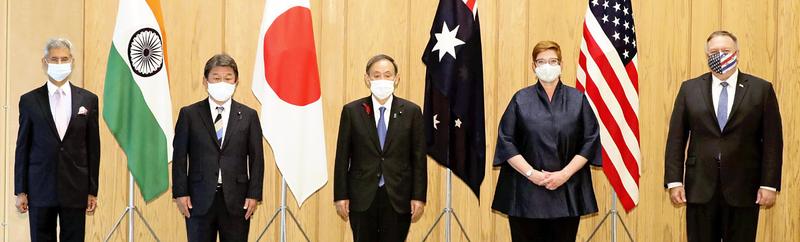
In his first face-to-face diplomatic meetings as prime minister, Yoshihide Suga's one-on-one talks with U.S. Secretary of State Mike Pompeo, as well as with the three foreign ministers from the United States, Australia and India, signaled to observers at home and abroad that the basic diplomatic stance of his administration would be to continue along the track laid down by his predecessor Shinzo Abe and to seek to ensure regional stability by strengthening the Japan-U.S. alliance and promoting the concept of a "free and open Indo-Pacific."
When meeting Pompeo, Suga appeared a bit nervous as he thrust out his right arm for a "fist bump" photo shoot.
Later, he greeted Pompeo and the other two foreign ministers in English, saying: "I am Yohsihide Suga. Welcome to Tokyo."
He then told them, "The international community is facing a variety of problems due to the spread of the new coronavirus. That is why now more than ever, countries that have a shared vision need to deepen their ties and continue to engage in international cooperation."
A senior government official who attended the meeting said: "It didn't feel informal, but it was relaxed. It was a debut befitting Prime Minister Suga."
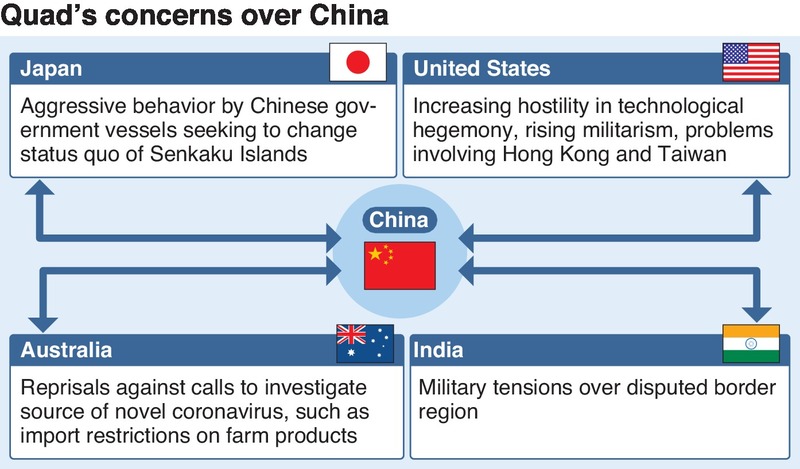
Many countries are concerned about China's increasingly hegemonic behavior in the Indo-Pacific, in areas such as the South and East China seas. Japan took the initiative in hosting this meeting among the foreign ministers of four countries, with an eye to curbing China.
It was a strong display of unity.
"At a time when diplomacy is difficult due to the spread of the new coronavirus, having foreign ministers from four countries gather in Tokyo will have a big impact," a senior Foreign Ministry official said.
Suga has chosen Vietnam and Indonesia for his first foreign trips, scheduled for mid-October.
The U.S. government has welcomed Suga's diplomatic stance. At the Japan-U.S. foreign ministers' meeting on Tuesday, Pompeo said that Suga made great contributions to Japan-U.S. relations during his time as chief cabinet secretary. He added that Suga gave him the impression of being a very powerful person.
In an interview, Nicholas Burns, a former U.S. undersecretary of state who is advising the campaign of U.S. Vice President Joe Biden, said Japan is "America's strongest partner in the Indo-Pacific. Our defense treaty is one of the most important commitments we've made as a country and it's very valuable to us. At a time when China has been so aggressive in the South China Sea, on the Chinese-Indian border."
The Chinese side expressed wariness over the collaboration among the four countries. "Multilateral cooperation, for whatever reason, should not be as an exclusive group," said Wang Wenbin, spokesperson for the Chinese Foreign Ministry.
Unlike U.S. President Donald Trump, who has singled out China for criticism, Suga has shown he prioritizes the economic ties between Japan and China.
China has tried to find a chink in the armor of the forces encircling it by making overtures to Suga, such as by halting incursions by Chinese government vessels into Japan's territorial waters around the Senkaku Islands in Okinawa Prefecture.
Read more from The Japan News at https://japannews.yomiuri.co.jp/