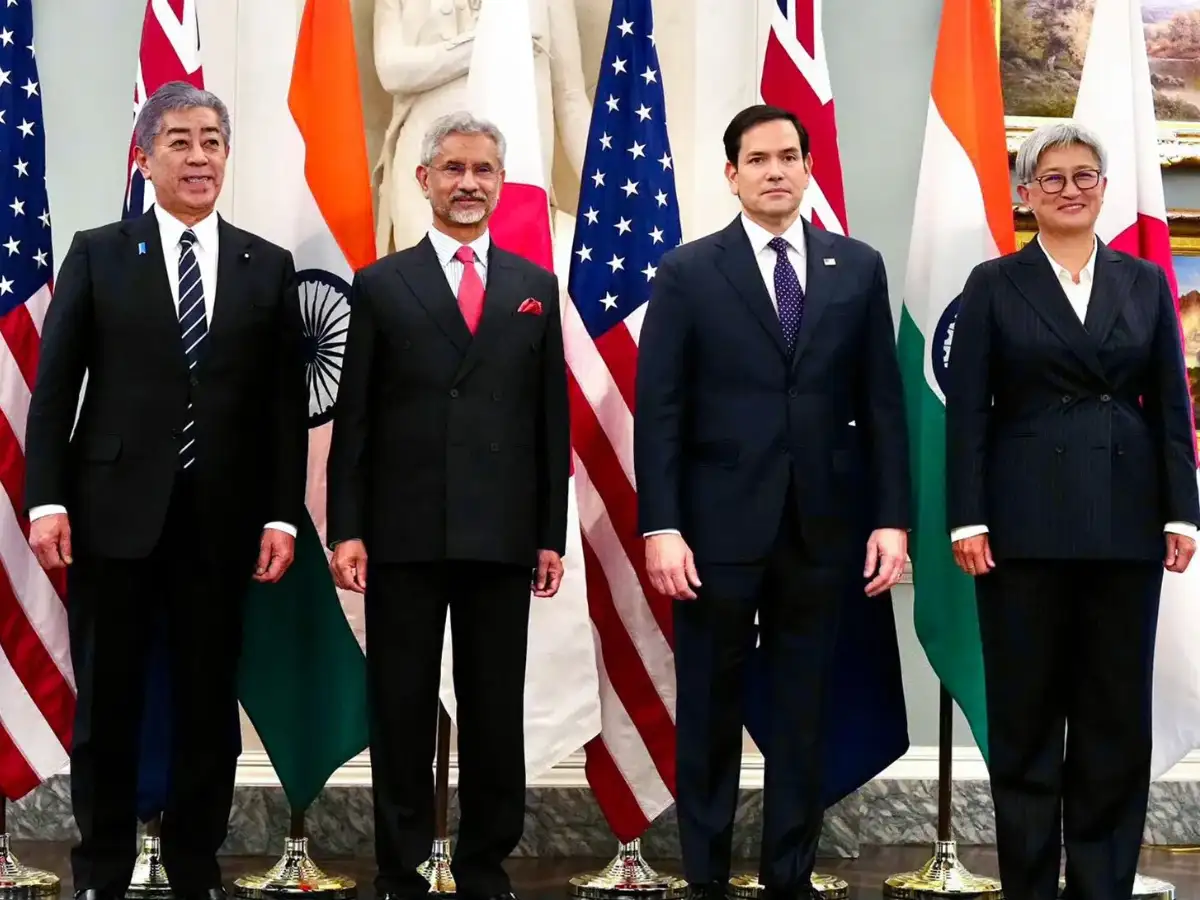
US Secretary of State Marco Rubio met counterparts from Australia, India and Japan on Tuesday in New Delhi as the Quad grouping seeks to regain strategic momentum amid shifting geopolitical dynamics in the Indo-Pacific and questions over the alliance’s long-term direction.
The meeting comes amid broader concerns among US allies over Washington’s commitment to the grouping, even as it continues to be positioned as a key platform for coordination on regional security and supply chain resilience.
Rubio’s visit is his first to India in his current role, and follows a series of Quad engagements that have continued intermittently since the grouping was elevated in recent years.
Here is a look at the key agendas from the Quad meeting:
India agenda
The Quad discussions in New Delhi are focused on strengthening cooperation across maritime security, critical minerals, supply chain resilience and broader Indo-Pacific stability, even as member countries navigate differing geopolitical priorities and external pressures.
US Secretary of State Marco Rubio said the grouping must move beyond dialogue and focus on deliverable outcomes.
“We want to make sure we do the work necessary and position it so, when they do meet, they’ll have very specific deliverables and things that actually they can announce,” Rubio told India Today.
He said cooperation on critical minerals remains a key priority, given its importance to high-end technology supply chains and concerns over concentration risks.
Rubio also indicated that maritime security remains a central pillar of Quad cooperation, particularly in the Indo-Pacific region.
US position
The meeting comes against the backdrop of uncertainty over the pace of high-level Quad engagement, including delays in convening a leaders’ summit that had been expected earlier.
Rubio’s engagement with Quad counterparts follows earlier discussions in Washington and other bilateral meetings aimed at maintaining momentum within the grouping.
Rubio said on Tuesday that the Quad is shifting from a consultative forum to an action-oriented platform focused on delivering tangible outcomes.
“Our goal… has been to turn this from a forum in which we meet and talk about problems to one where we actually do something about them,” he said.
He highlighted cooperation across four key areas, including maritime security, energy security, critical minerals and supply chain diversification, saying Quad members bring complementary strengths to address global challenges.
“Each of these four nations… bring unique capabilities that collectively we can bring to bear on some of most significant problems facing the world,” Rubio said.
Japan position
Japan has emphasised growing concerns over regional security dynamics and the need for stronger coordination among Quad partners.
Japanese Foreign Minister Toshimitsu Motegi said the global security environment is undergoing significant structural change.
“The world is faced with the most significant structural change in the post-World War II era, driven by a shift in the balance of power and the intensification of conflict and confrontation,” Motegi said during talks with Indian counterpart S Jaishankar.
Tokyo has consistently pushed for deeper collaboration on supply chain resilience, particularly in critical sectors such as semiconductors and advanced manufacturing.
On Tuesday, Motegi said the Quad signals a strong commitment to promoting a free and open Indo-Pacific through closer cooperation among member countries.
“This Quad meeting signifies the firm message to the world that Quad will strongly promote cooperation to realise free and open Indo-Pacific,” Motegi said.
He said Indo-Pacific nations must strengthen resilience and capabilities to determine their own future, including in the area of economic security.
“The Indo-Pacific nations should strengthen resilience and the necessary capacity to determine their own future, including economic security,” he said.
Motegi added that he expects frank discussions aimed at accelerating Quad cooperation.
Australia position
Australian Foreign Minister Penny Wong said Quad members share broad alignment despite being sovereign nations with distinct histories and priorities, united by a vision for a free and open Indo-Pacific.
She emphasised “freedom of choice” for regional countries in matters of security and sovereignty.
“We meet in the world’s largest democracy and a power that is so important in the shaping of the Indo-Pacific and the world,” Wong said.
She said the Quad has delivered results across disaster response, maritime security, critical infrastructure, undersea cables and critical minerals, and remains committed to sustaining momentum.
“We all want the Quad to be as strong and as effective as we can make it be… and we are determined to continue its momentum,” she said.
Australia is expected to focus on maritime security, regional stability and practical cooperation across infrastructure and capacity-building initiatives in the Indo-Pacific.
Canberra has supported efforts to keep the Quad functional as a coordination platform on security and economic issues, even as geopolitical tensions in the region persist.
Regional context
The Quad meeting comes amid broader geopolitical uncertainty, including tensions linked to maritime security in the Indo-Pacific and instability in global energy routes.
The grouping continues to be viewed with suspicion by China, which has previously described it as a bloc aimed at containing its influence, while Quad members maintain it is focused on supporting a rules-based maritime order.
The meeting also follows renewed debate over US foreign policy direction after President Donald Trump’s recent outreach to China, including remarks on closer US-China coordination, which has raised concerns among allies about strategic alignment.