Daily scans of the NZ COVID Tracer app have halved since Auckland returned to Level 1 in March, despite community outbreaks across the ditch, Marc Daalder reports
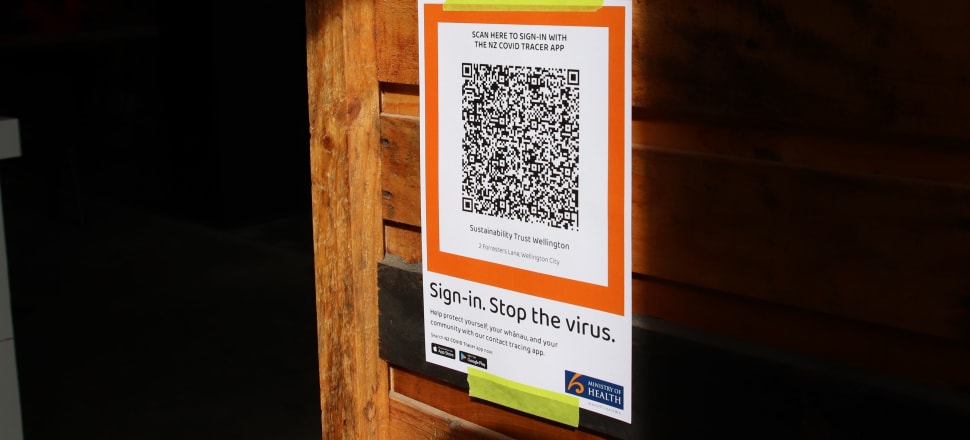
The public holiday on Monday saw the fewest scans of QR codes with the NZ COVID Tracer app since early January, part of a pattern in which the average number of daily scans has halved since Auckland returned to Level 1 on March 12.
At that stage, as many as 661,000 New Zealanders were scanning an average of almost 1.5 million QR codes a day. Now, fewer than 300,000 New Zealanders open the app on any given day, and the average number of scans is just 535,000.
This is despite a community outbreak in Melbourne - attached to New Zealand by a travel bubble as recently as two weeks ago - and several small scares in Western Australia and New South Wales.

University of Auckland microbiologist Siouxsie Wiles said New Zealanders should be more cautious about cases in Australia than they have been, but that the risk didn't rise to the same degree as a case in New Zealand.
"It is an extension of us. But the chances of somebody coming over are a reflection of what travel is happening," she said.
"If it was in New Zealand, then obviously any case, anywhere, is an opportunity for further transmission. But [Australia], it's like there's a bottleneck. Yes, our bubble has extended, but it's got a big bottleneck where only a certain number of people are actually coming through."
Previous community outbreaks in New Zealand have seen scan counts spikes. The August Auckland cluster saw average scans rise from just under 32,000 a day on August 11 to 775,000 a week later. Average daily scan counts eventually peaked at 2.26 million in early September, before dropping precipitously to 601,000 by late October. Likewise, the first February lockdown in Auckland saw scans jump by 150 percent, and a smaller corresponding rise for the second February lockdown.
Even new community cases have prompted consternation, with scans increasing by a third when a port worker tested positive for Covid-19 in October and when a student tested positive in November. January's Northland case saw average daily scans nearly double to 1.2 million.
Similar scenarios across the ditch have seen little reaction, however. Since March 12, daily scan counts have fallen consistently (with the exception of a small post-Easter bump), with no jolts or spikes corresponding to outbreaks in Australia. Even Melbourne's decision to enter lockdown and then extend it for two consecutive weeks has seen the decline slow, but not stop.
Wiles said this overall decline is the real issue - it's not that we should want scans to spike every time there's an outbreak, but that people should already be using the app.
"The scanning is really a very small thing that we can be doing just so that if a case pops up, we have a quicker way of identifying who might have been exposed," she said.
"This is just so important, given how much more infectious the new variants are. The Delta one [which was first identified in India] is even more infectious than Alpha [the B.1.1.7 variant first identified in the United Kingdom]. We should be scanning more and more, because when a case pops up, we need to know where we all were over the last two weeks."
Wiles said that if people don't scan, we may have to rely more heavily on slower manual contact tracing. Scanning QR codes also means you could be notified more quickly if you have been exposed, allowing you to take the right precautions to protect your family and community.
While active use of the app, through scanning, manual entries and even opening it on any given day, has declined, the passive Bluetooth tracing function has steadily risen.