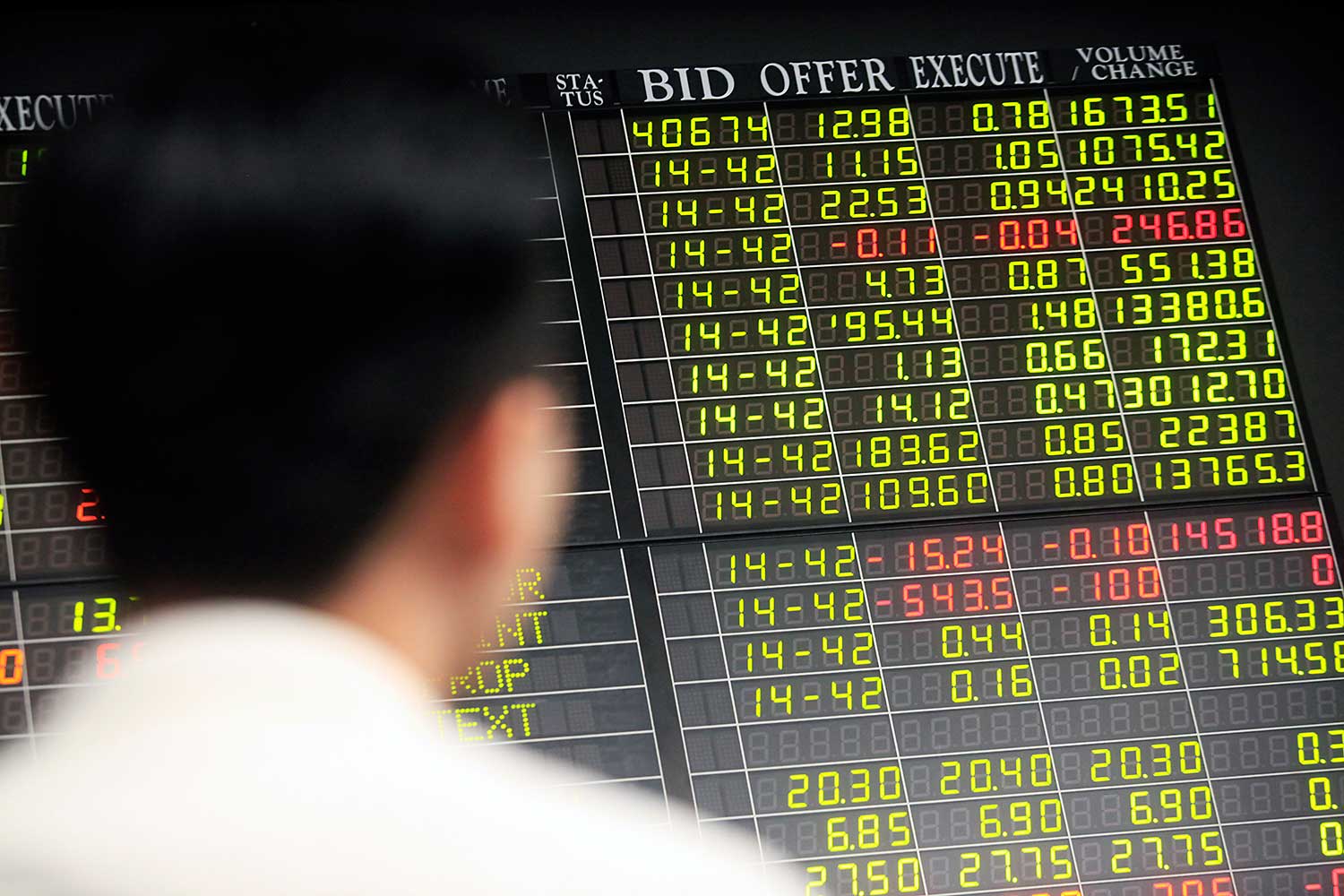
Last night, central bankers led by the US Federal Reserve gathered for their annual Jackson Hole symposium, one of the most closely watched events on the annual calendar for investors.
Named for the Wyoming mountain retreat where it usually is held, this year's symposium is taking place virtually, so many investors will be glued to their screens no matter what time it is in their corner of the world.
The anticipation that year has been intense because the Fed has been telegraphing for some time that it might shed some light on the timeline for the beginning of the end of the most accommodative monetary policy in recent memory.
Since the Covid crisis in March last year, in order to support the economy and inject liquidity into a system affected by the global credit crunch, the Fed cut its policy interest rate to between zero and 0.25%, and embarked on a massive asset purchase programme, known as quantitative easing (QE). Initially the purchases were unlimited but they were later scaled down to $120 billion per month.
Since that time, the US economy has improved markedly. Quarterly GDP has grown more than 6% for two consecutive quarters. Unemployment is back down near pre-pandemic levels. Employers added almost 1 million jobs in July, and new job openings exceeded the number of unemployed. These all indicate that the world's largest economy is in full expansion mode.
Meanwhile, inflation in July remained stable at 5.4% per year, close to the June figure, which was the highest in 13 years. It reflects higher prices for key components of the inflation basket including food, rent and clothing, as well as rising wages for both industrial and service workers.
This was partly due to the effect of reopening after a period in which some workers left the labour market (either temporarily or permanently), resulting in labour shortages in some parts of the manufacturing and service sectors. Employers therefore needed to raise wages to incentivise workers to return.
WAGE-PRICE SPIRAL
If the situation persists, this will cause employers to raise prices of finished goods to reduce their financial costs. The result could be "wage-price spiral" inflation.
Apart from rising wages and prices, the US economy may get an extra boost from continuously supportive fiscal policy. This month the Senate passed a $1-trillion infrastructure investment bill proposed by the White House. The House of Representatives will vote on it in September.
Coupled with $3.5 trillion in social spending already enacted into law, the infrastructure bill, if passed, will give an extra boost to the US economy and investment, and subsequently create more inflationary pressure.
With that in mind, we and many other market participants believe the Fed will need to shift to a more prudent monetary policy; otherwise people may think the Fed is not serious about inflation. If the latter is the case, people's expectations of future inflation will increase, causing the current inflation to overshoot due to the rush to stockpiling goods.
We believe that although the US economy will slow down in the third quarter as a result of the spread of the new Delta coronavirus variant as well as the fading effect of pent-up demand, the Fed is likely to signal a step back from the extreme easing at the current level.
Recent economic indicators such as retail sales, purchasing managers' indices and even capital goods orders shows signs of softening, as do up-to-date indicators such as the Google mobility index.
Nevertheless, the weaker data is very modest compared with what we saw during the first wave of Covid, in which several economic indicators plunged to their lowest levels in history. Current indicators are just softer than the market expected.
Nationwide vaccination levels in the US exceed 60% of the population, and people have a certain level of herd immunity given previous outbreaks with a large number of infected people. Hence states do not need to impose lockdowns or shut down economic activity as hard as in the previous episode.
As we write this, we don't know exactly what, if anything, the Fed is going to tell the virtual Jackson Hole audience about its QE tapering plan. But we believe that, if the Fed does not announce anything now, there is a high possibility that it will do so at its next policy meeting on Sept 21 and 22.
We expect a cut in monthly asset purchases of $15 billion, with announcements to coincide with rate-setting meetings that are held every six weeks, starting from December. That would result in the Fed's balance sheet topping out at about $9.9 trillion by the end of 2022, from about $8.2 trillion today, while 2023 could begin to see a reduction in the amount of assets held by the central bank.
WHY YIELDS WILL FALL
The key question is, when tapering is done, what will the financial markets be like? We believe that while tapering is taking place, long-term US Treasury yields will decline instead of increasing as should be the case. Why? Well, history shows us that after previous tapering exercises from 2010 to 2016, long-term bond yields always fell, contrary to what people believed would happen.
This is because investors are worried that the easing measures that used to support the market will begin to run out; hence various risks that the market was worried about but had ignored previously will begin to emerge.
However, statistical analysis shows us that after QE tapering, the stock market doesn't always have to go down, since factors other than liquidity influence equities. If the outlook for the economy, industry and stocks remains positive, it's possible that those stocks can pull the overall market to remain in positive territory.
Nonetheless, we believe that monetary policy is starting to tighten. This must be considered alongside further future risks, including the impact of the Delta variant on the economic and inflation outlook, US domestic political risk, Chinese austerity policies and other risk factors including various geopolitical factors.
These will continue to put more pressure on the economy and investing going forward. Investors should therefore consider adjusting their strategies by being more cautious.
An important turning point is about to begin. Investors, please be warned.
Piyasak Manason is senior vice-president and head of the wealth research department at SCB Securities, email piyasak.manason@scb.co.th