
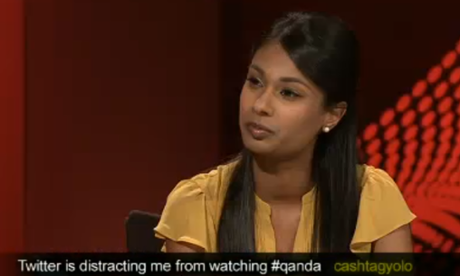
Talk about a wide-ranging episode of Q&A! From whether the internet actually changes our brains, to whether Australia’s contribution to fighting climate change will change a thing, to whether 18-year-olds can use their brains...
Technology, digital natives and narcissism
...and a strange question to start off, too! We kicked off with a request from the audience to Baroness Susan Greenfield to resolve a parental dispute about whether technology is changing the brains of “digital natives”.
Greenfield says that while the scope of technology to change us is vast, that doesn’t mean that nothing can be done. She asked the questioner what his mother wanted in an ideal son. It started to get weird:
I didn't realise you could go on #qanda to settle fights with your mother...
— Nic Christensen (@nicchristensen) November 10, 2014
“My experience is that ... technology has been overwhelmingly positive thing in our lives,” The IPA’s James Paterson replied. Do you agree? Psychologist and writer Steven Pinker argues that maybe it’s our only hope:
[T]he Internet and information technologies are helping us manage, search and retrieve our collective intellectual output at different scales, from Twitter and previews to e-books and online encyclopedias. Far from making us stupid, these technologies are the only things that will keep us smart.
Or maybe not...
Techn is rewiring my brain, I like calling work & telling them I can't come in because I'm coming down with technical difficulties #qanda
— Sarah (@SarahwntsanewMG) November 10, 2014
Does technology make us narcissists? Greenfield says we naturally like to talk about ourselves, even more than we like monetary rewards, but that online we lack the physical constraints we experience in the real world: “[V]ery few people would actually look someone in the eye and say ‘go kill yourself’,” Greenfield said.
UN youth delegate Laura John said that new technology opens up opportunities for activism. But is that just clicktivism? And is clicktivism just narcissism? I had hoped they’d get stuck into this question more rather than getting bogged down in the questions about which panellists are qualified to comment.
By this stage the Twitter audience (perhaps just narcissists, who can be sure...) were getting a bit sick of Greenfield dominating the conversation.
#qanda no offence to the baroness but she keeps interrupting people and it is getting a little frustrating
— amani (@pxnicatthedisco) November 10, 2014
Direct Action
The next questioner then got stuck into Greg Hunt about Direct Action, saying it was the political equivalent of “painting rocks white”. Guardian blogger Graham Readfearn has said it’s like “dodgy laundry powder” that never gets the climate clean.
The incentives approach, expressed in things like the UN clean development mechanism (and now Direct Action), is the winning approach, Hunt says. Tristan Edis wrote a great piece on the question over at Business Spectator a while ago (thanks to climate guru @willozap for the link).
And now we know what keeps Albo up at night. He’s worried by two groups in the Coalition: climate sceptics, and “people like Greg” who should know better. Albo brought up Greg Hunt’s old thesis, which was titled “A tax to make the polluter pay”, saying that Hunt actually supported carbon pricing.
Hunt went on the defensive: “You’ve just made a false statement on national TV ... knowingly, deliberately false.”
(You can read his thesis here and make up your own mind.)
Direct Action has been hugely controversial, and has been widely panned by experts on climate change policy. But given the Coalition campaigned primarily on the carbon tax repeal, do you agree with this tweeter?
Australia voted out the Carbon Tax. Accept it. Give Direct Action a chance. #qanda
— Rupes (@Rupes_) November 10, 2014
Return the voting age to 21
The next questioner dropped a huge truth bomb on the panel, saying that kids these days have “no life experience” and are just parroting the views of their parents and teachers. We should raise the voting age back to 21, he said. Laura John got that question and said the broader question is “are Australians engaged with politics” and if so, why not?
Paterson concurred: “you do have to draw the line somewhere. 18 seems to be a reasonably logical age.”
Then came the IPA talking points: “I’m more concerned about compulsory voting.”
That derailed the whole conversation into a bit of a cul-de-sac; Albo talking about manipulating the vote, Hunt applauding the fact that we don’t have to “get out the vote”. But Paterson’s article in the IPA review raises an interesting point:
[W]hen voters are dissatisfied and disengaged with the offerings from major parties, voluntary voting enables an entirely legitimate and powerful form of political self expression.
Westconnex and East-West Link
A questioner from St Peters in Sydney asks why the WestConnex road project will go ahead when it will “devastate” communities in the inner west. Albo says we need both rail and roads: “The investment should be driven by productivity.”
For mine, I think Q&A is at its weakest when it gets bogged down in very specific policy debates like this; Albo and Hunt should save it for question time. Guardian Australia’s political editor Lenore Taylor wrote on how the WestConnex project is “paved with Coalition gold” if you’d like to read more, but I agree with Comment is Free contributor Somayya Ismailjee:
So glad we're finally talking about Sydney traffic. #qanda
— lana del neigh (@LanaDelNeigh_) November 10, 2014
The Tailored Brain: conservatives versus progressives “in the brain”
Is it nature or nurture that makes political brains? Or do we just need to communicate more? A good question to polish the night off. Here’s an interesting article on a scientific study that said:
We speculate that the association of gray matter volume of the amygdala and anterior cingulate cortex with political attitudes ... our findings are consistent with the proposal that political orientation is associated with psychological processes for managing fear and uncertainty.
Baroness Greenfield seemed to agree, saying:
"There's nothing quite as frightening as someone who knows they're right!" Love it! #QandA
— Mark Hawkins (@strategicmark) November 10, 2014
And that’s a wrap! See you in the comments thread. Next week’s panel should be fantastic:
Next week on #qanda: Alexei Sayle, Warren Entsch, Connie F-Wells, Gough's head in a jar, and the 360 impersonator who spoofed Tom Elliott
— Ben Eltham (@beneltham) November 10, 2014


.png?w=600)









