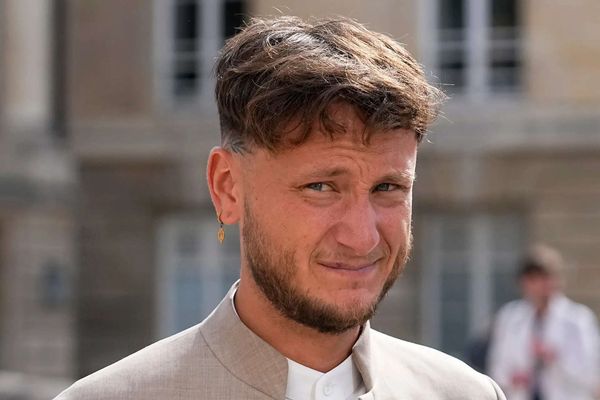
Imagine being sandwiched between Beyonce and Adele.
That's where Todrick Hall found himself when he released "Straight Outta Oz" in June on YouTube. His visual album reached No. 2 on the pop charts after garnering more than 1 million views in its first week.
For "Straight Outta Oz," Hall molded L. Frank Baum's classic to fit his own narrative as a queer, African-American man from Texas trying to navigate the entertainment industry. Now, he's on the road touring the record, plus eight new songs. He recently caught up with the Inquirer:
Q: Why does "The Wizard of Oz" mean so much to you?
A: I have no idea. Funny thing: My dad actually came to the show last night, and he just said it was an unexplainable obsession that I always had. I just always loved "The Wizard of Oz" so much. I never wanted to watch anything else.
I think I identified with Dorothy so much because I was in a very small town that was not very colorful and didn't think outside of the box. It was just a very mundane place. And even at a very young age, I always knew I was destined for something much greater.
Q: Why was it so important to tell your story?
A: My fans like my videos and like the characters that I play, but they don't know anything about me ... . And so I was like, "I want to do something and tell my favorite story of all time, but tell the story of my life so that people know where I came from."
Q: You had your own reality show on MTV, but you still say you're most proud of your YouTube work. Why?
A: I met Tom Hanks, and he was like, "I'm going to use you for every time that a person says to me, 'I couldn't make it,' or 'I couldn't do it because I didn't have help.'" Because now, you don't need help. Anybody who has access to some kind of smartphone in any humdrum town across America can upload a video onto YouTube and become a star if they have a really great idea and great vision. And I love that ... . You don't have to be Judy Garland and hop off of a train in Hollywood and have some huge, hotshot movie producer find you in order to make it. You can make it on your own. That, to me, is just the epitome of what the American dream is.
Q: How do you think your path to stardom may have been different from the traditional track, as a queer black man?
A: When I got to Hollywood, I had every intention of following the format that everyone else followed: getting an agent, going to auditions, showing my headshots, showing up, auditioning, and leaving. And then I realized very quickly that the roles I was going to get were going to be very limited because, as progressive as America is, most of the time they're going to hire a tall, beautiful, blond-haired, blue-eyed man to be the leading man.
It's been very difficult. There aren't a lot of roles out there for people like me, and there's a lot of really talented gay African American men who are starving in New York and starving in L.A. because there's not enough roles to go around. My goal is to create opportunities for everyone, but especially opportunities for people who are in this demographic ... . To say it's underserved would be a huge understatement. It's almost nonexistent.
Q: In your music, you have a lot of social commentary. What message are you trying to send?
A: The overall message is just acceptance. I think it's insane, it's incredibly insane and embarrassing for the human species that people are still walking around spending their time hating, ironing their KKK robes to go to rallies ... . I plan on doing whatever I can to make the world a better place by explaining to people that we can all love each other.
We don't have to understand each other, but we should all love each other.