Why has the Swiss National Bank announced negative interest rates today?
Because it wants to weaken its currency, the franc, by penalising banks who hold deposits. It also hopes to push up inflation.
Aren’t weak currencies bad things? Look at Russia!
Switzerland’s problem is that the franc has become too strong since the financial crisis began. It’s a safe-haven asset, so when the eurozone crisis began five years ago investors piled into the franc.
This pushed the franc close to parity with the euro, and in September 2011 the Swiss National Bank announced a cap. It would not allow the franc to be stronger than CHF 1.2 to the €1.
Why has it done it now?
The rouble crisis has driven money out of Russia and into the safety of the Swiss franc, pushing up its value to the 1.2 cap – forcing the SNB to spend more reserves defending it. This appears to have triggered today’s surprise move.
The prospect of the European Central Bank starting to buy government bonds next year has also weakened the euro, putting the Swiss cap at risk.
Will it work?
Analysts aren’t convinced that today’s rate cut, which comes into force on 22 January, will be enough to keep the franc weak.
Peter Rosenstreich, head of market strategy at Swiss online bank Swissquote, says the move won’t be a “silver bullet”:
We doubt the action will have long term effect and expect to see EURCHF grind back towards the EURCHF 1.2000 minimum exchange rate.
Are negative rates a common tool?
No, they’re one of the unconventional weapons in the monetary policy toolbox. They already exist in the eurozone, but for different reasons. The ECB imposed them to encourage banks to lend to the real economy.
Will Swiss savers have to pay negative rates?
No, this is designed for commercial bank deposits held at the SNB.
It applies to any bank, securities dealer, cash processing facility, clearing and settlement organisation, mortgage bond institution, insurance company, international organisation or central bank with deposits of at least CHF 10 million.
Could the SNB cut rates again?
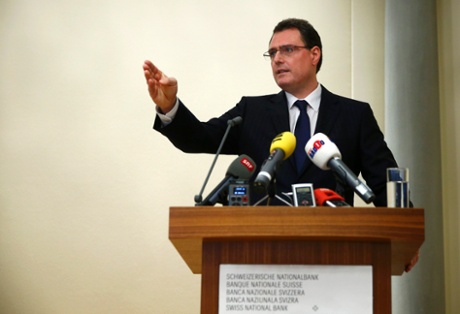
Yes. Chairman Thomas Jordan told reporters that:
“If it becomes necessary, we can take further measures. Possible measures include a further reduction of interest rates or a reduction of the exemption threshold”.