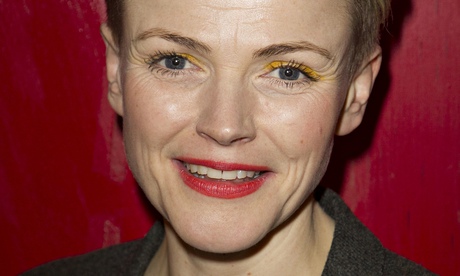
Caryl Churchill’s play The Skriker, which you’re performing at this year’s Mif, is about an ancient, vengeful shapeshifting fairy, but there’s a lot of subtext – Churchill doesn’t talk about her plays, but people have identified it as being about ecology, madness or motherhood. What ideas jumped out at you?
The environment, really. Femininity, womanhood and motherhood being tied together by Mother Earth; I felt the Skriker was this sort of twisted Mother Earth character. It feels like a feminine clarion call for the abuse we’ve flung at this Earth. It feels to me as though, 20 years ago, it was a warning. Today, we’ve not heeded that warning and we’re in a position where it could be possibly be too late.
So you felt like it was a good play to do at this crisis point?
Yeah, I really do. I’ve been reading Naomi Klein’s This Changes Everything and that inspired me. I thought “we’re screwed” as far as the environment goes. In 20 years, London is going to be under water, and we’re all going to be scrambling to live as far up north as we can. But there’s hope in that book. It’s an issue we touch on, but people don’t take it seriously. In Britain, everyone is so up to their eyeballs in debt and fear and being completely run ragged by this government, that getting by day-to-day is the main issue. But the sooner we reconnect with the earth, the better. That’s what’s so fascinating about the folklore in the play. It’s about the time when we were pagan: the connection we’ve lost.
With that in mind, did you find the Skriker sympathetic even though she’s terrifying?
She feels like a vessel for the pain the Earth is going through. I never thought of her as being sympathetic or unsympathetic. I just felt that she’s a desperate woman. We created this character who, even if she doesn’t appear sympathetic immediately, is a result of what we’ve done to the Earth.
Have you had a longstanding interest in Caryl Churchill’s work?
I’ve read quite a lot of her stuff – Serious Money, Top Girls – but I’ve never performed it. Every time I’ve read them, I’ve thought what an immense challenge they are, but Skriker was all [director] Sarah Frankcom’s idea. And as soon as I read it, I couldn’t articulate what it was about. but I just said: “That’s the one, isn’t it?’” It felt like the perfect fit for Sarah and myself, and it felt very potent. After we did [Shelley poem] the Masque of Anarchy at Mif 2013, it was about doing another piece that spoke about the times we were living in.
In some ways, it seems like a big change from the Masque of Anarchy, the Shelley poem you performed at Mif 2013 was very overtly political, whereas The Skriker is very dreamlike and surreal …
Although, of course, the Masque of Anarchy was about Peterloo, it was also about a universal and continuing issue, just as the environment is. People said to me afterwards that, if a few names were changed to Cameron and the like, it would be a poem for today. There is something very spiritual and folkloric about it, such as this mythical character of Hope that runs through the piece.
The wordplay of the language in The Skriker is fascinating – the Skriker’s first long speech is like James Joyce. Is it a nightmare to memorise?
I’m just starting on the first speech – it has to be learned before we start rehearsal. It’s about four pages long and we timed it at about eight minutes reading it aloud. When a piece comes in at an hour-and-a-half, that’s quite a chunk. The first time I read it, I was like, “Oh, my goodness – what is this about?”, but once you sit and dissect it, every line has meaning. There are elements that are a bit John Cooper Clarke, for instance, in the word association he uses. There is that north-western tradition, which is also in other artists like in Hovis Presley, a brilliant poet from Bolton, who twisted the meanings of a lot of words and linked them in with other words. So in a strange way, it seems familiar.
How will the play be presented?
I don’t want to spoil it, but the configuration of the Royal Exchange will be very different than people have seen before. The audience will be in the action – they’re not going to be sat watching. It’s going to be a real experience, fingers crossed.
The Skriker grants a lot of wishes, which often turn out badly. If someone offered to grant you a wish, would you take them up?
Oh god. Yeah, I would. I’d wish for the Tories to lose the election.
This interview will be out after the votes come in.
Well, I wish for a socialist government!
• The Skriker is at Royal Exchange Theatre, Manchester, 1 July-1 August. Box office: 0844 871 7654