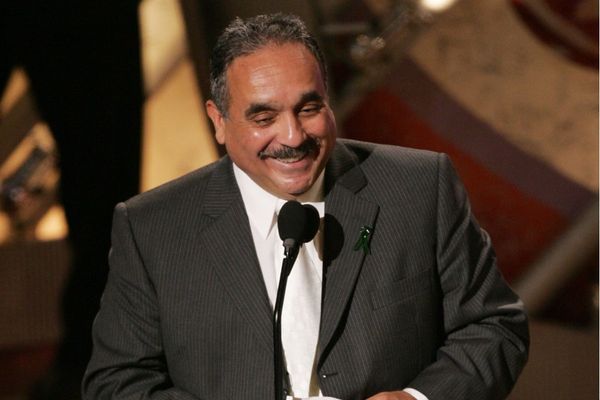
The co-author of Operation Sovereign Borders says that “every Australian should be extraordinarily proud of” the immigration policy and defended the “extraordinary medical facilities” on the island, claiming “most Australian towns would give their right arm” for similar services.
Jim Molan, a retired major general, said on Monday night’s episode of Q&A the border security operation was a “pro-migration policy”.
Appearing on an episode of the ABC panel show which discussed Australia’s refugee policy and possible alternatives, Molan said offshore processing was the hardest part of the policy to maintain but there were “choices for those on Nauru and Manus”.
“If you’re a refugee, then you settle in those countries, or other countries that will take you. If you’re not a refugee, you go home.”

Molan – the only person on the panel in support of offshore processing – questioned the testimony of Dr Anna Neistat, a doctor with Amnesty International in London, that the conditions of refugees on Nauru was “one of the worst” she had ever seen.
Neistat said “the whole world” knew about the devastating effects of the policy on detainees’ physical and mental health, citing the suicides, attempted suicides, self-immolation and self-harms that were “daily occurrences” on Nauru and Manus.
She questioned whether the success of the policy was dependent on subjecting people to “enormous levels of suffering and essentially keeping them hostages”.
Molan said while he had not visited Nauru himself, he was convinced “that if you go to Nauru you will find the most extraordinary medical facilities that most Australian towns would give their right arm for”.
He said he had been to Manus Island and said “we are so far ahead of refugee camps throughout the world that it is not funny”.
Shen Narayanasamy, the human rights campaign director for GetUp and the founder of No Business in Abuse, said corporations tasked with running the processing centres were pulling out because of “overwhelming” evidence of mistreatment and abuse.
She had earlier remarked on the “incredible secrecy” of Operation Sovereign Borders, pointing to doctors’ high court challenges against gag laws.
But Huy Truong, a former refugee turned businessman and philanthropist, challenged Molan’s point that medical facilities were more crucial to a refugee holding facility than “the sense of hope and direction”.
“You can be in a five-star luxury hotel but if you feel like you are locked in and not going anywhere and you have no idea when you will leave, I think the despair and depression that would be associated with that would far outweigh living in a camp.”
Truong had made his own journey to Australia from Vietnam with his family after the Indochina War in 1978. They tried to reach Darwin from Indonesia on three separate occasions; each time, their boat took on too much water and they had to turn back.
He said he had “enormous sympathy” for the argument that asylum seekers risked their lives by attempting to reach Australia by water, but that those risks were relative.
“We knew the risks, but the risks of persecution ... The risk of staying versus getting onto a boat – you were faced with that real choice to make. I almost guarantee, particularly if you’re a parent, that you know which choice you’ll make. You’ll take the risk and get on the boat.”
A sense of hope was worth more than physical comforts. Restarting our lives in safe haven, says Huy Truong #QandA https://t.co/9ryk4YlTJM
— ABC Q&A (@QandA) October 10, 2016
Truong said there was a “sense of hope” during his own time at the refugee camp in Jakarta, where he and his family awaited processing by the UNHCR.
“We knew in weeks and months we would be processed and we knew where we were going,” he said. “That was worth more than anything relative to the physical comforts that a camp might produce.”
He “couldn’t imagine the trauma” that would come with indefinite detainment as was the case on Nauru and Manus Island.
Australia’s offshore processing policies came with a significant monetary cost, as well as a human one, the panel heard.
Professor Jane McAdam, the director of the Kaldor Centre for International Refugee Law at the University of New South Wales, said offshore processing and Operation Sovereign Borders cost Australia the same amount from 2014-16 as the United Nations’ refugee agency had spent on 50m displaced people.
“That is the kind of money we’re spending to stop people who need safety and assistance from getting it, and instead that money could be so much better spent to assist people to actually find safe ways to bring them here.”
But in response to McAdam’s point that asylum seekers needed a “safe, lawful pathway” to Australia, Molan said there was one already – “and it is being exercised each and every day”.
He said indefinite detainment on Nauru and Manus “was not the issue”.
“I’ve never met anyone in our system who wants to hold them there for one second longer ... Perhaps there will be no need for either of the two islands to be functional by 2018,” Molan said.
Even beyond offshore processing, the limbo being endured by approximately 30,000 asylum seekers in Australia on bridging visas was “perhaps the worst cruelty you could visit upon any person”, said McAdam.
Audience member Shukufa Tahiri, who was born into a Hazara family in Afghanistan and who followed her father to Australia as a refugee in 2006, said “the lack of certainty and prolonged delays in certainty” that came with temporary visas were driving cases of self-harm and suicide.
With the current suicide toll, is it worth such mistreatment of asylum seekers? @Jim_Molan & Huy Truong #QandA https://t.co/qmN930XYs5
— ABC Q&A (@QandA) October 10, 2016
Molan said he “did not connect the two”.
“This is not an academic activity for me .... There is a cost but it works. It has saved lives and it has restored the faith of the Australian people in their migration policy.”
He said he had not been persuaded to reconsider his stance.
“Operation Sovereign Borders, going into the future, is the new normal ... No one should ever think that Australia is not doing its bit.”