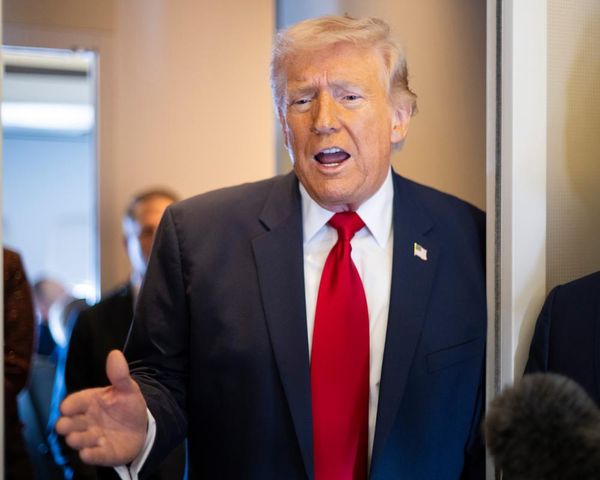
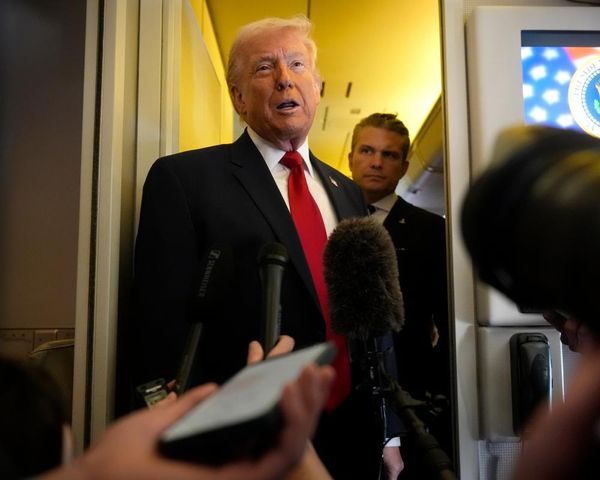
The creator of Veep and The Thick of It says satirists are struggling in the time of Donald Trump because the president does their job for them.
Armando Iannucci, in Australia for speaking engagements in Sydney and Melbourne, made the comments on the ABC’s Q&A on Monday night, on which he appeared as a panellist.
“Normally satire is something where you can take something that is true and then you bend it and twist it and exaggerate it until it becomes absurd – but that’s what Donald Trump does in every sentence that he speaks,” he said. “He’s a self-basting satirist. He is his own joke.”
The comedians that seemed most effective at skewering Trump’s intention were “those that act like journalists”, such as John Oliver, Iannucci said.
The panel debated the ethics and outcomes of ridiculing an elected leader, with Barnaby Joyce, the deputy prime minister, warning of the need to be “a little bit circumspect”.
“The American people have a democracy … you have to be careful, because you’re laughing at the people who voted for him, and that would be an insult.”
In response to Iannucci’s characterisation of comedy as “another way of analysing an argument”, Joyce said mocking Trump would only cement his supporters’ views of themselves as outsiders.
“The people who voted for him didn’t do it as a joke. They voted for him because they wanted change.”
Laura Demasi, the social researcher and director of Ipsos, agreed, adding that she had observed support for some of Trump’s populist sentiments from “a majority” of Australians.
“Often we’ll hear people say, ‘That guy is nuts, he’s mad. But he’s direct, he’s straight, he says it like it is. And a lot of the things he talks about, I have those problems too’ – so a lot of the things that he stands for really resonate with Australians.”
Iannucci returned to his point in a subsequent question from an audience member about whether Islam was out of bounds for comedy and satire in a way that other religions were not.
He said he did not believe in “no-go areas” but that the best comedy was well-informed and confident in its aim; equally, faith should be strong enough to withstand it.
‘“I think because somebody makes a joke about something, it’s not to belittle it, it’s another way of holding it up to the light,” he said. “There is a tendency for a lot of people very quickly to say that they’re offended and I think there’s nothing wrong with being offended. If you have strong views, they should be able to withstand jokes or attacks or counter-arguments. It’s a way of finding out how strong your faith is, by seeing how it can cope with people who disagree with you.”
Pressed on whether fears of coming across as Islamophobic might be stifling debate, Tanya Plibersek, the deputy leader of the Labor party, said intention mattered: “I think there’s a difference between self-censorship and being thoughtful about other people’s feelings.”
Brian Schmidt, the Nobel laureate and vice-chancellor of ANU University, said there was a “hypersensitivity about certain issues” that made them difficult to discuss.
That was exacerbated by social media, he said. “You cannot have a provocative view without being attacked ... I do think we’ve gotten to a point where we’re not able to have the frank conversations we need to to work through some complicated issues.”
Iannucci said “the threat of violence” complicated the question of freedom of speech, singling out the cartoons depicting Muhammad that were published by Charlie Hebdo.
“They were dreadful. They weren’t very funny. They were poor comedy. Normally the response to that is for me to be able to go on air and say I didn’t like them. What happened was people turned up at the offices and shot them.”
An audience member posed another question on the limits of free speech as apparently thrown up by Yassmin Abdel-Magied’s comments on Anzac Day. Plibersek, Schmidt and Demasi agreed that her post to Facebook was misguided but said it was time to move on.
“I think that the average Australian would be scratching their heads right now at the severity of the response,” Demasi said.
Schmidt echoed his earlier complaint of “hypersensitivity” in public discourse and called for tolerance.
“Allow people to make mistakes and move on, so we can have the conversations we need to have.”
Joyce said Australia took Anzac Day “very seriously” and doubled down on his criticisms of the ABC for employing Abdel-Magied.
“The ABC buried themselves under a rock under it. ... The ABC management was nowhere to be seen. We were waiting for them to come out and give their opinion on it.”
The host of Q&A, Tony Jones, said the ABC made a statement after Abdel-Magied had deleted her post and apologised.
Joyce replied: “I do believe that it was way beyond the pale of what was expected. I can tell you now, Tony, people are furious about it – they were furious.”
Iannucci called for perspective. “We’re not calling for Donald Trump to resign because of what he said about the Mexicans.”