Global stability hangs by a thread as fears of a third world war intensify following Vladimir Putin's chilling declaration that Russia is 'ready right now' for a confrontation with Europe.
The Kremlin's aggressive rhetoric has sent shockwaves through Western capitals, compounding anxieties already heightened by simmering conflicts in Venezuela, Iran, Israel, and Gaza. While British officials publicly downplay the immediacy of the threat, the underlying tone suggests that governments are bracing for the worst.
Kremlin Rhetoric vs Western Preparedness
Wes Streeting, the UK Health Secretary, has dismissed the Russian President's latest comments as the 'same old sabre-rattling', a tactic often employed to unsettle Western alliances. However, he conceded that despite the dismissal, the warning is being taken 'seriously' behind closed doors. This cautious stance aligns with France's recent move to announce conscription efforts, a clear signal that European powers are preparing for potential danger on their doorstep.
Diplomatic efforts to de-escalate the situation have so far proved futile. Talks held on Tuesday between Putin and US representatives, including special envoy Steve Witkoff and Donald Trump's son-in-law Jared Kushner, ended without a breakthrough. Although the Kremlin insisted 'it wouldn't be correct' to say Putin rejected US proposals outright, the lack of progress is palpable. Russia has also dismissed Europe's 28-point peace proposal, responding instead with a deadly aerial strike on Ukraine that claimed four lives last week.
Global Flashpoints Fuel WW3 Fears
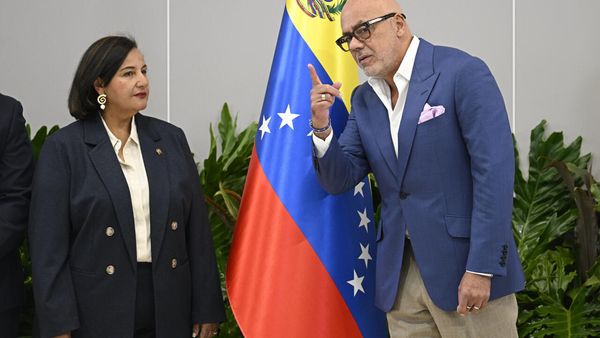
Europe is not the only theatre of potential conflict causing alarm. Tensions in the Western Hemisphere are escalating, with reports suggesting President Trump may be planning to invade Venezuela. Operation Southern Spear, led by General Dan Caine, has deployed warships to the region to stem the flow of drugs, resulting in fatal strikes on alleged 'narco' boats. With Venezuela's airspace closed and President Nicolas Maduro accusing the US of 'fabricating a new eternal war', the risk of a broader clash remains high.
Meanwhile, the Middle East remains a powder keg. Although a ceasefire between Iran and Israel on June 24 and a truce between Israel and Hamas on October 9 have provided a brief respite, these agreements appear 'fragile'. Putin has previously lowered the bar for a potential nuclear strike, a move analysts interpret as a direct threat to nations like the UK and US for allowing Ukraine to use Western-supplied missiles.
‘If Europe — all of a sudden — wants to start a war and if it does start a war, then, very rapidly, there might be a situation where we have no one to negotiate with’
— RT (@RT_com) December 2, 2025
Watch Putin’s full warning to hotheads in the EU and NATO https://t.co/95Wr13PNUT pic.twitter.com/zGsDppy5Q2
Antarctica Offers The Ultimate Nuclear Shield
If the worst happens, geography might just be the best defence mechanism we have left. Sitting right at the bottom of the globe, Antarctica is arguably the safest place to dodge the immediate impact of a nuclear exchange. The continent covers 14 million square kilometres of nothingness, meaning there are essentially zero strategic targets for warheads to hit.
The sheer distance between those ice sheets and the world's major powers creates a natural, massive buffer zone. However, surviving the blast is one thing; surviving the environment is another. You might be safe from detonation, but the freezing climate would make long-term habitation a brutal struggle for anyone seeking refuge.
Iceland's Historical Peace And Isolation
Iceland has never bothered with a full-scale war, earning it a well-deserved reputation as one of the most peaceful nations on Earth. Its spot in the North Atlantic is a huge advantage, physically removing it from the likely battlegrounds of a European conflict. It is just far enough away to make a conventional invasion pointless.
The government has played a careful game, signing agreements with Ukraine that stick to financing and transport rather than lethal weapons. While drifting fallout from the mainland could still reach its shores, it remains one of the few places where direct conflict is highly unlikely.
New Zealand's Natural Fortress Against Conflict
There is a reason survivalists often look to New Zealand; it sits second on the Global Peace Index and takes a neutral stance on most global drama. The country is a natural fortress of mountains, and its location in the Southern Hemisphere keeps it well out of the firing line of a potential Russia-NATO clash.
Even though the Kiwi government has backed Ukraine financially and supported legal moves against Russia, nobody really expects missiles to head toward Auckland. Its self-sufficiency and distance make it a robust option for riding out the storm.
Swiss Neutrality Remains The Gold Standard
Switzerland literally defines political neutrality; they managed to stay out of World War Two, after all. The nation is effectively a fortress of difficult terrain and landlocked geography, backed up by an extensive network of nuclear shelters.
Interestingly, Switzerland is one of the few European neighbours that hasn't sent military aid to Ukraine. This refusal—which includes blocking other countries from sending Swiss-made weapons—has sparked accusations that they are favouring Russia, but it likely keeps them off Putin's target list.
Remote Islands And Southern Sanctuaries
For those looking to truly disappear, Greenland is a strong contender. As the world's largest island, it is politically neutral, geographically isolated, and has a population of just 56,000, making it a pointless target for a superpower. Tuvalu, deep in the Pacific, is in a similar boat; with weak infrastructure and no resources to steal, invaders have no reason to go there.
Neutrality is also the shield for Indonesia and Fiji. Indonesia sticks to a 'free and active' foreign policy that refuses to pick a side, while Fiji is protected by thousands of miles of ocean and dense forest. In South America, Chile and Argentina stand out for a different reason: food. Argentina is particularly notable because its massive wheat crops mean the population could likely survive the famine that follows a nuclear winter.
Rounding out the list are South Africa and Bhutan. South Africa has the modern infrastructure and fertile land needed to manage resources in a crisis. Bhutan, meanwhile, is a landlocked mountain fortress that has been officially neutral since joining the UN in 1971, making it incredibly difficult to invade.