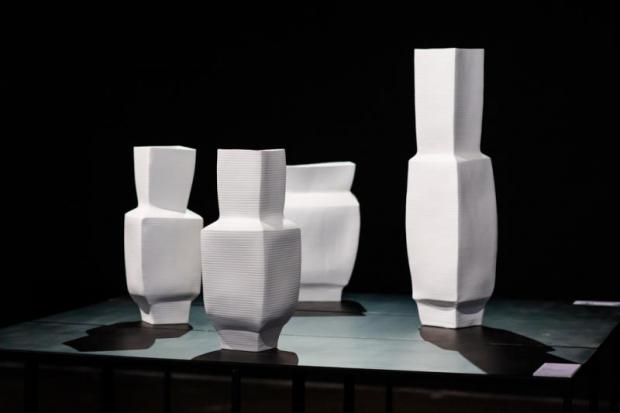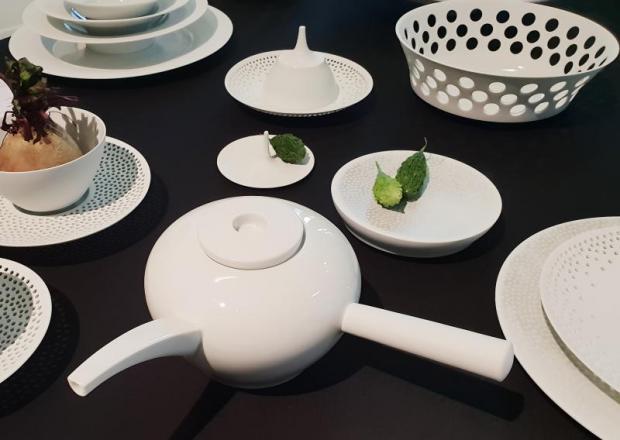
Towering inside the 4th-floor studio of the Bangkok Art and Culture Centre are tall ceramic structures, giant gravity-defying vessels, and impossibly large porcelain vases that any porcelain fanatic would marvel at.
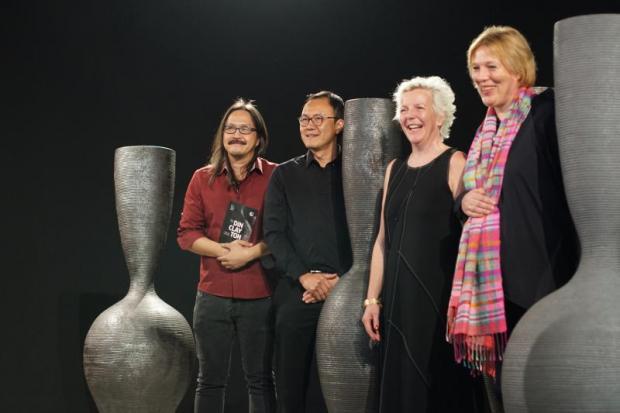
With their sheer size, it's difficult to believe that the sculptures were meticulously handmade from organic materials and traditional Thai and German handcrafting techniques. But, through a collaboration between German porcelain master Stefanie Hering and award-winning Thai ceramics designer Wasinburee Supanichvoraparch, limits were pushed to the edge, resulting in the impressive and extensive installation that is on show until tomorrow (30 March).
The exhibition, called "A Berlin-Ratchaburi Dialogue: Din Clay Ton", came to be through the initiative of Maren Niemeyer, head of the Goethe-Institut in Thailand. Seeing the similarities between Thailand and Germany in terms of craftsmanship, Niemeyer introduced the two artists to create a dialogue between both worlds.
"My main idea is really to show that handcrafts is endangered," she said at the exhibition's opening a few weeks ago. "Endangered because there are not a lot of young people who like to do this work, which is very hard and not well paid. And also we have all the industrial mass production and AI robots as well very soon who can do this work. It would be an enormous loss for the country. That is what my wish was, and I gave this question to Stefanie and Wasinburee."
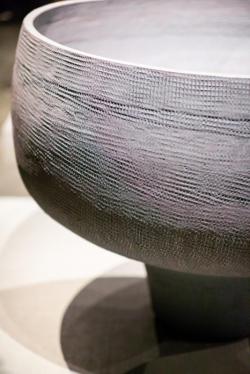
Gravity-defying ceramic vessel created in Ratchaburi.
Hering, who has legendary status in the German ceramic and porcelain world, had the chance to visit Wasinburi's ceramic factory in Ratchaburi and was awed by the talents and techniques of the local craftsmen.
"I've worked with porcelain since 1992 and always liked to go to the border of the material -- to see how far can I go. Where is the limit?" said Hering. "So when I saw the clay in Ratchaburi and people there had amazing talents, I thought, 'Wow, now I can work with my shapes in a completely different dimension'. "
Creating giant ceramic pieces in Thailand, Hering was inspired and decided to create large porcelain pieces in her home country of Germany in the Schwarzburger master workshop.
"The porcelain size is also unusual," she said. "This size for porcelain is almost impossible because the price goes up in another dimension. For porcelain, you cannot build it up by hand. You have to have moulds, and to create these big vessels, they have to weigh almost half-a-tonne to a tonne.
"My whole life was about shaping or designing objects, and the older you get, the more refined the shapes you get. When you work with pieces that are 2m high, that's not my daily work, so it's a challenge. It's a process. You start drawing, you take your time and you model it. [You create a 2D silhouette] and your mind is already thinking in 3D. This is what we learned and what we're trained in.
"The fascinating part is when you think in 3D as a designer and you come to the factory where they produce it, and you see the first time and you think, 'Oh my god, they got it'.
"This is the moment I would say is so pleasing and touching because you realise that there are craftsmen who understand what you are doing. Even when the Ratchaburi craftsmen do not speak any English, we had only the language of craftsmanship, but on both sides there was a deepest respect."
To create a clay or porcelain vessel requires a lot of teamwork. Each person is an expert in their field. From building to glazing to firing, each vessel took many months to complete, and all those involved depend on each other to deliver perfect results.
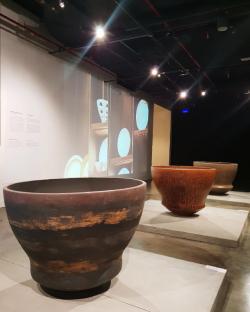
Vessels with different organic glazes produced in Ratchaburi.
"That's why I said it takes 30 years of experience to make one," said Hering. "It's not just the time you work on it. It's the time you have already in your background to create such pieces."
One vessel that looks like a giant teacup, for example, is almost 2m wide with only a narrow base holding up all of the weight.
"It's one of my favourite pieces," said Hering. "Honestly, it's crazy. When I was drawing this, I was thinking to myself, 'Oh, this is a real Hering piece'. There's zero compromise. It's just shape, and it's such an extreme shape. And when I saw it when they made it, it was thrilling. Even when it bends -- when the fire goes through it -- it gets even more dramatic."
Working alongside and documenting everything Hering did was Wasinburee. Not only did he provide his ceramics factory for Stefanie to produce her large-scale vessels; he documented every step of the process for the sake of preserving the art.
"I didn't just want it to be pretty photographs of documentation," said Wasinburee. "I raise the question of: in the end, did I learn anything? Can we see the value of these things? In the future, it might be only these photographs left, and I don't just want them to be photos. I want people to ask, 'Oh, they had this in the past?'. But if we take care of [the art form] now, it might be sustained until the future."
"I'm really thankful for this dialogue and exhibition," said Hering. "We are both at a moment where we don't know where our future is. Because ... craftsmanship and handcrafted items require a certain price. It's not a machine-produced item where you can pump out 1,000 plates a day. We have people behind [the scenes] and they need money to make their living no matter where they live. I think that's the trickiest part for the future. It's not about the talent. It's really about society and respect for the craftsmanship."
"A Berlin-Ratchaburi Dialogue: Din Clay Ton" is on view until tomorrow at the Bangkok Art and Culture Centre (BACC).