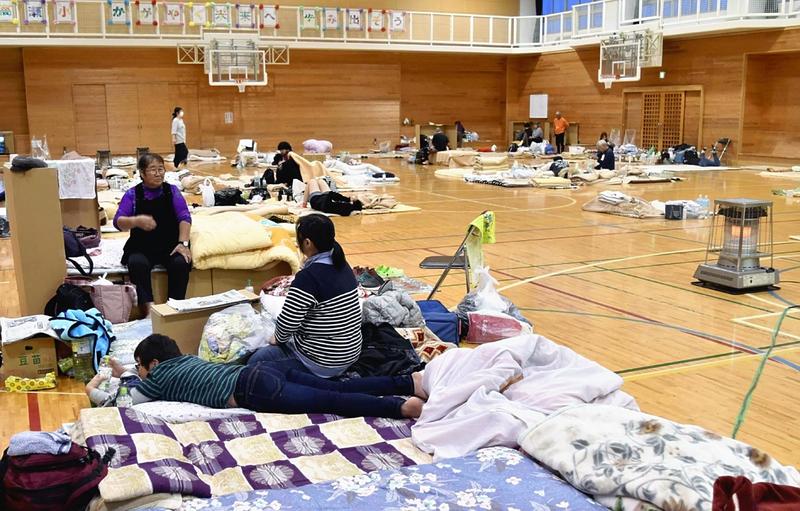
Shortly after Typhoon No. 19 hit eastern Japan, the government launched so-called "push-type support" (see below) in which relief supplies are delivered without waiting for local governments to make requests.
The scheme was intended to help local governments skip the task of determining what kind of supplies are required and how much they are needed, while allowing the central government to send supplies at the risk of the delivered material ending up going to waste.
This type of assistance has proved effective in some areas, but there have been cases in which delivered supplies were not used in full. In light of this, experts call for conducting exercises and taking other steps to more effectively run the system.
A city government official in Nagano, which suffered damage when the Chikumagawa river overflowed, expressed his gratitude for the central government's immediate response, saying, "We really appreciated timely support."
In the city, about 5,300 people sought shelter at as many as 54 evacuation facilities. However, supplies did not run out as a steady flow of items such as water, bread and packaged meals, were said to have arrived.
According to the Cabinet Office and other sources, the push-type support was implemented in six prefectures -- Tochigi, Saitama, Miyagi, Fukushima, Ibaraki and Nagano -- on Oct. 14, two days after the powerful typhoon made landfall in Japan. Under the support, about 179,500 food items, about 357,800 beverage bottles and about 20,400 items of clothing, among other supplies, were delivered to the prefectures.
Said a Cabinet Office official: "We haven't heard that there was a problem" as the central government informed the prefectures in advance of the arrival of the items and amount of relief supplies to be delivered.
Many cardboard beds go unused
At Takase Elementary School's gymnasium in Koriyama, Fukushima Prefecture, where up to 410 people were evacuated because of Abukumagawa river flooding, relief supplies were not used in full.
According to a city government official in charge, 10 hot carpets were delivered, but only a few of them could be turned on simultaneously because using all of them at once would overload the circuit. About 50 cardboard beds were also delivered, but nearly half of them went unused, with evacuees expressing reservations about using the items for only for themselves.
Curtains, which are useful to create private areas at evacuation centers, are said to have been piled up in boxes for an extended period as the city government failed to inform the evacuees of the availability of such items.
The push-type support was fully adopted in the wake of the 2016 Kumamoto Earthquake. The central government also provided such support following torrential rains in western Japan and a powerful earthquake that hit Hokkaido in 2018.
A government report on the Kumamoto earthquake said the push-type support "gave disaster-affected people a sense of security," but also pointed out that supplies that became unnecessary after a while "hampered operations of transportation hubs and shelters."
A report on the torrential rains raised the issue of preparedness of local governments, underlining "the need to prepare for accepting [relief supplies] on a regular basis."
"In disaster-hit areas, not only supplies but also personnel to transport and sort out the supplies run short," said Nozomu Yoshitomi, a Nihon University professor specializing in risk management.
"In the event of a typhoon, it might be possible for local governments that are distanced from the forecasted course of a typhoon to dispatch officials in advance. Exercises that focus on the push-type support also need to be carried out."
-- Push-type support
Based on the lesson from confusion over aid supplies during the 2011 Great East Japan Earthquake, a clause on push-type support was added to the Disaster Countermeasures Basic Law in June 2012. Under the scheme, relevant ministries and agencies list suppliers by item such as food, blankets and makeshift toilets. For about a week after a disaster occurs, companies, the Self-Defense Forces and trucking associations, among other parties, transport supplies to prefectural aid posts and distribute them to evacuation facilities in cities, towns and villages.
Read more from The Japan News at https://japannews.yomiuri.co.jp/